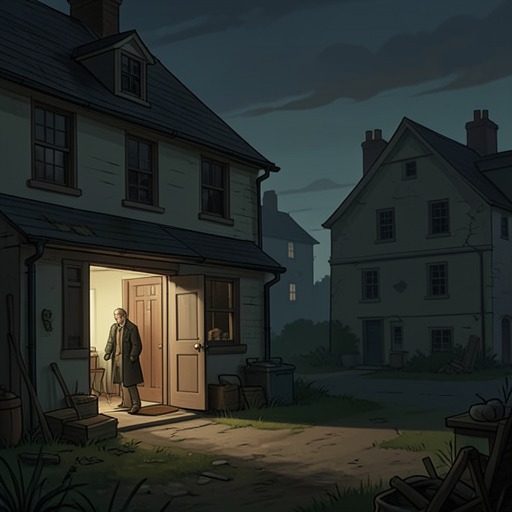
The Hollow as an echo
The HollowThe Hollow as an echo is the novel’s governing image of imitation without identity. The house resembles Ainswick, the Angkatell family’s remembered home, yet its resemblance is incomplete and unsettling; after John Christow’s murder, the borrowed forms of domestic innocence become charged with secrecy, fear, and the persistence of the dead. The metaphor explains why The Hollow feels both familiar and unreal, and why John remains psychologically present after his burial.
Ainswick and the Incomplete Copy
The idea first takes shape through memories of Ainswick. Midge Hardcastle recalls visits there as a kind of lost paradise: the small country station, the Daimler waiting outside, the drive through the woods, the large white welcoming house, and the permission to enjoy themselves given by old Uncle Geoffrey. Those visits centered emotionally on Edward Angkatell, while Henrietta Savernake was also present and seemed to Midge to occupy the attention that Midge herself could never receive. Ainswick therefore exists not merely as a house but as a concentrated image of childhood happiness, desire, and belonging.
Henrietta shares this idealization. She calls Ainswick the loveliest place in the world and remembers a younger self who loved trees and was happy without understanding that happiness would later be lost. Her desire to return to that earlier state makes Ainswick a standard against which The Hollow is judged. The newer house can recall the older one, but it cannot restore the time, innocence, or relationships that made Ainswick real to the family.
The Hollow as Mask and Echo
Henrietta explicitly understands The Hollow as an echo of Ainswick. The word does not signify a faithful reproduction; an echo repeats a sound after the original has spoken, preserving a trace while weakening presence. The Angkatells likewise become echoes: they continue living within inherited gestures and surroundings, but Henrietta feels that they are less substantial than John Christow, whose force of life makes their own existence seem shadowlike. Her recognition turns a description of place into a judgment on the family’s emotional condition.
Midge reaches a similar conclusion through fear rather than poetic insight. She says that The Hollow frightens her because it resembles Ainswick without being the real thing, and she compares such appearances to a mask. The mask conceals whatever lies behind it; the danger is not simply that the surface is false, but that the observer cannot know what the surface is hiding. The Hollow thus becomes an architectural form of uncertainty, where a reassuring resemblance can shelter an unrecognized reality.
The motif also depends on the difference between genuine and staged appearances. When Hercule Poirot encounters the swimming pool after the murder, the house looks innocent in its sleeping stillness, but its innocence is excessive and therefore suspicious. Around the pool, several people occupy separate paths and positions: Lady Angkatell arrives from the farm path, Edward Angkatell and Henrietta come separately from the woods, and the scene gathers them like actors around an arranged spectacle. The artificial murder scene, with the body posed beside the water and the revolver held by Gerda Christow, makes The Hollow’s underlying theatricality visible. What appears to be a coherent scene is assembled from divided routes, partial views, and misleading surfaces.
Space, Memory, and the Return of the Dead
The physical paths around the pool reinforce the echo motif. The lower path comes from the farm; separate routes descend from the woods; another path beside the pavilion leads toward Podder’s Lane. Later, the hillside path above the chestnut groves gives Henrietta and Poirot a view of the blue water below. These routes create a geography of convergence and separation: people reach the same place by different histories, and the visible scene cannot fully disclose how those histories meet.
After the police have left, the swimming pool appears peaceful in the soft autumn light, but its calm is not a restoration of innocence. Poirot notices that the platinum fox cape has been removed while six boxes of matches remain in the pavilion, an incongruous residue that keeps the scene from becoming ordinary again. The place repeats its innocent appearance, yet the objects left behind preserve the event’s unresolved strangeness. The Hollow’s echo is therefore material as well as psychological: the setting returns to normal while continuing to carry signs of what happened.
Henrietta’s strongest formulation comes when she identifies The Hollow itself with an echo and connects it to the family. She sees that the Angkatells are “not real” in comparison with John, while John remains powerfully real even in death. This contrast reverses the expected order. The living occupy the house, but the dead man’s presence dominates it; burial does not place him securely in the past. Midge later feels the same persistence, thinking that John is not truly dead and gone but still present at The Hollow. The house becomes a resonating chamber in which the murder continues to sound after the physical event has ended.
The Motif’s Emotional and Narrative Meaning
The Hollow as an echo gives form to the novel’s treatment of memory. Ainswick survives in recollection, in the house’s resemblance, and in the emotional patterns of those who once gathered there. John’s return to memories of Veronica Cray operates through a comparable mechanism: the Mediterranean sea, mimosa, and hot dust have been suppressed but never erased, and their recurrence reveals that the past has remained active beneath the orderly life he constructed. The present is repeatedly invaded by what it resembles and represses.
The metaphor also explains why the characters respond differently to the same setting. To Lucy Angkatell, The Hollow is a home in which social arrangements can be managed; to Poirot, the pool is a mathematically organized scene requiring reconstruction; to Henrietta, it is a place where memory and guilt have become inseparable; and to Midge, it is a mask whose familiar outline conceals an unknown interior. These perspectives do not resolve into one stable meaning. They form a chorus of competing interpretations, each exposing a different layer of the house’s social and emotional structure.
By the end, Henrietta leaves The Hollow carrying the exhaustion of a task imposed by John’s death. As she drives toward London, the questions of what she should do and where she should go echo through her mind. She remembers deliberately drawing the Ygdrasil sign on the pavilion’s iron table by matchlight on the night of the murder, before she had been able to mourn. That act converted the setting into a message-bearing surface, while her later departure marks the beginning of life beyond the enclosed world of repetition. The Hollow remains an echo, but Henrietta is no longer simply another voice trapped within it: she recognizes the resonance, the deadness behind the familiar forms, and the necessity of moving away.