The staged murder scene
The HollowThe staged murder scene is the central visual deception surrounding John Christow's death at the swimming pool. It presents an apparently complete story at a glance: a recently shot man lies beside the water, Gerda Christow stands over him holding a revolver, and several witnesses seem to have arrived from separate paths at the same moment. The tableau is convincing enough to direct immediate suspicion toward Gerda Christow, yet artificial enough to become the key to reconstructing what actually happened. Its decisive significance is that the murder is concealed not by hiding the scene, but by making the scene look too legible.
Construction and Appearance
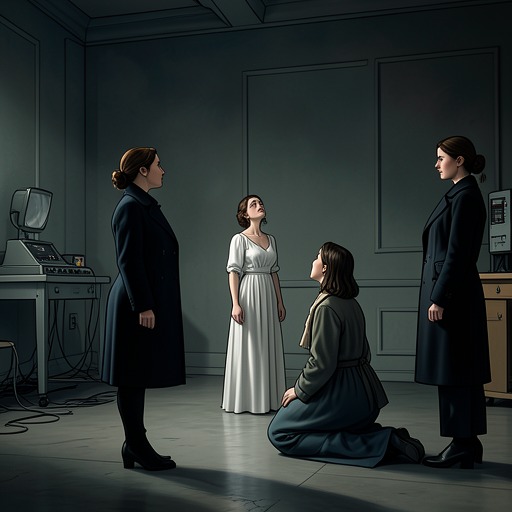
Hercule Poirot first encounters the poolside tableau after a long walk and an unexpectedly disappointing arrival at The Hollow. At first he assumes that the Angkatells have arranged an elaborate practical joke for him. He sees what appears to be a spectacular body: a handsome fair-haired man artistically arranged beside the pool, with one arm flung outward and red liquid seemingly dripping over the concrete into the water. Gerda Christow stands over the figure with a revolver in her hand, her expression curiously blank. The scene has the theatrical completeness of a prepared display rather than the disorder of an unforeseen act of violence.
The arrangement includes three apparent supporting actors. Henrietta Savernake stands on the far side of the pool with a basket filled with dahlia heads. Edward Angkatell is farther away in a shooting coat, carrying a gun. Lucy Angkatell, Poirot's hostess, stands immediately beside him with a basket of eggs. The incongruity of flowers, eggs, guns, and the carefully displayed body gives the scene a composed, almost stage-managed quality. The objects do not merely furnish the setting; they help assign each person a visible role within the false narrative.
Poirot's first response is irritation rather than alarm. He regards the supposed crime as a cheap and excessively elaborate joke, a piece of English humour that has failed to amuse him. He considers whether he is expected to pretend to believe in the crime, display conventional shock, or compliment his hostess on the arrangement. This comic misreading is abruptly overturned when the tableau comes into focus as reality: the man is not a painted corpse but a dying man, and the red substance is blood. The shock changes the scene's value from theatrical spectacle to an urgent murder investigation without removing its artificial appearance.
Spatial Design and Misleading Evidence
The scene is persuasive because its spatial pattern appears to explain how the participants reached the pool. Several paths converge around the water, and Poirot immediately recognizes that the people present seem to have arrived by different routes. Inspector Grange later clarifies the arrangement: Lucy Angkatell came up from the farm; Edward Angkatell came from the woods by the left-hand path; and Henrietta Savernake came by the right-hand path leading from the long flower walk above the house. The three were standing on the far side of the pool when Poirot arrived.
This geography creates the impression of simultaneous discovery. Each witness appears to have approached independently, so the group seems to be a set of shocked arrivals rather than a collection of people who had coordinated their positions. The paths therefore function as part of the deception. They do not simply record movement; they manufacture an apparently natural chronology in which Gerda Christow has already committed the shooting and the others have just come upon its aftermath.
Poirot later separates the visible arrangement from the actions it claims to represent. Around the pool, enclosed by a thick grove of young chestnuts, five paths lead away: one to the house, one to the woods, one to the flower walk, one down to the farm, and one to the lane. Because the routes are multiple and partially screened, one of the three apparent late arrivals could have been at the pool before Gerda Christow, shot John Christow, withdrawn along one of the paths, and then turned back to arrive with the others. The tableau's greatest weakness is thus contained within its greatest apparent strength: the paths make the witnesses look separate, but they also provide the murderer with alternative movements.
The Revolver and the False Story
The revolver is the scene's most direct piece of visual evidence and its most important false clue. Gerda Christow is holding it in the exact position required by the apparent story: the woman beside the body possesses the weapon with which she seems to have just shot her husband. Poirot admits that this was the impression he initially received. Seeing Gerda standing over John Christow with the gun in her hand, he thought she had killed him, or at least that the scene had been designed to make him think so.
The distinction between believing an image and understanding its intention becomes crucial. Poirot had not simply inferred Gerda's guilt from neutral facts; he had recognized the impression that the arrangement was meant to produce. The image was a performance, and Gerda's attitude was part of it. Later investigation establishes that the revolver in her hand had not been used to shoot John Christow. The gun therefore remains relevant as an object physically present at the scene while being false as proof of the shooting.
This contradiction prompts a wider suspicion. If the central weapon is misrepresented, other elements of the picture may be wrong as well. Poirot tells Inspector Grange that the scene was planned beforehand and that it resembled a stage scene: a man who had just been shot and the woman who had shot him holding the gun she had used. The description is not merely metaphorical. The scene has been composed around recognizable theatrical signs—body, weapon, posture, witnesses, and routes—so that the viewer will complete the intended story before testing any individual fact.
Discovery of the Staging
Poirot's understanding develops through a sequence of reversals. At the pool he first rejects the tableau as an elaborate joke, then recognizes that the death is genuine, and finally questions whether the apparent murder story is genuine. His initial sight of Gerda Christow does not disappear from his reasoning; it becomes evidence about the staging. He remembers the woman standing over her husband with the revolver and the blank look on her face, but he no longer treats that impression as transparent access to her guilt.
The crucial realization is that the scene was set to deceive. Poirot observes that the eyes sometimes see what they are meant to see. The tableau directs attention toward the most emotionally legible explanation—Gerda Christow has shot John Christow—while concealing the more difficult question of who arranged the image and why. The apparent clarity of the scene is therefore a form of concealment. It replaces uncertainty with a ready-made interpretation.
When Poirot eventually explains his conclusion to Henrietta Savernake, he says that he felt from the first that the scene had been set, although he did not initially understand that Gerda Christow had set it. He was puzzled by its simultaneous simplicity and complexity: the picture was simple enough to be understood immediately, yet complex enough to contain a second action beneath the visible one. He later recognizes Henrietta's ingenuity as the force he had been opposing, with the Angkatell relations aiding and abetting the plan once they understood what she wanted done.
Purpose and Consequences
The staged murder scene serves to protect Gerda Christow from the consequences of what she has done. Henrietta Savernake explains that John Christow's final word, her name, was a request that she protect Gerda. In Henrietta's interpretation, John loved Gerda more deeply than he had understood, more than he loved Veronica Cray or Henrietta herself, and believed Henrietta would do anything for him because she loved him. The false tableau is therefore not an isolated trick but the practical expression of a promise made under the pressure of John's death.
Gerda's role is especially complex because her theatrical attitude is both incriminating and deceptive. She is made to appear as the wife who has just fired the shot, yet the staging depends on her acting a part rather than simply displaying the unmediated truth of her action. The blankness that first seems to signal guilt becomes part of the performance. The visual scene does not deny that Gerda is implicated; instead, it assigns her a false position within the chain of events so that another truth can be hidden behind an apparently obvious one.
The consequences extend beyond the pool. Once the revolver is shown not to be the murder weapon, the witnesses' positions and arrival times can no longer be accepted at face value. The investigation must reconstruct movement through the five paths rather than rely on the frozen picture. The Angkatells' collective assistance also transforms the matter from an individual deception into a family cover-up. The scene's theatrical surface thus produces a moral and investigative problem: preserving Gerda requires several people to cooperate in sustaining a lie, while Poirot must distinguish the real death from the false story built around it.
Narrative and Thematic Significance
The staged murder scene is the novel's clearest embodiment of the conflict between appearance and reality. It makes sight feel authoritative while demonstrating how easily sight can be organized by intention. The body, blood, revolver, blank expression, and converging paths appear to form a complete account, but each detail has been selected or positioned to make the account persuasive. The reader is placed in the same vulnerable position as Poirot: forced first to react to the image, then to reconsider the assumptions that reaction contained.
Its theatrical form also turns the swimming pool into a stage on which social relationships become visible as roles. Gerda is made into the apparent killer, the surrounding figures into witnesses, and the paths into entrances and exits. Yet the performance cannot fully control reality: John Christow is genuinely dying, the blood is genuine, and the weapon's history contradicts the picture. The scene's irony lies in its attempt to use artificiality to conceal an actual crime, only for that artificiality to become the clue that exposes the deception.
The final explanation gives the set scene an additional emotional dimension. It is not constructed solely from calculation or self-interest, but from Henrietta Savernake's love for John Christow and her determination to honor what she understands as his last request. That motive does not make the deception innocent. It shows instead how affection, loyalty, guilt, and family solidarity can turn the visual language of theatre into an instrument of protection. The staged murder scene remains memorable because it is simultaneously a false picture, a genuine emergency, a criminal strategy, and the narrative device through which hidden loyalties are brought into view.