Tingzi by the Holo Swimming Pool
The HollowThe pavilion beside the swimming pool at The Hollow is more than a garden shelter: it is the spatial hinge of the murder plot. Set beside the pool, furnished for comfort yet exposed to several approaches, it becomes successively a place of encounter, a vantage point over the staged crime scene, a temporary police-observation area, and a chamber in which private conversations acquire evidentiary force. Its apparent domestic ease continually conflicts with the violence and uncertainty concentrated around it.
Setting and Physical Arrangement
The pavilion stands in the open space beside the swimming pool, at the edge of the chestnut woods. The Angkatells use it on sunny days when a cold wind makes sitting in the open uncomfortable, giving the structure an ordinary social purpose before the murder transforms its meaning. Its position connects the house, the woods, the farm, the flower walk, and Podder’s Lane through a network of paths rather than isolating it as a purely decorative outbuilding.
Inside, the pavilion is luxuriously furnished with comfortable settees and gay native rugs. A painted iron table holds glasses and a decanter of sherry, and the setting is associated with the household’s expected hospitality, including cocktails that Gudgeon has not yet brought out. This combination of comfort, color, and ritual makes the pavilion appear harmless, but it also establishes the material background against which later clues become conspicuous.
Visibility is one of the pavilion’s defining practical features. From its open door, people can see the pool, the body, and the path toward the house along which the police will arrive. The structure therefore offers shelter without complete concealment: anyone inside can observe movement across the scene, while the arrangement of paths makes every arrival potentially significant.
The Murder Scene and the Converging Paths
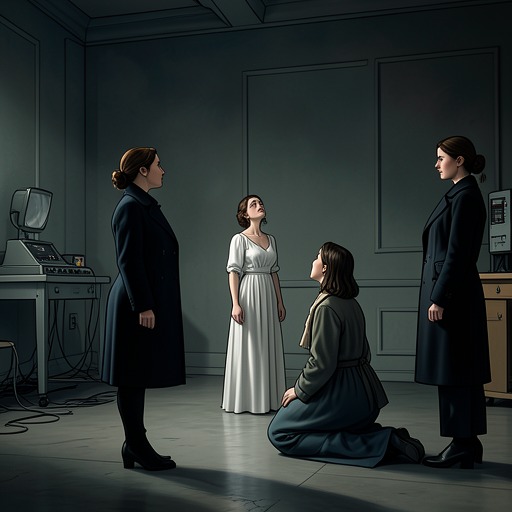
When Hercule Poirot reaches the pool, the pavilion forms part of an artificially composed tableau. Beside the water lies John Christow’s body, arranged with an outflung arm and red paint dripping over the concrete into the pool. Gerda Christow stands over him with a revolver, while Henrietta Savernake, Edward Angkatell, and Lucy Angkatell occupy different positions around the water. The pavilion is not merely adjacent to this spectacle; its location helps make the scene legible as a set piece whose participants have entered from separate directions.
The paths are carefully distinguished. Lucy Angkatell comes up from the farm by the path below the pool. Edward Angkatell comes down from the woods by the left-hand path, while Henrietta Savernake approaches by the right-hand path leading out of the long flower walk above the house. The path beside the pavilion continues toward Podder’s Lane. Inspector Grange’s reconstruction depends on these spatial differences, because the apparent unity of the scene conceals a sequence of separate movements.
This geometry contributes to the murder’s deceptive theatricality. The pool, the body, the armed woman, and the surrounding figures initially resemble a deliberately arranged performance, while the pavilion provides a nearby point from which the scene can be watched and later reconsidered. The location thus helps produce both the first impression of certainty and the later recognition that the evidence has been staged.
Observation, Evidence, and Suspicion
After the police have finished their work, the pool is deserted and the pavilion remains a surviving fragment of the crime scene. Poirot looks inside and notices that the platinum fox cape has been removed, but six boxes of matches still stand on the table by the settee. Their number and location trouble him: one box might be kept there for convenience, but six boxes seem inappropriate in a damp pavilion. The ordinary furnishing of the room therefore becomes an index of abnormal activity, as a familiar object loses its transparency and demands interpretation.
The pavilion also supports the practical management of the investigation. Sir Henry Angkatell and Poirot sit gingerly in wicker chairs near the door so that they can watch the path from the house, while remaining in a position from which the pool and the approaching police route are visible. Sir Henry hesitates to touch the sherry or anything else before the police arrive, even though he thinks there is probably nothing inside that would interest them. The pavilion consequently becomes a space governed by caution, where hospitality is suspended by the requirements of crime-scene preservation.
Its significance grows because the house itself appears too innocent. After leaving the pool, John Christow looks up at the sleeping house and notices the half-open French window left for his return; the quiet domestic setting seems reassuring but somehow false. The pavilion belongs to that same contradiction. It is connected to the protected household, yet its openness, paths, doors, and sightlines allow private actions to pass between domestic shelter and public exposure.
Private Conversations and Recovered Meaning
The pavilion is later identified as the likely place where John Christow and Veronica Cray converse. When asked whether their conversation took place there, Veronica confirms that they sat, smoked, and talked for some time. Her brief hesitation before the admission makes the pavilion important not only as a physical location but as a site of withheld knowledge. A conversation held there becomes part of the investigation because Poirot can infer the place before Veronica openly confirms it.
The location also frames Poirot’s later movement through the grounds with Henrietta Savernake. They do not need to pass the pool; instead, they take the upper path toward the flower walk, reaching a bench on the hillside above the chestnut trees. From there, a curving path descends toward a glimpse of blue water. Even when the pavilion itself is not entered, the pool remains visible as a remembered center of the case, linking Henrietta’s present conversation with the landscape in which the murder was discovered.
At another point, Henrietta sits on a bench and draws the outline of a fantastic tree with a pencil on the white-painted wood. Poirot’s thoughts return to several earlier details, including the painted iron table in the pavilion and a question he had asked Gudgeon. The pavilion therefore persists in his reasoning as a material memory: its table, objects, and arrangement remain part of the pattern through which apparently unrelated observations begin to cohere.
Narrative and Thematic Significance
The pavilion’s repeated appearances make it an architectural echo of The Hollow itself. It is a domestic refuge that cannot keep violence outside; a comfortable room that becomes a watch post; and an apparently open space whose paths and partial shelter permit concealment. Its furnishings stage the tension between cultivated leisure and forensic suspicion, while its doors and approaches turn movement into evidence.
Because several routes converge around it, the pavilion exposes the limits of visual certainty. Characters can see the pool without knowing what preceded the tableau, and they can occupy the same landscape while arriving by different paths and carrying different knowledge. The location thus embodies the novel’s broader logic of misdirection: what looks like a complete scene may be only a carefully selected arrangement of visible facts.
By the end of its remembered appearances, the pavilion has become a repository of the murder’s unresolved meanings. The removed cape, the six boxes of matches, the sherry prepared for ordinary company, and the conversations held beneath its shelter all remain attached to the same small structure. Its decisive narrative function lies in that accumulation: the pavilion converts a picturesque corner of The Hollow into the place where social performance, physical evidence, and hidden intention repeatedly meet.