Veronica Cray
The HollowVeronica Cray’s return to The Hollow is one of the novel’s most theatrical disturbances: she enters through a window, presents herself as a charming neighbour, and immediately reopens the emotional history connecting her with John Christow. Her decisive significance lies in the contrast between performance and possession. She can appear gracious, rueful, and eager to help, yet her conduct reveals a fixed conviction that the past still gives her a claim on John, even after fifteen years of separation and his marriage to Gerda Christow.
Identity and Introduction
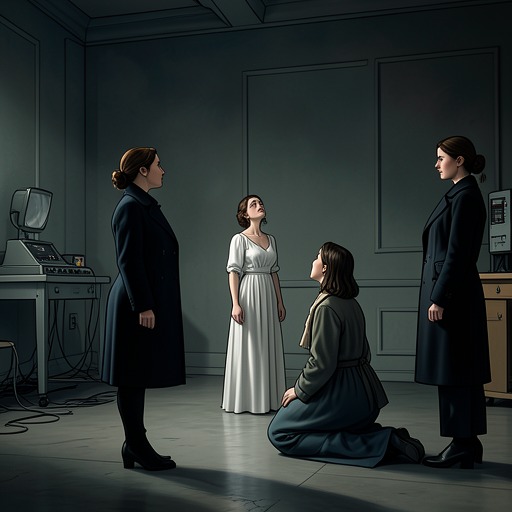
Veronica Cray is an actress living at Dovecotes, the “ridiculous cottage” near The Hollow. Her first appearance is staged like an entrance before an audience. The French windows have been left partly open because the evening is warm; Veronica pushes them wide, walks through, and pauses framed against the night before speaking. She apologizes for “bursting in” and announces that a “frightful catastrophe” has occurred, presenting herself at once as neighbour, messenger, and dramatic presence.
The scene establishes that Veronica understands the effect of her body, timing, and manner on other people. Her entrance is not merely a practical arrival. It converts a private gathering into a stage and makes her the focus of every observer. The performance is interrupted, however, by her recognition of John Christow. On seeing him, she displays utter amazement and incredulous delight, steps toward him with outstretched hands, takes his hands in hers, and addresses him with warmth as though the intervening years had collapsed.
The Return of the Past
Veronica’s encounter with John exposes a history that his present life has not erased. When she gestures toward the leaf-strewn swimming pool and compares it with the Mediterranean, she activates his memory of the blue sea, mimosa, and hot dust associated with their earlier relationship. John realizes that, throughout the fifteen years of separation, Veronica has remained emotionally present in him. The setting therefore becomes a trigger: the pool at The Hollow is not the Mediterranean, but her remark makes the old world return inside the new one.
Veronica later explains to Hercule Poirot that she and John had been engaged fifteen years earlier. She says that John was deeply in love with her, so possessive and masterful that he wanted her to abandon acting and give up having an independent mind or life. She broke off the engagement because she felt unable to accept that demand, and she acknowledges that John suffered severely from the decision. This account gives the former engagement a double structure: it was a passionate attachment, but also a struggle over Veronica’s freedom and identity.
Her account also clarifies why the reunion is dangerous rather than merely nostalgic. Veronica did not simply encounter John by chance after a long absence. She tells Poirot that, since returning to England eighteen months earlier, she had been thinking about him and had taken the cottage because she knew he often spent weekends with the Angkatells. Her residence near The Hollow was thus connected to a deliberate attempt to place herself within his orbit.
Possession, Performance, and Conflict
Veronica interprets John’s refusal through a rivalry with the women around him. She rejects the suggestion that his wife or Midge Hardcastle is the decisive obstacle and identifies “that insolent devil” leaning against the mantelpiece as the other woman who is turning him down. Her accusation transforms the reunion into a confrontation over ownership. When she asks whether the previous night was planned, the implication is that she has arranged circumstances to bring John back within reach.
Her language makes the emotional claim explicit: “You belong to me, John. You always have!” The statement is not presented as a negotiated promise but as an assertion of continuing entitlement. It reveals a possessive logic parallel to the one she attributes to John when describing their former engagement. Veronica once rejected John because his love threatened her independent life; on returning, she herself treats his attachment as something that can be reclaimed and commanded.
This contradiction is central to her characterization. Veronica resists being absorbed into John’s world as an actress whose mind and career must be surrendered, yet she does not relinquish the idea that John remains hers. Her independence and her possessiveness coexist without being reconciled. The theatrical self she presents to others therefore has a hard private centre: charm is not the opposite of control, but one of its instruments.
Conduct After John’s Death
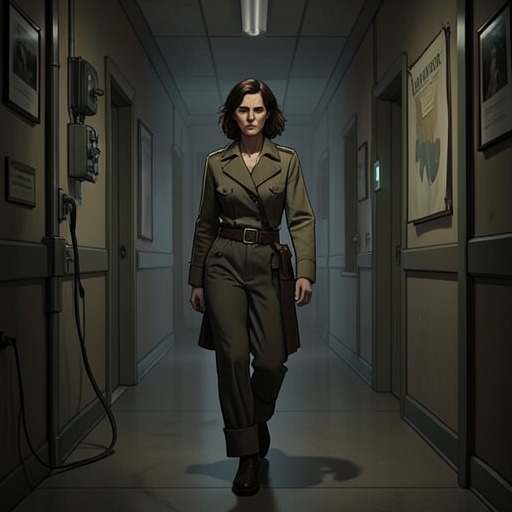
John’s death changes Veronica’s position from returning lover to person of investigative interest. When Inspector Grange seeks information, she says that she is anxious to help. The readiness is outwardly cooperative, but the narration emphasizes that she is not what the Inspector had imagined. Her manner resists easy classification: she appears poised and self-assured rather than conventionally shaken, and her confidence in the effect she produces becomes part of the mystery surrounding her.
Hercule Poirot observes that Veronica is so certain of her impact that she may occasionally make a mistake. That judgment gives her glamour a procedural weakness. A woman who trusts her ability to control an audience may overplay a gesture, misjudge an interlocutor, or assume that charm has concealed the underlying design. Her effectiveness as a performer consequently creates the conditions for her exposure: the same confidence that enables her to stage appearances and manipulate impressions can make her underestimate an investigator devoted to the pursuit of truth.
Narrative Role and Significance
Veronica functions as the embodiment of the past returning in a highly composed form. Her entrance through the window, her recognition of John, the Mediterranean image, and her account of the old engagement all make memory materially present within the weekend at The Hollow. She does not merely remind John of an earlier love; she forces the household to confront the fact that his apparent present has been shadowed by an unresolved former attachment.
Her role also sharpens the novel’s opposition between domestic reality and theatrical display. The Hollow contains marriages, rivalries, habits, and concealed loyalties, while Veronica arrives with the polished timing of an actress and the confidence of someone accustomed to being watched. Yet the performance cannot remain separate from consequence. Her calculated return, her claim over John, and her subsequent interaction with the investigators turn romantic history into evidence-bearing circumstance, making Veronica one of the figures through whom desire, self-dramatization, and criminal suspicion converge.