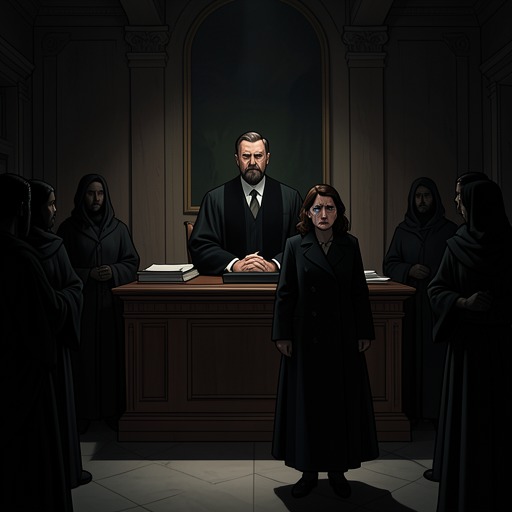
the fortnight adjournment
The HollowThe fortnight adjournment is the two-week postponement requested by the police after the inquest into John Christow’s death. Although the inquest itself is described as little more than a formality, its suspension prevents the case from settling into an official conclusion and keeps the household at The Hollow under investigation. The interval therefore functions not as empty time but as a pressure chamber in which forensic evidence, private loyalties, and competing versions of truth continue to develop.
Definition and Immediate Context
The adjournment begins when the inquest is completed provisionally and postponed at the police’s request. Those present experience the proceeding’s end as an anticlimax: they had been warned that it would be routine, yet they still resent its inconclusive conclusion. The formal process has occurred, but it has not produced closure. The death remains publicly unresolved, and the police retain authority to continue searching for the weapon and testing the testimony surrounding the poolside shooting.
The delay follows a sequence in which Inspector Grange has recorded statements, the police surgeon has examined John Christow’s body, and the body has been removed to the mortuary. The swimming pool, once an ordinary domestic setting, has become the place where John’s blood ran into the artificially blue water. The adjournment preserves that transformation: the crime scene remains active in the investigation even after the visible body has gone.
Investigation During the Interval
The police use the postponed period to pursue physical evidence rather than accept the revolver identified by Sir Henry as the murder weapon. Inspector Grange informs Sir Henry that Dr. Christow was not shot with the revolver identified that morning, a revelation that overturns the apparent simplicity of the evidence and gives the investigation a new direction. The search is consequently aimed at finding the actual firearm used to kill John.
The investigation extends across The Hollow and its surrounding chestnut woods. Police officers search the grounds, startling pheasants and appearing unexpectedly in different places. They also enter the house with a search warrant, despite Inspector Grange’s apologetic manner. The search fails to locate the revolver, but its failure does not end the inquiry; it heightens the sense that the interval is occupied by unseen surveillance and unfinished forensic work.
The adjournment also allows suspicion to attach to documents and movements. Inspector Grange produces a note signed by Veronica Cray asking John to come over because she must see him, a piece of evidence that challenges any attempt to treat her connection with John as remote or insignificant. Later, a Ventnor 10 is identified as a police car following Henrietta Savernake and Edward Angkatell. The investigation thus becomes mobile and social as well as physical: cars, letters, fingerprints, searches, and encounters all extend the case beyond the pool.
Social and Emotional Effects
While the police continue to seek material proof, the people at The Hollow try to perform ordinary domestic life around the unresolved death. Their supper consists of cold ducks followed by caramel custard. Lady Angkatell treats the pudding as a matter of emotional delicacy, arguing that a favourite dessert would be too gross immediately after the death of a friend and that caramel custard is appropriate partly because guests can leave some of it on their plates. The scene makes the adjournment’s social function visible: mourning is being regulated through manners, appetite, and the appearance of moderation.
Henrietta Savernake resists that regulated version of grief. When Edward offers to accompany her to the swimming pool, she refuses because she wants to be alone with her dead. At the pool she confronts the speed with which a living person can become an absence, repeating the word dead until it seems to lose meaning. Her response shows how the adjournment stretches the moment of death rather than resolving it. Public procedure turns the murder into a case; private memory keeps returning to the abrupt disappearance of the man himself.
The delay also creates an ethical conflict around Gerda Christow. Henrietta argues that further damage should not be imposed on Gerda, who adored John and has already lost him. Her concern is complicated by her admission that she had been John’s mistress, but she presents the relationship as one episode in a larger procession rather than as the cause of the collapse of his marriage. During the adjournment, the question is therefore not only who killed John but what forms of truth Gerda should be required to bear.
Delayed Grief and Resolution
The postponed inquest gives Henrietta time to act before she can mourn. On the night of John’s death she had gone to the pavilion and deliberately drawn Ygdrasil upon the iron table by matchlight, choosing purposeful planning over immediate surrender to sorrow. Only later does she feel that she can grieve, because she now has all the time there is. The interval thus marks a psychological transition: the practical emergency of concealment and investigation gradually gives way to the delayed recognition of loss.
Its emotional logic is echoed by Mrs. Crabtree’s blunt statement that what is gone cannot be brought back. Henrietta recognizes that Mrs. Crabtree and Hercule Poirot express the same idea in different language. Yet the adjournment also demonstrates that “gone” does not mean finished. The dead cannot return, but their death continues to generate testimony, evidence, surveillance, moral decisions, and grief.
By the later stages of the interval, Hercule Poirot has identified the significance of three pieces of thick, shiny brown leather as the holster. He proposes that Gerda’s death be treated as suicide while she was of unsound mind, protecting her from the full public consequences of the truth. Lady Angkatell understands that the police may search for the owner of fingerprints and fail to find him, allowing the matter to be dropped, but she knows that Poirot will not abandon the truth. The fortnight adjournment therefore ends as a period in which legal closure remains suspended while ethical judgment reaches its decisive form: the investigation uncovers enough to explain the crime, but the handling of that knowledge is shaped by mercy as well as proof.