Nairobi Hospital
The Hot ZoneNairobi Hospital is presented as East Africa’s leading private hospital and as the setting where the book’s account of a Marburg-virus emergence becomes a medical and institutional crisis. In 1980, Charles Monet arrived there critically ill after traveling from Kisumu; his physician, Shem Musoke, became infected while treating him. The episode led the hospital to close for a week and quarantine 67 people, exposing the vulnerability of ordinary clinical work when an illness is unfamiliar and highly dangerous.
Identity and Role
Nairobi Hospital serves patients arriving from elsewhere in Kenya as well as those in the capital. The book first places it at the end of Monet’s journey: after doctors in Kisumu failed to identify his illness and antibiotics did not help, they advised transfer to the larger hospital. Monet could still walk, so he traveled by taxi to the airport and continued to Nairobi by plane. From there, another taxi brought him to the hospital’s casualty department.
The hospital is both a place of treatment and a point of connection between cases, staff, and diagnostic institutions. Its importance does not rest on an elaborate account of its administration or facilities; rather, the narrative shows how a busy hospital’s ordinary routines became consequential when Monet’s illness proved inexplicable and a doctor treating him fell sick in turn.
Monet’s Admission and the Unidentified Illness
Monet reached the casualty department on foot and indicated that he was very ill, though speaking was difficult. He waited among other patients until a doctor could see him. The waiting room had padded benches, a central floor drain, and notices asking patients to maintain silence and warning that emergency cases might be given priority. The scene places a rare and severe illness inside an everyday system of triage, where the patient initially appeared to be one more person needing urgent attention.
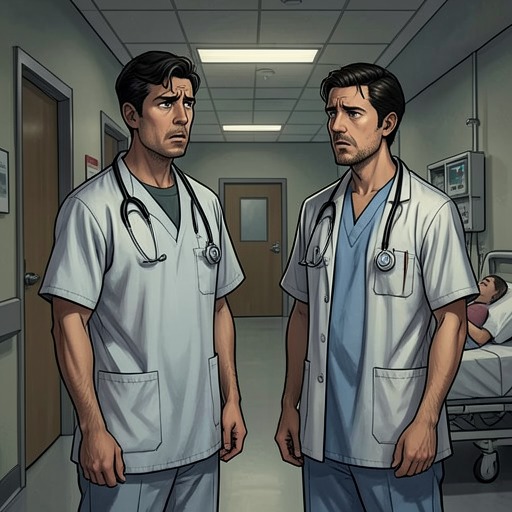
When Monet suddenly deteriorated, staff moved him to the intensive care unit. Shem Musoke, a young physician known for his energy and skill in emergencies, responded to the call. Monet was suffering a massive hemorrhage and had difficulty breathing. Musoke worked to restore his breathing and stabilize him, but the attempt to give a transfusion failed because Monet’s veins would not hold the needles. He remained unconscious and died in the early hours of the morning. The hospital could not identify what had killed him. An autopsy found extensive damage to his liver and kidneys, but the number and severity of the failures made a single cause difficult to establish. The death was ultimately recorded as fulminating liver failure, a description that expressed the limits of what the clinicians then knew rather than identifying the virus.
Musoke’s Illness and the Search for a Diagnosis
Nine days after Monet’s illness had exposed him to infectious material, Musoke began to feel unwell. He initially attributed his backache and fever to exhaustion or malaria, then tried treatment for malaria and typhoid as his symptoms worsened. When he could no longer continue working, Dr. Antonia Bagshawe examined him. His fever, red eyes, jaundice, and abdominal pain suggested possible liver or gallbladder disease, but did not yield a clear diagnosis. An ultrasound showed an enlarged liver without explaining the illness.
Musoke underwent exploratory surgery under a team led by Dr. Imre Lofler. The surgeons found an abnormal, swollen liver, but no gallstones; they also encountered persistent bleeding during the procedure. Afterward, Musoke deteriorated and his kidneys began to fail. David Silverstein took over his care and suspected an unusual virus. He collected blood, separated the serum, and sent frozen samples to the National Institute of Virology in South Africa and the Centers for Disease Control and Prevention in Atlanta. The hospital’s clinical uncertainty thus prompted testing beyond its walls, turning a baffling case into material that could be investigated by specialist laboratories.
Musoke survived. Around ten days after he fell ill, his condition began to improve; later, his fever subsided and his mental state and personality returned. He recovered slowly and completely. He went on to practice at Nairobi Hospital as a member of Silverstein’s group, linking his recovery to the institution where he had first been exposed and treated.
Closure and Quarantine
Once Silverstein learned what Marburg virus could do, he persuaded Kenyan health authorities to shut Nairobi Hospital. For a week, incoming patients were turned away while 67 people, most of them medical staff, were quarantined inside. They included the doctor who had performed Monet’s autopsy, nurses who had attended either Monet or Musoke, the surgeons who had operated on Musoke, and aides and technicians who had handled secretions from the two patients.
The quarantine reflected the breadth of contact within a hospital: exposure was not limited to the physician who had treated Monet, but extended across clinical and support work. Surgeons who had operated on Musoke faced particular uncertainty because they had been in close contact with his blood. No additional proven case of Marburg disease emerged among the hospital staff, but the week-long closure had already halted ordinary care and made clear that an unexplained infection could put the whole institution at risk.
Later Cases and Institutional Significance
Nairobi Hospital appears again in the account of Peter Cardinal, a ten-year-old brought from Mombasa by air ambulance after his parents became alarmed by his worsening condition. He came under Silverstein’s care. Cardinal was alert when admitted, but developed respiratory distress, bruising, and signs of severe internal illness. His case renewed the hospital’s encounter with Marburg and placed a family’s bedside vigil alongside the clinicians’ struggle to understand the disease. Silverstein and the family faced the decision of whether to continue respiratory support after evidence of brain death; the available treatment could not reverse the course of the illness.
Across Monet, Musoke, and Cardinal, Nairobi Hospital occupies a distinctive place in the narrative: it is where a patient’s passage through routine casualty care became a chain of clinical exposure, where an unexplained death initiated laboratory investigation, and where the consequences reached staff, patients, and families. The hospital is not portrayed as the source of the virus. It is the point at which an infection acquired elsewhere entered a densely connected medical setting, and where the difficulty of recognizing an unknown disease became inseparable from the work of caring for those already ill.