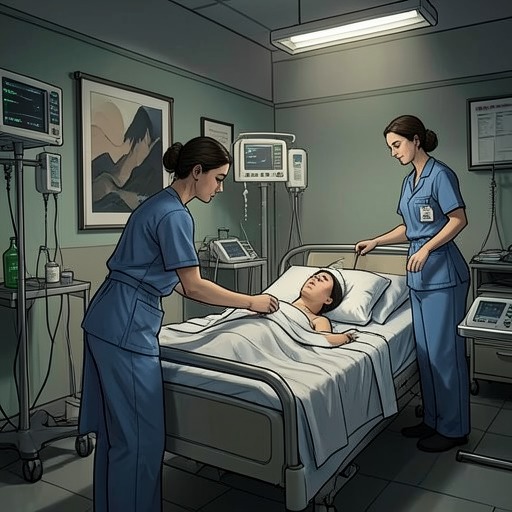
Ngaliema Hospital
The Hot ZoneNgaliema Hospital, a private hospital in Kinshasa run by Swedish nurses, became a critical site in the 1976 Zaire Ebola outbreak. Sister M.E. and Nurse Mayinga N. died there, and the hospital became both a place of intimate bedside care and a focus of emergency containment. Its role was not to identify the virus’s original source: Sister M.E. arrived already gravely ill after being moved from the outbreak area. But her case, Mayinga’s illness, and the response to the danger surrounding them made the hospital central to the crisis in the capital.
A refuge for Sister M.E.
A priest and Sister E.R. brought Sister M.E. from Bumba to Kinshasa, traveling first by Land Rover to an airfield and then by small plane. They took her to Ngaliema Hospital, where she was given a private room. The transfer was an attempt to obtain better medical care for a seriously ill nun; instead, it carried the outbreak into a hospital far from its rural origin. The doctors initially suspected Marburg or a similar agent because they did not know what was causing her illness.
The uncertainty prompted an agonal biopsy, a rapid tissue sample taken near death rather than a full autopsy. Sister M.E.’s religious order prohibited autopsies, but doctors wanted to identify the unknown agent. They sampled her liver and drew blood, sending specimens to laboratories in Belgium and England. These samples became valuable material in the race to identify the disease. The procedure also underlined the hospital’s predicament: learning what was killing a patient required handling material that might itself carry the danger.
After Sister M.E.’s death, her room was stained with blood. Staff members were afraid to enter and clean it, and the room was locked for days. Sister E.R., who had traveled with her, later developed the same illness and was placed in a private room at the hospital. The two cases turned the rooms themselves into part of the emergency, while the cause and transmission route remained uncertain.
Nurse Mayinga’s illness and care
Nurse Mayinga N. had cared for Sister M.E. and may have been exposed to her blood or vomit, although the precise route of infection was not established. When Mayinga began to feel ill, she left the hospital and was out of sight for two days. She went to government offices to arrange travel papers, then sought help at Mama Yemo Hospital and University Hospital before returning to Ngaliema Hospital and asking to be admitted. At the time, she hoped her symptoms might have another explanation; her movements through Kinshasa later became the focus of fears that the virus might spread widely in the city.
At Ngaliema, Mayinga was placed in a private room reached through an empty intermediate space where staff were meant to put on protective gear. Margaretha Isaacson, a South African doctor, cared for her. The gas mask Isaacson first wore became increasingly difficult to tolerate in the tropical heat, and she ultimately treated Mayinga face-to-face. She tried to ease Mayinga’s suffering with ice cubes and Valium and gave her three whole-blood transfusions as she lost blood. Mayinga remained conscious until the final stage of her illness and died after her heart developed a rapid, abnormal rhythm.
Isolation and the city response
Mayinga’s illness provoked alarm because she had spent two days moving through public places before she was admitted. Rumors of her contacts spread through mission and government networks and reached diplomats and the World Health Organization. Officials feared that she might have exposed people across a city of two million. In response, President Mobutu Sese Seko ordered soldiers to surround Ngaliema Hospital and allow entry or exit only for doctors. Much of the medical staff was quarantined inside, and the soldiers enforced the restriction.
Medical teams identified 37 people who had been in face-to-face contact with Mayinga during her time away from the hospital. Two biocontainment pavilions were established at Ngaliema, and those contacts were held for a couple of weeks. Mayinga’s body and those of the nuns were wrapped, sealed in plastic, and placed in airtight coffins; funeral services were held at the hospital under medical supervision. Isaacson also cleaned blood-contaminated rooms after the deaths, taking on work that other staff feared to do. These measures joined bedside care to practical containment: the hospital had to care for the sick while limiting exposure among staff and contacts.
Outcome and significance
The feared citywide spread did not follow. None of the 37 people identified as having face-to-face contact with Mayinga became ill, including a person with whom she had shared a bottle of soda. The book presents this outcome as evidence that the virus did not appear to spread readily through those encounters or through the air; it does not establish the route by which Mayinga herself became infected. Her case therefore exposed the difference between an alarming possibility and the transmission that investigators could actually document.
Ngaliema Hospital’s role was defined by that tension. Its staff treated patients before the agent was understood, worked amid uncertainty about contaminated rooms and protective equipment, and helped isolate people whose exposure might have led to further cases. The hospital became a boundary between care and containment, but not an impermeable one: caregivers entered private rooms to assist the dying, while soldiers and quarantine facilities tried to keep the danger from moving beyond them. In the end, the expected epidemic in Kinshasa did not occur, and the hospital’s emergency response became part of the explanation for how the threat was faced without a wider outbreak in the city.