Peter Cardinal
The Hot ZonePeter Cardinal was a ten-year-old Danish boy whose death in Kenya in 1987 turned a single, unexplained illness into a renewed investigation of Marburg virus. His case established that the agent was present in his blood, and the history of his travels led researchers to Kitum Cave on Mount Elgon. The cave became a compelling lead, but neither the precise route of infection nor the virus’s natural host was established.
Identity and Family
Cardinal was a tall, thin, fit-looking boy with blond hair and blue eyes. He had been a student at a boarding school in Denmark. His parents worked for a Danish relief organization in Kenya and lived in Kisumu, near Lake Victoria; his older sister attended a private school in Nairobi. The siblings were very close. When Cardinal came to Africa to visit his family, they spent much of their time together, sharing activities throughout his stay.
The family travelled through Kenya after his arrival, intending to show him the country. They were in Mombasa when his eyes became red. Local doctors thought he had malaria, but his mother doubted that diagnosis and became convinced that he was seriously ill. She pressed for him to be taken to Nairobi. The Flying Doctors air-ambulance service brought him to Nairobi Hospital, where David Silverstein treated him. Silverstein had also cared for Shem Musoke after Musoke became ill following Charles Monet’s infection, a prior experience that informed the precautions taken around Cardinal.
Illness and Death
At Nairobi Hospital, Cardinal was feverish but alert and communicative. His lung condition developed into acute respiratory distress, and he needed a respirator within a day. Staff took precautions because they suspected Marburg, though they did not initially approach the case with the same alarm they had felt during Musoke’s illness. Cardinal also developed bleeding, abnormal liver function, bruising, and signs of severe neurological injury. His condition worsened despite intensive support.
As his brain activity became profoundly impaired, his family faced the decision of whether to discontinue the respirator. His mother later wondered whether an earlier transfer from Mombasa might have helped. Silverstein told her that earlier arrival would not have changed the outcome: Cardinal’s illness was already beyond what the available treatment could reverse. His parents and sister watched his deterioration without being able to relieve his suffering or know what he could perceive. The account emphasizes the limits of both medical intervention and family comfort in the face of an infection that was not yet understood.
The Blood Sample and Laboratory Identification
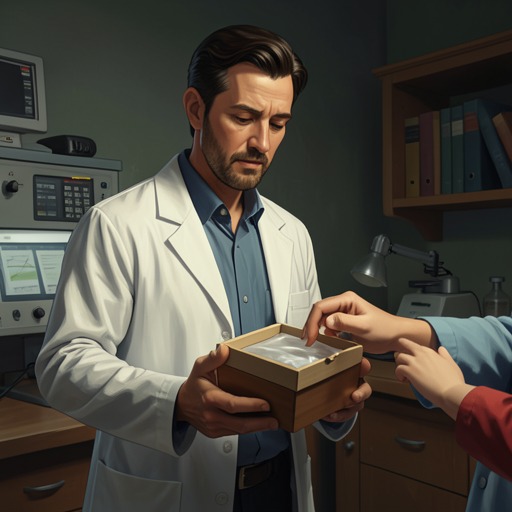
After Cardinal’s death, a blood-serum sample was carried from Kenya to the United States. On September 2, 1987, Eugene Johnson met an arriving contact at Dulles International Airport and received a taped cardboard box wrapped in towels. The box contained serum from the boy. Johnson considered destroying it rather than spending the night testing what might prove to be an unremarkable sample, but decided that the possibility of a dangerous agent required immediate investigation.
At the United States Army Medical Research Institute of Infectious Diseases, Johnson opened the package inside a Level 4 cabinet. The serum had been protected by layers of packing: foam peanuts, a taped metal cylinder marked with a biohazard symbol, paper towel soaked in bleach, a sealed bag, and small plastic vials. He inoculated living monkey cells with some of the serum. The cells began to die rapidly, indicating that an active agent was present. Subsequent tests showed that the agent could infect monkeys and guinea pigs; two of three rhesus monkeys died, while the third survived after becoming critically ill. Johnson identified the agent as Marburg.
The sample also became a defining object for Thomas Geisbert, the Institute’s electron-microscope operator. When he later examined virus grown from a Reston monkey, the particles’ threadlike forms recalled the images he had studied in Cardinal’s tissue. He recognized a resemblance to the Cardinal strain and understood that the new finding might involve a dangerous filovirus. Cardinal’s case thus continued to shape the work of researchers who had never met him: his illness supplied a visual and scientific reference point for recognizing a related threat.
Kitum Cave as a Possible Exposure Site
Once the virus was identified, Johnson asked Peter Tukei of the Kenya Medical Research Institute to reconstruct Cardinal’s movements and speak with his family. Tukei learned that Cardinal had visited Kitum Cave on Mount Elgon. That discovery gave the investigation a specific geographic lead: Charles Monet and Cardinal had both been in the cave, the one known place where their paths crossed. The shared location raised questions about what they might have touched or breathed, but it did not prove that the cave was the source of either infection.
Johnson and Tukei retraced the boy’s movements and interviewed his parents. They learned that Cardinal was an amateur geologist who had wanted to collect crystals from the cave. He struck the cave walls with a hammer and brought rocks home; the family’s driver broke them up, and the cook washed them. Tests found no Marburg antibodies in either worker. Johnson considered whether Cardinal might have made a small cut on a crystal contaminated by animal urine or the remains of a crushed insect. This was a possible route of entry, not a confirmed explanation, and even a cut would not identify the virus’s natural host.
The cave investigation was shaped by the danger of airborne exposure. Johnson had previously shown in experiments that monkeys could be infected by breathing small amounts of Marburg or Ebola virus. On an initial visit, the team used military gas masks and improvised head coverings made from flowered pillowcases. After surveying the cave, Johnson persuaded the Army to support a larger expedition. In 1988, he returned to Nairobi with twenty crates of protective gear and scientific equipment; the team even discussed how its members’ remains would be handled if someone died. These precautions show how Cardinal’s death transformed a family’s account of a visit into an organized, high-risk search.
Significance and Unresolved Questions
Cardinal’s case provided strong evidence that Marburg could infect and kill a child in Kenya, and it prompted investigators to examine a particular cave as a possible point of contact. The distinction between evidence and hypothesis remains central to the story. His visit to Kitum Cave was established; his handling of crystals was reported by his parents; a tiny cut and contamination were possibilities. The natural reservoir, however, remained unidentified. No test of the rocks or the family’s negative results could settle where the virus ordinarily lived.
The narrative presents Cardinal both as an individual whose closeness to his sister and family is made visible through the investigation, and as the source of a scientific trail that extends beyond his death. His serum enabled laboratory confirmation; his itinerary narrowed the search; and his possible contact with cave crystals focused attention without resolving the mystery. The case’s lasting significance lies in that combination: a particular child’s fatal illness made an elusive virus more legible, while leaving its ecological origin unknown.