Peter Cardinal's Marburg case and the Kitum Cave lead
The Hot ZonePeter Cardinal's Marburg case and the Kitum Cave lead links the death of a ten-year-old boy to a larger investigation into the virus's hidden reservoir. After Cardinal died in Nairobi, Gene Johnson tested his blood and confirmed Marburg. Learning that Cardinal had visited Kitum Cave on Mount Elgon, Johnson recognized that it was also the only place where Cardinal's path and Charles Monet's had crossed. The cave offered a striking lead, not a definitive explanation: the virus's natural host and the precise means by which Cardinal became infected remained unknown.
Cardinal's illness and death
Cardinal was visiting his parents and older sister in Kenya after attending boarding school in Denmark. His parents worked for a Danish relief organization and lived in Kisumu. The family traveled around the country, including a stay in Mombasa, where Cardinal developed red eyes. His parents initially took him to a local hospital; his mother doubted the diagnosis of malaria and pressed for him to be taken to Nairobi. The Flying Doctors air-ambulance service brought him to Nairobi Hospital, where he was treated by David Silverstein, who had also cared for Shem Musoke after Musoke was infected following Charles Monet's illness.
Silverstein recalled Cardinal as a tall, thin, fit-looking boy who was alert and communicative when he arrived, despite fever and early respiratory problems. His condition worsened quickly. Staff took precautions because they suspected Marburg, and within a day he needed a respirator. His symptoms included bleeding at puncture sites, impaired liver function, and signs of brain death. His parents and sister faced the decision of whether to discontinue life support. Silverstein told them that survival was not possible because of the brain damage; he also made clear that earlier arrival from Mombasa would not have changed the outcome. Cardinal died, leaving his family with the loss of a child whose illness had advanced beyond the reach of treatment.
The blood sample and identification
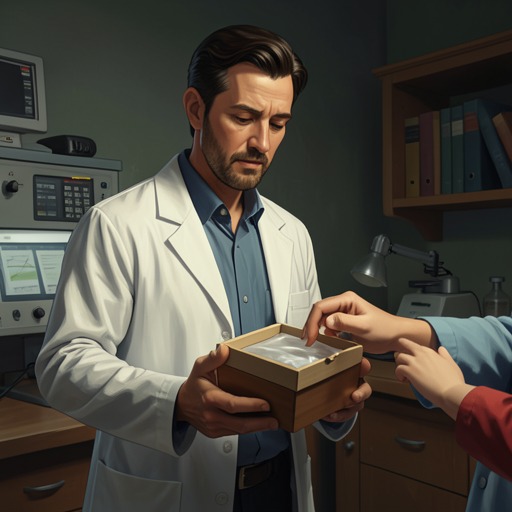
On the second day of September 1987, Johnson waited near the customs gates at Dulles International Airport for a passenger returning from Kenya. The passenger handed him an unmarked cardboard box wrapped in towels. Inside was serum from Cardinal, who had died a day or so earlier at Nairobi Hospital. The delivery was informal and the packaging improvised, but the sample might contain an unidentified Level 4 agent and had to be examined before it deteriorated.
At the United States Army Medical Research Institute of Infectious Diseases, Johnson opened the package in the Level 4 cabinets. Beneath foam peanuts, he found a taped metal cylinder marked with a biohazard symbol. It held bleach-soaked paper towels, a plastic bag, and two small vials of golden serum. The careful containment around the vials contrasted with the improvised wrapping that had brought them to the Institute. Johnson worked through the night, placing some of Cardinal's serum into flasks containing living monkey cells.
The cells burst and died, showing that the sample contained a highly active agent. Johnson then injected fluid from the cultures into three rhesus monkeys: two died, while the third became critically ill but survived. In guinea pigs, the agent also caused severe disease. These tests demonstrated its ability to infect multiple species and supported Johnson's conclusion that the agent was Marburg. Its lethal effects in humans, monkeys, and guinea pigs also suggested that none of those species was likely to be its natural host, since a virus generally does not kill the host in which it is maintained.
The Kitum Cave lead
After identifying the agent, Johnson turned from the question of what Cardinal had contracted to where he might have encountered it. He asked Peter Tukei, a scientist at the Kenya Medical Research Institute, to obtain a history of the boy's travels. Tukei contacted Cardinal's family and reported that the boy had visited Kitum Cave on Mount Elgon. That discovery gave the investigation a precise geographical focus: Kitum Cave was the one place shared by the known paths of Cardinal and Charles Monet.
Johnson and Tukei later traveled through Kenya with Silverstein, retracing Cardinal's movements and speaking with his family. Cardinal had been especially close to his older sister, and the two had spent much of his visit together. Since she had not fallen ill, investigators looked for a difference in what the siblings had done. Their family said Cardinal was an amateur geologist. In the cave, he had struck the walls with a hammer and collected crystal-bearing rocks. The rocks were broken up by the driver and washed by the cook; tests found neither man positive for Marburg.
Johnson considered whether Cardinal had pricked a finger on a crystal contaminated by animal urine or the remains of a crushed insect. A tiny cut could have provided a route into the bloodstream, but this remained a possibility, not a finding. Even if a contaminated crystal had been the point of contact, it would not reveal which animal or insect maintained the virus in nature. The cave focused the search without resolving it.
From a lead to an expedition
Johnson knew that Marburg could be transmitted through the air. An experiment he had conducted in 1986 showed that monkeys could be infected by breathing in a small amount of airborne Marburg or Ebola. When he and his colleagues entered Kitum Cave to inspect it, they used military gas masks and improvised head coverings. On a later reconnaissance, the group mapped the cave; the precautions reflected uncertainty about what might be present, not evidence that the virus had been found there.
Half a year after Cardinal's death, in the spring of 1988, Johnson returned to Nairobi with an Army-sponsored expedition and twenty shipping crates of protective gear and scientific equipment. The team even discussed how to handle its own remains if a member died of Marburg. That preparation marked the consequence of Cardinal's case: his illness had turned a location named in a family travel history into the focus of a serious search for the virus's natural reservoir. Yet the expeditionary effort did not make the suspected route certain. In the larger account, tropical forest loss, human settlement, and the trade in wild primates form a wider context for emerging viruses, while the specific host and transmission chain behind Cardinal's infection remain unresolved.
Significance and uncertainty
The case joins clinical diagnosis, laboratory testing, family testimony, and field investigation into a single chain of inquiry. A serum sample carried from Kenya allowed Johnson to identify Marburg; interviews then placed Cardinal in Kitum Cave; comparison with Charles Monet's history made the cave an especially consequential lead. Each step narrowed the question, but none supplied a confirmed natural host or proved exactly how infection occurred.
That distinction matters to the book's account of viral emergence. The narrative presents viruses as capable of crossing species boundaries and situates emerging infections within changing ecological conditions, but it does not establish that environmental disruption caused Cardinal's particular infection. The cave is therefore both a concrete site in the investigation and a boundary of knowledge: the place where two cases converged, and where the search for what sustained Marburg in nature began without reaching a conclusive answer.