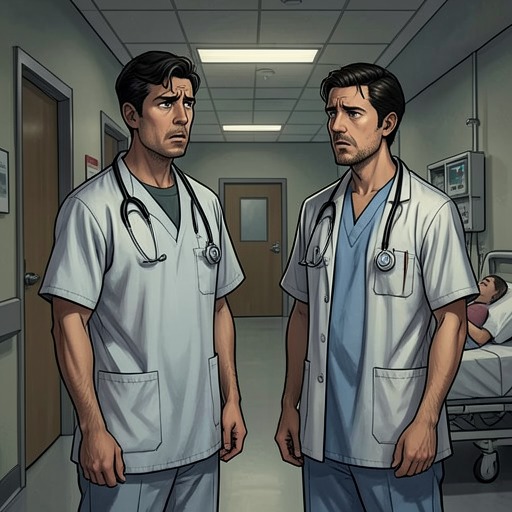
Shem Musoke
The Hot ZoneShem Musoke is a physician at Nairobi Hospital whose treatment of Charles Monet places him in direct contact with Marburg virus. He falls ill nine days after Monet’s death, survives a severe infection, and returns to medical practice. His story makes the outbreak more than a sequence of alarming symptoms: it shows how an infection can pass through ordinary acts of care, remain unrecognized while a doctor keeps working, and leave a survivor with only fragmentary memories of what happened.
Identity and Work
At the time of Monet’s emergency, Musoke is described as one of the best young physicians at Nairobi Hospital. He is energetic, works long hours, has a warm sense of humor, and is considered capable in emergencies. When a call announces that a patient in intensive care is bleeding, he runs to help. He does not yet know what has caused Monet’s condition; the immediate task is to address the patient’s breathing and support him through a crisis.
That professional reflex places Musoke close to the danger before anyone understands it. He examines Monet and works to reopen his airway, without wearing rubber gloves. During the procedure, Monet vomits and the material reaches Musoke’s face and clothing. Musoke continues treating him, including clearing the patient’s mouth and managing the airway. The scene establishes the exposure not as a deliberate risk but as an unforeseen consequence of emergency care: the physician responds to what appears to be a catastrophic medical emergency without knowing that the patient carries a highly dangerous virus.
Exposure and Delayed Illness
Musoke does not immediately connect the encounter with his later illness. Nine days after the exposure, his back begins to ache. He attributes the pain to exhaustion: he has spent successive nights attending patients, including a person with heart problems and Monet, whose illness has not been explained. As the symptoms spread, he first considers malaria. Red eyes and fever seem compatible with an infection, and he tries antimalarial treatment, but it does not help.
The illness continues to resist his own attempts at diagnosis. A painful injection of an antimalarial drug strikes him as unusually painful. When abdominal pain develops, he suspects typhoid and takes antibiotics, again without improvement. Meanwhile, he continues working because his patients need him. His pain grows severe, jaundice appears, and he is no longer able to carry on at the hospital. The sequence underscores the delay between exposure and recognition: Musoke is both an experienced physician and a patient trying to interpret symptoms whose cause remains hidden from him.
At Nairobi Hospital, examination does not immediately settle the question. His fever, red eyes, jaundice, and abdominal pain lead to possibilities including gallstones or a liver abscess. An ultrasound shows that his liver is enlarged, but offers no clear explanation. As his condition worsens, he is placed in a private room and receives continuous nursing care. His expression becomes markedly withdrawn. The working explanations remain uncertain while the infection advances.
Treatment and Recovery
David Silverstein provides Musoke with supportive care, trying to maintain his nutrition and lower his fever. At first, there is no specific treatment plan because the cause of the illness is unknown. A telephone call from an American researcher eventually reports that South African investigators have found Marburg virus in Musoke’s blood. The discovery changes the meaning of the preceding days: Monet’s unexplained emergency and Musoke’s illness are no longer separate medical puzzles but parts of the same chain of infection.
Musoke’s recovery is gradual rather than immediate. Around ten days after he first falls ill, doctors notice a change in his behavior: instead of lying passively, he becomes confused and angry, refuses medicine, and waves a fist at a nurse attempting to turn him in bed. Around this period his condition begins to improve. His fever subsides, his eyes clear, and his usual mind and personality return. He eventually recovers completely. The change is striking because the same illness that had left him unable to work had also temporarily altered his behavior; recovery includes the return of both physical health and personal presence.
Memory, Relationships, and Significance
Musoke’s relationship with Monet is defined by an act of care that becomes an occupational exposure. He meets Monet not as a known carrier of Marburg but as a critically ill patient needing immediate attention. Musoke’s response is practical and urgent, while the danger remains unrecognized. The later diagnosis recasts that intervention as the point at which the virus reached another person in the hospital. Yet Musoke survives, and no other person at Nairobi Hospital develops a proven case of Marburg disease.
His connection with Silverstein continues beyond the illness. After recovery, Musoke becomes one of the leading physicians at Nairobi Hospital and practices as part of Silverstein’s group. He also becomes a figure in the medical record of Marburg: samples of his blood are sent to laboratories, and the strain identified through his case becomes known as the Musoke strain. The naming preserves his place in the history of the virus, even as the story begins with him as a doctor confronting an emergency whose cause he cannot yet know.
When interviewed later, Musoke says he remembers little of the weeks he was ill. What remains is discontinuous: confusion, an episode in which he walked out of his room with his intravenous drip still attached, muscle aches, lower-back pain, and the memory of Monet vomiting on him. This partial recollection places a limit on what can be known from the survivor’s own account. The narrative has reconstructed the clinical sequence around him, but Musoke’s experience of it survives chiefly as scattered impressions. His role is therefore both personal and structural: he is a physician who returns to his work, a survivor whose blood helps identify the virus, and the human link through which the book traces the consequences of an initially unexplained exposure.