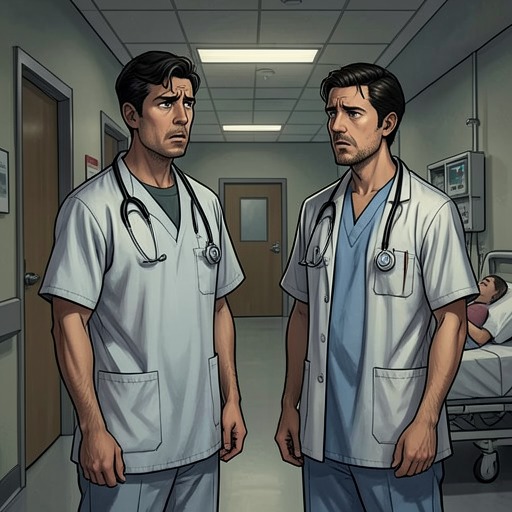
Shem Musoke's Marburg virus infection and recovery
The Hot ZoneShem Musoke's Marburg virus infection and recovery turned an emergency effort to save a patient into a second medical crisis at Nairobi Hospital. After treating Charles Monet without gloves, Musoke developed symptoms nine days later and became gravely ill. His recovery was slow, but the episode exposed the risks carried by patient fluids, prompted the quarantine of hospital staff, and yielded a strain of Marburg virus that would bear his name.
The encounter with Charles Monet
On January 15, 1980, Musoke responded to an emergency in the hospital's intensive care unit. Monet had suffered a massive hemorrhage and was struggling to breathe. Musoke had no diagnosis to guide him; he concentrated on restoring the patient's airway. He opened Monet's mouth, cleared it with his fingers, and used a laryngoscope to reach the airway. When Monet vomited during the procedure, blood and dark fluid struck Musoke's face and clothing, including his eyes and mouth. He continued treating Monet, whose breathing resumed, but whose condition remained critical.
Musoke attempted to arrange a blood transfusion. The needle punctures failed to provide a usable route: Monet's veins broke down and blood continued to escape, so Musoke abandoned the effort rather than risk further bleeding. Monet remained unconscious and died in the early hours of the morning, with Musoke staying at his bedside. At the time, the cause of death was unknown. The encounter, however, had placed Musoke in direct contact with material from a patient carrying a highly dangerous virus.
Delayed onset and worsening illness
Nine days after the exposure, on January 24, Musoke noticed an ache in his back. He had recently worked long hours and initially attributed the discomfort to exhaustion or age. When the pain spread through his muscles and his eyes reddened, he suspected malaria. He took antimalarial pills, then received an injection of an antimalarial drug from a nurse; the unusually intense pain of the injection struck him as abnormal, but did not identify the cause of his illness.
Abdominal pain led him to suspect typhoid fever, and he tried antibiotics without improvement. He continued working while his condition worsened. Fever, muscle pain, abdominal pain, and jaundice eventually left him unable to carry on at the hospital, and he presented himself to Dr. Antonia Bagshawe. Her examination did not yield a definite diagnosis. Gallstones or a liver abscess seemed possible, so she ordered an ultrasound, which showed an enlarged liver but no clear explanation for his symptoms.
Surgery, investigation, and isolation
As Musoke deteriorated, surgeons led by Dr. Imre Lofler operated to investigate the suspected liver problem. They found no gallstones. Instead, blood continued to ooze from the vessels cut during surgery, resisting the usual measures used to control it. The team took a wedge of liver for biopsy and closed the incision as quickly as possible. Musoke's kidneys then began to fail, and his condition appeared life-threatening.
David Silverstein took over his care when Bagshawe had to travel abroad. Suspecting an unusual virus, Silverstein collected Musoke's blood, separated the serum, and sent frozen samples to the National Institute of Virology in South Africa and the Centers for Disease Control and Prevention in Atlanta. The samples made it possible for laboratories to test for the agent, even as the hospital faced the possibility that more people had been exposed.
Once Marburg virus was recognized as the danger, Kenyan health authorities shut Nairobi Hospital to incoming patients for a week. Sixty-seven people were quarantined inside, most of them hospital staff. The group included people who had attended Monet or Musoke, performed Monet's autopsy or Musoke's surgery, and handled secretions or samples from either patient. Surgeons who had operated on Musoke remained under quarantine for two weeks, uncertain whether they too would develop the disease. No other proven case of Marburg virus disease emerged at the hospital.
Recovery and the Musoke strain
About ten days after Musoke fell ill, his doctors saw a change: rather than remaining passive in bed, he became disoriented and angry and resisted medication. This marked the beginning of improvement. His fever subsided over the following days, his eyes cleared, and his personality returned. He recovered slowly but completely. He later became one of Nairobi Hospital's leading physicians and practised in Silverstein's group.
Musoke retained little memory of the weeks of illness. He recalled confusion, leaving his room with an intravenous drip still attached before his surgery, muscle and lower-back pain, and Monet vomiting on him. The gaps in his recollection mark how thoroughly the disease disrupted both his body and his awareness; the clinical record, rather than a continuous personal account, carries much of the story of his illness.
Blood from Musoke provided laboratories with samples of living Marburg virus. The account traces the virus in his blood to Monet's vomit and suggests that it may originally have come from Kitum Cave, without establishing that origin as certain. The strain came to be known as the Musoke strain, and some of it was preserved in United States Army freezers. His recovery therefore had consequences beyond the hospital: the case helped define a particular viral strain even as its circumstances demonstrated how a single patient's treatment could create a wider exposure crisis.
Significance of the episode
The episode is presented as an isolated emergence, or microbreak: one infected patient entered a hospital, and the clinical efforts to save him exposed a doctor and many others to an unknown danger. The subsequent absence of other proven cases did not make the exposure inconsequential. For a week, Nairobi Hospital could not receive patients, and dozens of staff members faced quarantine while they waited to learn whether the infection had spread.
The narrative's predator imagery gives the event an unsettling scale, but Musoke's case also rests on concrete links between transmission and medical practice: an ungloved airway procedure, blood and other patient fluids, surgical treatment, and serum sent for testing. His gradual return to health stands against Monet's death and the uncertainty surrounding the source and reach of the virus. The name attached to the strain preserves that contrast: Musoke survived, while his blood became both evidence of the disease and a means of carrying its scientific identity forward.