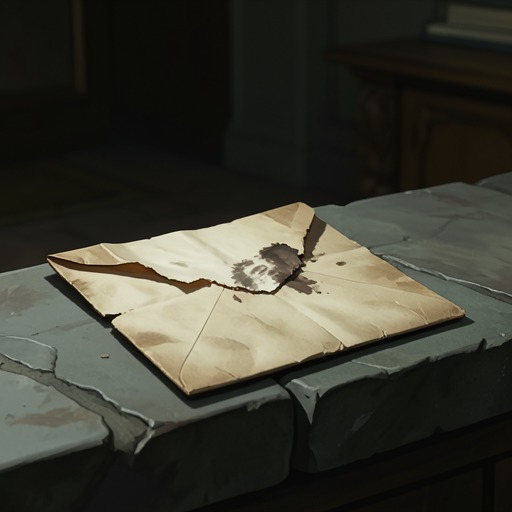
Anonymous warning to Sir Henry Baskerville
The Hound of the BaskervillesThe anonymous warning to Sir Henry Baskerville turns the approaching journey to Baskerville Hall into an explicit question of danger: should Sir Henry heed an unknown sender and stay away from the moor, or claim his family home despite the risk? The warning is at once a possible act of protection and a possible attempt at intimidation. Its cut-and-pasted words give Sherlock Holmes a physical puzzle to examine, while its uncertain motive leaves Sir Henry to make a consequential choice before he knows the full story.
Arrival of the Warning
Sir Henry brings the message to Sherlock Holmes after arriving in London, describing it as something that might be no more than a joke. The envelope is ordinary gray paper, addressed to him at the Northumberland Hotel in rough printed characters. Its postmark shows Charing Cross, and it was posted the previous evening. Those details quickly make the delivery seem less casual: Dr. Mortimer explains that he had been staying with a friend, and that there was no reason for anyone to know they meant to go to that hotel.
Inside is a half-sheet of foolscap folded into four. Across it, printed words have been pasted together to form a sentence: “As you value your life or your reason keep away from the moor.” Only the word “moor” is written in ink. The warning does not name a particular assailant or explain what awaits Sir Henry. Instead, it couples a threat to his life with a threat to his reason, leaving open whether the danger is supposed to be physical, supernatural, or both.
Holmes Examines the Message
Holmes treats the letter not simply as a statement of danger but as evidence about its maker. He asks Watson for the inside page of The Times and scans its leading articles, identifying the printed source of the warning’s other words. The connection is exact enough to establish that the sentence was assembled from the newspaper; “moor,” a less common word, was supplied in ink because Holmes could not find it in print. Sir Henry recognizes the significance of the deduction, though the sender’s identity remains unknown.
The way the words are arranged adds a second layer of evidence. Their line is uneven: “life,” for instance, sits out of place, while “keep away” and “from the” have each been cut as a single piece. Holmes reads this irregularity alongside the sender’s choice of materials. The rough printed address and pasted message make their author appear uneducated, but the use of The Times suggests, in Holmes’s view, an educated person deliberately posing as someone else. The effort to conceal handwriting also raises the possibility that the writer’s hand might be recognized by Sir Henry, or become recognizable to him.
Holmes does not treat the irregular layout as proof of a single explanation. It might signal carelessness, but he favors haste or agitation: the warning’s importance, he reasons, makes simple carelessness less likely. That possibility leads to another unanswered question. Since a letter posted early enough would still reach Sir Henry before he left the hotel, why was its maker in such a hurry? Holmes wonders whether someone feared interruption, but Dr. Mortimer cautions that the inquiry is entering conjecture. The object yields clues, not a name or a settled account of events.
Two Possible Motives
The warning’s purpose remains as uncertain as its author. Dr. Mortimer suggests that it could have come from someone convinced that the family danger was supernatural. He also observes that the sender appears to know more about what is happening on the moor than the men discussing the letter do. Holmes draws a more hopeful possibility from the same evidence: someone who warns Sir Henry may not be ill-disposed towards him. Sir Henry, however, points out the opposite possibility—that the message is meant to frighten him away for the sender’s own purposes.
Holmes acknowledges both readings rather than treating the letter’s threatening language as proof of either benevolence or malice. Its sender may be trying to preserve Sir Henry from danger, to exploit his fear of the Baskerville legend, or to clear the way for some private purpose. The warning therefore opens a practical problem as well as a detective one: whether Sir Henry should go to Baskerville Hall. Holmes promises that Sir Henry will learn what the others know before leaving, but at this point the message has not resolved the nature of the threat it announces.
Sir Henry’s Decision and the Continuing Risk
Sir Henry refuses to let the warning determine his course. He insists that neither the family fiend nor any human being will prevent him from going to his own people’s home. At the same time, he admits that the matter is too large to consider at one sitting and asks for an hour alone before giving Holmes a clearer answer. His response combines resolve with deliberation: he is not persuaded to abandon the journey, but he wants time to understand what has been placed before him.
The danger implied by the letter continues to shape what follows. Holmes proposes Watson as a companion, and Watson is taken by surprise when Sir Henry grasps his hand and welcomes the offer to come down to Baskerville Hall. Later, after arriving on the moor, Sir Henry insists that he must go out alone despite Holmes’s instructions that he not do so. Watson is left uncertain how to stop him, then sets out after him, fearing the consequences of allowing him to go unaccompanied. The warning has not prevented the journey; it has helped establish why the journey cannot be treated as safe.
The uncertainty is still active when Holmes later tells Watson not to reveal the hound to Sir Henry. Holmes wants him to believe that Selden’s death occurred as Stapleton would have him believe, so that he will have a steadier nerve for the ordeal expected the next day. This later concealment does not establish who sent the warning or what the sender intended. It does show that, even after the letter has been analyzed, knowledge of the danger remains divided, and Sir Henry’s decisions continue to be made without access to everything Holmes knows.
Narrative Significance
As a piece of evidence, the warning shifts attention from the old family legend to a present, deliberate human act. The printed scraps are tangible enough for Holmes to trace to a newspaper, yet their careful disguise and uneven assembly preserve the mystery of who made them. The message is legible in its demand but equivocal in its purpose: a direct instruction to stay away may be compassion, manipulation, or both.
Its effect is not to settle whether the moor is dangerous, but to make that danger immediate for Sir Henry and to frame his arrival as a choice taken under uncertainty. Holmes can infer something about the sender’s education, concealment, and possible haste; he cannot yet identify the sender or prove the motive. The letter thus functions both as a warning within the story and as an early demonstration of the limits of deduction: its physical construction can be closely read, while the human intention behind it remains unresolved.