Baskerville Hall
The Hound of the BaskervillesBaskerville Hall is the ancestral residence of the Baskerville family, set among the high, sparsely settled uplands of Dartmoor. Its grounds include the Yew Alley where Sir Charles Baskerville took his nightly walks and where he was found dead; the house also becomes the home of his heir, Sir Henry Baskerville. Its age and isolation give the family’s inheritance a visible setting, while its rooms and grounds hold practical clues to the events surrounding Sir Charles’s death and the secret nighttime activity that follows.
Setting and Approach
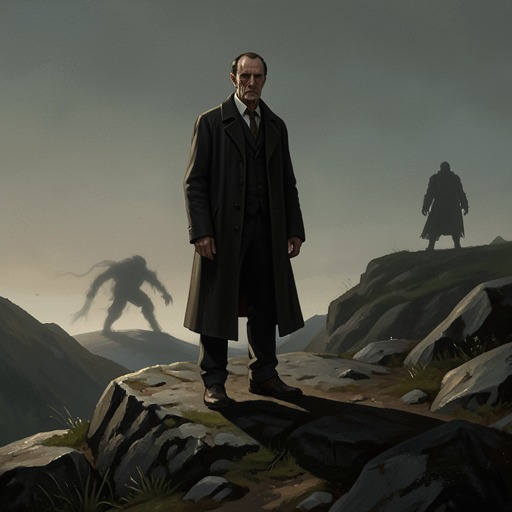
The approach to Baskerville Hall marks a transition from cultivated country to a more exposed upland landscape. The road climbs away from fertile fields and passes broad slopes scattered with large stones and occasional stone-built cottages. The Hall itself stands in a hollow among trees, with two narrow towers rising above them. From the road, the house appears at the end of a long, dark drive; the surrounding terrain places it close to the open moor without making it part of an ordinary village setting.
At the entrance, wrought-iron gates stand between weathered pillars bearing the Baskerville boar heads. The lodge beside them is in ruins, with its roof gone, but a new building is being constructed opposite it. This is described as the first result of Sir Charles’s South African gold. The contrast between a decayed entrance structure and new construction makes the estate’s history and changing fortunes tangible: the family seat is old, but Sir Charles’s wealth had begun to finance its renewal.
The House and the Family Estate
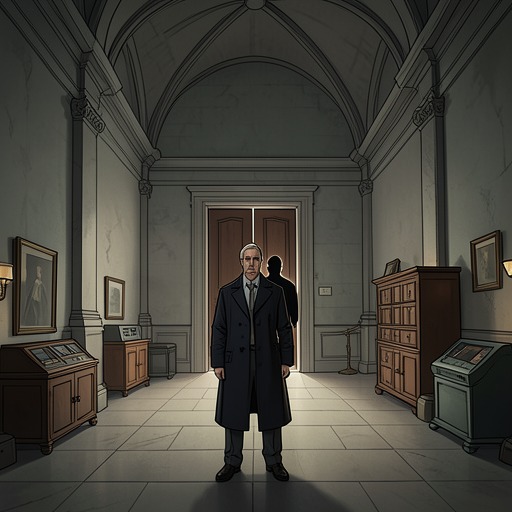
The principal interior room described on Sir Henry’s arrival is a large, high-ceilinged hall with heavy oak beams, oak panelling, old stained glass, stags’ heads, and coats of arms. A fire burns in the fireplace, and the subdued lighting leaves the inherited furnishings and emblems as the room’s most conspicuous features. Sir Henry recognizes the place as the home in which his family had lived for five hundred years. His response frames the house not simply as property but as a continuing family inheritance, one whose weight he feels as soon as he enters it.
That inheritance has a substantial financial value. Sir Charles’s estate is estimated at close to a million pounds, and the question of who would receive it becomes important when Holmes asks about the consequences of Sir Henry’s death. Since Rodger Baskerville, Sir Charles’s younger brother, died unmarried, the estate would pass to the Desmonds, distant cousins; James Desmond, an elderly clergyman, is identified as the next in that line. The land is entailed, while Sir Henry could make a will concerning the money. He says he believes the money should accompany the title and estate, so that the owner can maintain the property and restore the family’s standing.
Grounds and Sir Charles’s Death
The Yew Alley is the most consequential part of the grounds described in connection with Sir Charles. He customarily walked there each night before bed, smoking a cigar. On the night he did not return, Barrymore found the hall door open at midnight and went out to search for him. Because the day had been wet, Sir Charles’s footprints could be followed down the Alley to the point where his body was discovered.
A gate about halfway along the Alley leads out onto the moor. The evidence suggested that Sir Charles paused there before continuing toward the far end. Barrymore reported that after passing the gate, Sir Charles’s footprints changed: they appeared to show him walking on his toes. The circumstances remained difficult to reconcile, even though the inquest accepted a natural cause of death. Sir Charles had a history of impaired health, including heart symptoms, and the post-mortem examination supported the medical account of cardiac disease. The formal finding did not erase the local rumors associated with his death; rather, it provided an official explanation while the unexplained detail of the footprints continued to trouble the investigation.
Household and Hidden Activity
When Sir Henry takes possession, the resident indoor staff consists of Barrymore, the butler, and Eliza Barrymore, the housekeeper. They have served the family for generations. Barrymore tells Sir Henry that he and his wife had been attached to Sir Charles and that his death has made the surroundings painful to them; they expect that the changed household will require more staff and consider leaving to establish themselves in a business, using means provided by Sir Charles’s generosity. Sir Henry, reluctant to end an old family connection at the start of his life at the Hall, asks them to remain for the time being.
The servants’ rooms and access through the house also give them knowledge and reach that their new master does not initially share. Watson observes Barrymore crossing the corridor at night with a candle, then follows him to an unused room. There, Barrymore holds the light against a window while watching the moor; he later returns by the same corridor. The unexplained signal makes the domestic interior seem to contain a private system of communication. When Sir Henry confronts Barrymore, Eliza intervenes to explain that the light is a signal to her brother, Selden, who has escaped from prison and is hiding on the moor. Every second night, the couple checks for an answering light, and Barrymore carries him bread and meat when it appears. The Hall’s household is therefore not merely a background to the investigation: its established loyalties and private movements conceal a secret that the master and his guest must uncover.
Inheritance, Memory, and Narrative Role
Baskerville Hall joins the case’s material and familial stakes. Sir Charles’s sudden death leaves both a vast estate and an ancestral home to be settled by his heir; the possibility that Sir Henry might also die makes the succession beyond him a subject of explicit discussion. Later, the question of how a concealed claimant could establish a right to the inheritance is raised as a practical obstacle. The Hall’s value thus gives the investigation a concrete financial dimension, while its long family history explains why Sir Henry regards maintaining the house and its land as part of his duty.
The residence also concentrates several kinds of evidence. The Yew Alley and its gate preserve the route and altered footprints associated with Sir Charles’s final walk; the corridors and unused rooms reveal the Barrymores’ nighttime signaling; and the great hall’s family emblems make the continuity of the Baskervilles visible to the incoming heir. From the distant view of its towers to the old interior where Sir Henry first stands, the house is presented as both an inherited home and a setting in which the past remains active. Its importance lies not in architecture alone, but in how its grounds, household, and succession bind the family’s history to the investigation.