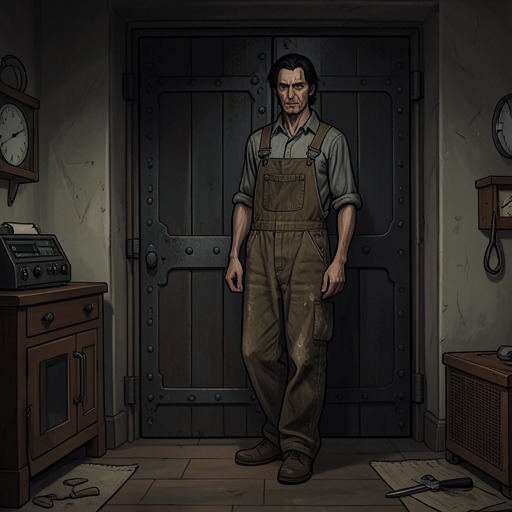
Baskerville family manuscript
The Hound of the BaskervillesThe Baskerville family manuscript is the family record that gives the hound legend its written form and connects an old story of violence to the danger surrounding the Baskerville inheritance. Its authority rests on a specific chain of custody and descent: Sir Charles Baskerville entrusted it to his friend and medical attendant, James Mortimer, and the manuscript presents its writer as a direct descendant of Hugo Baskerville.
Document and Custody
James Mortimer brought the old manuscript in his pocket to meet Sherlock Holmes and Dr. Watson. He explained that Sir Charles had committed the family paper to his care; Sir Charles had died suddenly about three months earlier. Mortimer had been both his personal friend and his doctor, making the document part of the personal legacy left in the wake of that death as well as a record of family history.
The paper was yellow, its writing faded, and its heading read Baskerville Hall above the date 1742. Holmes had recognized it as an old document before Mortimer produced it, estimating its age from the visible script; he pointed to the manuscript’s alternating long and short forms of the letter s as one clue. Mortimer then supplied the exact date, fixing the account within a particular historical moment rather than leaving it as an undated family tradition.
Mortimer described the text as a statement of a legend running in the Baskerville family and read it aloud because it was closely connected to the urgent matter he had come to discuss. The document’s opening establishes its claimed provenance through generations: its writer says that he descends directly from Hugo Baskerville and heard the story from his father, who had heard it from his own. The manuscript is therefore presented not as an eyewitness account by its author, but as a written link in a family chain of oral transmission.
The Legend and Its Warning
The manuscript locates the family’s origin story in the Great Rebellion, when Hugo Baskerville held Baskerville Hall. It depicts him as profane and cruel, and makes his violence—not simply his wild reputation—the beginning of the calamity. At Michaelmas, knowing that the yeoman and his sons were away, Hugo and five or six companions seized the yeoman’s daughter and carried her to the Hall. They shut her in an upper chamber while they drank and shouted below. In fear, she climbed down the ivy covering the south wall and crossed the three leagues of moorland toward her father’s farm.
Hugo and his companions pursued her across the moor. The manuscript’s account culminates in the appearance of a hound with blazing eyes and dripping jaws, which tears out Hugo’s throat as the men watch. The three flee in terror; one is said to die that night from what he saw, while the other two remain broken men for the rest of their lives. The hound’s attack makes the legend more than a tale of supernatural punishment: the daughter’s escape is followed by the pursuers’ ruin, and the family’s violence returns upon its instigator in a monstrous form.
The account turns that sequence into an explicit admonition to Hugo’s sons. Its writer urges them not to fear the past’s consequences so much as to guard against the foul passions that brought suffering upon the family. It invokes justice and sin, but also the possibility of forgiveness through prayer and repentance; inherited guilt is not presented as unavoidable if descendants change their conduct. The closing warning against crossing the moor in dark hours gives the family legend a practical rule, joining a moral lesson to the landscape where the tragedy unfolded.
A note at the manuscript’s end attributes it to Hugo Baskerville and says it was addressed to his sons, Rodger and John, with instructions that they tell nothing of it to their sister Elizabeth. That secrecy sits uneasily beside the document’s later role as a family warning: a record meant to preserve caution was itself restricted within the household. Its transmission thus carries both the legend and the limits placed on who could know it.
Succession and the Human Stakes
The manuscript’s account of an inherited family curse acquires a practical counterpart when the question turns to who would own the Baskerville estate. Sir Charles Baskerville’s property was worth close to a million pounds. Because the estate was entailed, it would pass to the next eligible heir; if Sir Henry Baskerville died, James Desmond, a distant cousin, would inherit it. The money could follow the estate unless its current owner chose otherwise. The legend’s language of family suffering therefore sits beside a concrete succession whose value gives the danger surrounding the family an unmistakable financial dimension.
Sir Henry had not yet made a will, having learned only the previous day how matters stood. He nevertheless believed that the money should remain with the title and property, as Sir Charles had intended, so that the next owner could maintain the estate. Holmes recognized the scale of the inheritance as a stake for which someone might play a desperate game. The manuscript itself does not establish anyone’s legal claim or identify a criminal; its importance lies in the way its hereditary warning frames a modern crisis whose decisive pressures include wealth and succession.
That contrast sharpens when Holmes later connects the apparent family likeness in a portrait to the succession. His inquiries establish that the man living as Stapleton was a son of Rodger Baskerville, Sir Charles’s younger brother, and thus a Baskerville with designs on the inheritance. The discovery makes the manuscript’s emphasis on descent resonate with the case, but in a different register: the written legend preserves a moral explanation for the family’s misfortunes, while the investigation uncovers a present-day human plot driven by the estate. Holmes also identifies a practical obstacle to claiming it: Stapleton would have had to explain why he had lived near the property under another name. The manuscript’s place in the story is consequently not that of proof of the supernatural, but of an inherited narrative set against the concealed identity and calculated interests that threaten the family in the present.
Narrative Framing and Evidentiary Limits
The manuscript reaches the reader through several layers of transmission rather than as a direct record of the events it describes. Its writer claims descent from Hugo Baskerville and says the tale came down through his father and grandfather; the closing note, in turn, associates the document with Hugo’s message to his sons. That layered attribution gives the paper two functions: it preserves a story passed across generations and presents the story as a warning originating within the family. Its dated, aged paper establishes the document as a historical object, but does not by itself verify the supernatural events within the legend.
The act of reading also sets the old narrative against the present investigation. James Mortimer introduces it as relevant to an urgent modern matter, yet it remains a family account whose moral and emotional force exceeds what it can prove. After Mortimer finishes, Sherlock Holmes responds with a yawn, a small but telling contrast between the legend’s elaborate horror and the investigator’s reserve. The manuscript supplies a powerful inherited frame for interpreting danger; the case must still be resolved through evidence beyond the story it preserves.