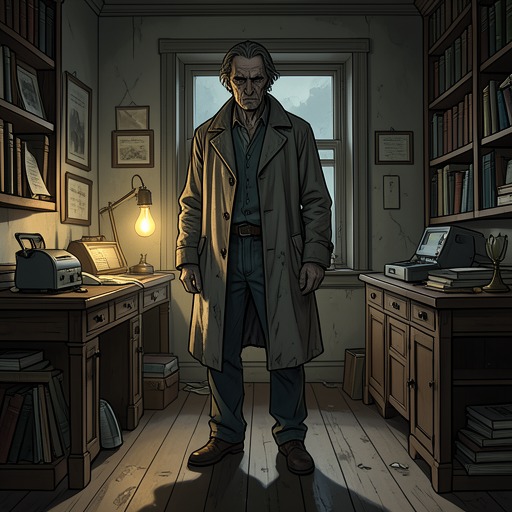
Baskerville family warning against crossing the moor at night
The Hound of the BaskervillesThe Baskerville family warning against crossing the moor at night is both a caution preserved in a family manuscript and a rule that gains immediate practical force in the present-day investigation. First framed as protection against a supernatural family curse, it shapes Sir Charles Baskerville’s fears and is later repeated by Sherlock Holmes to Sir Henry Baskerville. The investigation ultimately disproves the supernatural explanation without making the warning irrelevant: darkness, hazardous terrain, and a deliberately staged hound give the old counsel a real-world basis.
Origin in the Family Manuscript
The warning appears at the close of a narrative attributed to Hugo Baskerville’s descendant, who says the account has passed through his family from father to son. Addressing his own sons, the writer treats the story not simply as a record of the past but as a lesson for the next generation. He urges them not to fear the past’s consequences but to guard against the passions that had brought suffering upon the family, and places hope in repentance and divine forgiveness.
That moral framing leads to a specific instruction: the sons should avoid crossing the moor during the dark hours, when, according to the manuscript, evil powers are exalted. The advice follows a tale of family violence and uncanny retribution, and presents avoidance as a form of prudence in the face of a frightening inherited history. The document is addressed to Rodger and John, with instructions that they keep it from their sister Elizabeth; it therefore records a family warning intended for a limited audience, not a public rule.
Inheritance of Fear
The manuscript’s caution becomes consequential through the way later Baskervilles interpret it. Sir Charles takes the legend deeply to heart. According to Dr. Mortimer, he would walk on his own grounds but would not venture onto the moor at night, and he was convinced that a dreadful fate hung over his family. He repeatedly asked Dr. Mortimer whether he had seen a strange creature or heard a hound at night. The warning thus operates not only as inherited advice but as a framework through which Sir Charles understands unexplained sounds and sights.
After Sir Charles’s death, Dr. Mortimer reports accounts of a huge, luminous, spectral creature seen on the moor by several local witnesses. Their testimony sustains the community’s fear, while the legend itself supplies a ready interpretation: the apparition seems to confirm the family’s inherited danger. When Stapleton later asks Sir Henry about the fiend dog, he notes that many local people claim to have seen it and suggests that the story contributed to Sir Charles’s end. The warning’s force therefore spreads beyond the family: local belief turns an old household narrative into a broader expectation of peril after dark.
Holmes Repeats the Caution
Holmes invokes the manuscript’s advice when Sir Henry is about to leave for Baskerville Hall. He specifically warns him not to go about alone and recalls the instruction to avoid the moor during the dark hours. The repetition gives the old rule a new function. Holmes does not present it simply as proof that the family curse is true; in the context of his investigation, it is also a precaution for a living person who may be in danger.
The moor provides concrete reasons for caution. Holmes studies a large-scale map showing Baskerville Hall, the Yew Alley, Grimpen village, scattered farms, and the distant prison of Princetown across an extensive, sparsely inhabited landscape. Stapleton warns Dr. Watson against trying to cross certain stretches: their bright green patches mark ground that can be fatal, and safe passage depends on remembering complicated landmarks. The supernatural language of the manuscript may be mistaken, but the landscape is not benign. Darkness makes navigation and escape harder in a place where a wrong step can have grave consequences.
The warning is not followed as an absolute prohibition. Pursuing the escaped convict at night, Watson and Sir Henry move across the moor toward a candle concealed among rocks. Their action is a deliberate risk undertaken to follow a signal and find their quarry, not evidence that the terrain has become safe. The scene makes the distinction implicit in Holmes’s advice: a dangerous crossing may be attempted for a reason, but it calls for vigilance rather than casual confidence.
Reinterpretation of the Rule
The investigation eventually explains how the supposed hound acquired its supernatural appearance. Holmes identifies the luminous mixture used to disguise the animal and connects the device to the family legend: the story gave the deception its form, while the fear it inspired helped make the disguise effective. The warning’s supernatural premise is therefore overturned. The apparent confirmation of the curse had been engineered, and the inherited story had provided a means of frightening and misleading people.
Yet the rule retains a practical truth. The moor’s bogs and deceptive routes remain dangerous, and the staged hound made its nighttime crossings more threatening still. The episode in which a dense fog drifts over Grimpen Mire shows how quickly conditions can restrict movement and obscure safe ground; later, signs at the abandoned mine reveal where the animal had been kept. The warning survives this explanation not as evidence of evil powers but as an inherited response to a landscape and a human scheme capable of real harm. Its significance lies in that double history: a family superstition governs perception, while the danger it names is partly manufactured and partly physical.