Death of Sir Charles Baskerville
The Hound of the BaskervillesThe Death of Sir Charles Baskerville is both the apparent natural death of a wealthy country gentleman and the concealed crime that sets the investigation in motion. Found at the far end of Yew Alley after his nightly walk, Sir Charles was pronounced dead from cardiac exhaustion; yet a trail of footprints and a detail omitted from the public account undermined that conclusion. Dr. Mortimer’s later disclosure of a gigantic hound’s tracks transformed an apparently settled death into the central mystery surrounding the Baskerville inheritance.
Background and Stakes
Sir Charles had lived at Baskerville Hall for only about two years, but his generosity had won him local affection. A widower and childless, he had made his fortune through South African speculation and returned to England with the money, intending to restore the fortunes of his old family and improve the estate. His plans included extensive reconstruction, and he had also given generously to local and county charities. His death therefore interrupted both a programme of work and a relationship between the estate and the surrounding community.
The death also carried substantial financial consequences. The estate was valued at close to a million pounds. Sir Charles’s nephew, Sir Henry Baskerville, was the expected heir if he was alive; if Sir Henry died, the entailed estate would pass to distant cousins, the Desmonds. The money could be disposed of by will, but Sir Henry later said he believed it should remain with the title and property. This succession made the death more than a private bereavement: it placed a large fortune and the future of Baskerville Hall within reach of whoever could alter the line of inheritance.
Before Sir Charles died, his health had already caused concern. His heart was affected, and Dr. Mortimer observed changes in colour, breathlessness, and periods of acute nervous depression. Sir Charles also lived under persistent anxiety, which Dr. Mortimer believed was worsening his condition. On medical advice, he was preparing to leave for London, where a change of scene might help him recover. His planned departure gave the last evening a particular turn: he had ordered Barrymore to prepare his luggage, but never made the journey.
The Last Walk
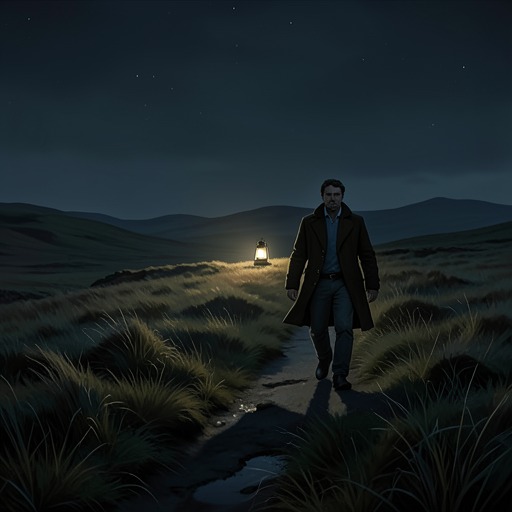
On the night of May 4, Sir Charles followed his established routine, walking down Yew Alley before going to bed and smoking a cigar as he went. The day had been wet, so his footprints were clearly visible. At the gate that led from the alley onto the moor, the tracks indicated that he had paused for some time. From there he continued toward the far end of the walk, where his body was later found.
At midnight, when Sir Charles had not returned and the hall door remained open, Barrymore became alarmed. He took a lantern and searched for his master, tracing the footprints along the wet ground. The reported pattern changed after Sir Charles passed the moor gate: from that point, he seemed to have walked on his toes. The observation was strange but initially offered no clear explanation. A horse-dealer named Murphy was on the moor nearby and later said he had heard cries, though he could not identify where they came from; he had also been drinking.
Barrymore sent the groom Perkins on horseback to Dr. Mortimer, who arrived at Baskerville Hall within an hour. Mortimer retraced the route, examined the ground and the body, and confirmed the details later presented at the inquest. Sir Charles lay face down, his arms outstretched and fingers dug into the ground. His features were so altered by strong emotion that Mortimer initially struggled to recognize him. He found no physical injury, and the soft gravel showed no other nearby tracks apart from Barrymore’s.
The Official Account and Its Omission
The inquest accepted the medical explanation. A post-mortem examination showed longstanding organic disease, and the coroner’s jury returned a verdict consistent with death from cardiac exhaustion. The facial distortion, which had so disturbed Mortimer, was treated as a possible symptom of breathlessness and heart failure. Sir Charles’s impaired health, the lack of visible injury, and the medical findings together made natural causes plausible to the authorities.
A newspaper account presented the death as sufficiently explained and rejected local rumours of a supernatural cause. It reported Barrymore’s statement that there were no other traces around the body. Mortimer later clarified the distinction: Barrymore had not noticed the tracks, but Mortimer had. Some distance from the body, he saw fresh, clear footprints belonging to a gigantic hound. The difference between what the inquest recorded and what Mortimer had personally observed left the most consequential evidence outside the official explanation.
The tracks did not by themselves identify who had brought the hound to Yew Alley or establish exactly how it caused Sir Charles’s death. They did, however, change the terms of the case. The apparent natural death now had to be considered alongside a large animal’s presence, the pause at the moor gate, and the altered pattern of Sir Charles’s steps. The local legend supplied a supernatural interpretation, but Mortimer’s physical observation also made a human explanation unavoidable.
Reinterpretation and Consequences
The death initially appeared to be a medical tragedy followed by a straightforward inheritance. Its consequences instead opened a dangerous succession dispute. Sir Henry chose to go to the family home despite being warned that the danger might come from either the family legend or human beings, and Dr. Watson was asked to accompany him rather than let him travel alone. The hidden significance of Sir Charles’s death thus shaped the next heir’s arrival and the precautions taken to protect him.
Later in the investigation, Holmes connected the hound to a deliberate scheme. He reasoned that the animal might frighten a victim into death, or at least paralyze resistance, and referred to the old uncle as having been frightened to death by a hound. He also examined the problem of how Stapleton could claim the inheritance while having lived near the estate under another name. In this later account, the hound’s tracks cease to be merely an uncanny detail: they point toward an instrument of human design, while the inheritance supplies the material stakes behind the danger.
The case’s force comes from the collision of two accounts of the same scene. The coroner’s verdict was supported by real evidence of heart disease, yet it did not encompass all that Mortimer had seen. The walk, the gate, the changed tracks, and the hound’s prints leave the death poised between medical explanation and deliberate violence until the investigation can connect the clues. Sir Charles’s death is therefore not only the event that transfers attention to Sir Henry; it is the buried crime whose apparent simplicity allows the threat to continue.