Dr. Watson
The Hound of the BaskervillesDr. Watson is both Sherlock Holmes’s trusted field companion and the principal recorder of the Baskerville investigation. In Devon, he is asked to observe without prematurely theorizing: his reports preserve the uncertainty of events as they unfold, while his patient attention to people, rooms, and small signs supplies the facts from which Sherlock Holmes builds his explanation. His narration makes the case not simply a sequence of deductions but an accumulating record of what it was possible to know at each moment.
Identity and Working Method
Dr. Watson’s attention to physical evidence is established at Baker Street in London. When he finds James Mortimer’s substantial, silver-banded walking stick, he examines its inscription and appearance before Sherlock Holmes asks what he makes of it. Later, Dr. Watson consults a medical directory to check James Mortimer’s age and professional history, reading aloud his record as a country medical officer in Grimpen and neighboring parishes, his hospital appointment, and his scientific publications. The exchange shows Dr. Watson contributing practical verification to Sherlock Holmes’s more speculative deductions. He is not merely present while the detective reasons: he tests an inference against an available reference and reports what the record actually contains.
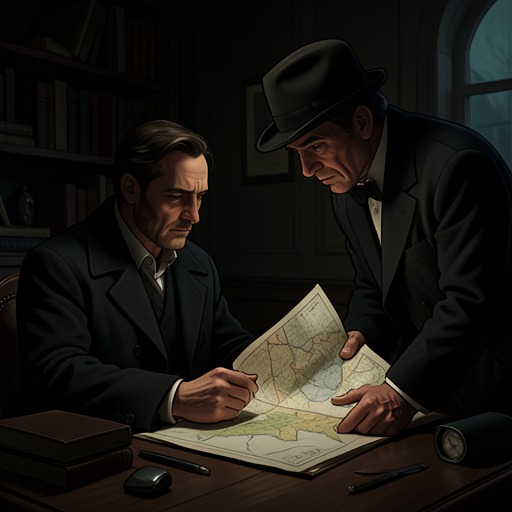
That balance between independent observation and trust in Sherlock Holmes governs their partnership. When Sherlock Holmes asks Dr. Watson to spend the day away so that he can concentrate on the newly submitted problem, Dr. Watson understands that solitude is part of his friend’s investigative method. He returns in the evening to find the sitting room clouded with smoke from strong tobacco and Sherlock Holmes surrounded by rolls of paper. The episode places Dr. Watson in a complementary role: he can recognize the labor behind a deduction, even when he is not included in its private stages.
Assignment to Baskerville Hall
Dr. Watson agrees readily to accompany Sir Henry Baskerville to Baskerville Hall, drawn both by the promise of adventure and by Sherlock Holmes’s confidence in him. Sherlock Holmes asks him to report carefully and says he will direct his actions if a crisis arises. At the station, as the party prepares to leave for Devon, Sherlock Holmes gives a more exact instruction: Dr. Watson is to report facts fully and leave the theorizing to him. The distinction defines Dr. Watson’s task. His value lies in sustained, candid observation rather than in trying to imitate Sherlock Holmes’s conclusions.
The journey also gives Dr. Watson a place beside Sir Henry Baskerville, whose return to his ancestral home is itself new territory. Sir Henry Baskerville says he had never seen Baskerville Hall, having gone from the south coast to a friend in America after his father’s death; the moor is unfamiliar to him as well. Dr. Watson therefore travels not only as an investigator but as a companion to the new baronet as he encounters the landscape and household. At Baskerville Hall, the butler Barrymore tells Sir Henry Baskerville that he and his wife had been deeply attached to Sir Charles Baskerville and that his death has made the house painful to them. Dr. Watson’s account preserves this human response alongside the case’s suspicious evidence.
The Field Observer and Letter Writer
From the investigation’s turn toward the moor, Dr. Watson changes the form of his narrative. He transcribes his letters to Sherlock Holmes, explaining that they preserve his feelings and suspicions at the time more accurately than later recollection. One page is missing, but otherwise the letters are presented as written. The choice makes the reports both evidence and a record of limited knowledge: the reader encounters Dr. Watson’s impressions before the underlying explanations are available.
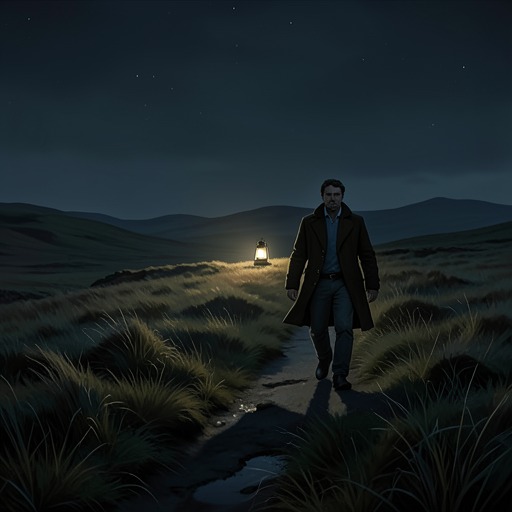
His October 13 report shows how he separates what he sees from what he suspects. He describes Barrymore’s stealthy, barefoot passage down the corridor at about two in the morning, a candle in his hand. Following him around the balcony, Dr. Watson sees him enter an unoccupied room and stand at its window, holding the candle against the glass as he watches the darkness of the moor. Barrymore eventually groans, extinguishes the light, and returns along the passage; later, Dr. Watson hears a key turn but cannot tell where. The observation leaves the purpose of the signal unresolved. Dr. Watson admits that he cannot yet explain it and withholds his theories because Sherlock Holmes has requested facts.
When Barrymore’s wife appears and insists that the secret activity is not directed against Sir Henry Baskerville, Dr. Watson witnesses the revelation that transforms his earlier observations. Eliza Barrymore explains that the fugitive Selden is her younger brother. She and Barrymore had taken him in after his escape from prison, fed and cared for him, and helped him hide on the moor. Every second night they placed a light in the window to learn whether he remained nearby; if he answered, Barrymore carried him bread and meat. Dr. Watson’s narrative thus records not only the clue but its correction: what had looked like a plot against the household was a clandestine effort to protect a wanted relative.
Pursuing Leads and Rejoining Sherlock Holmes
By October 18, Dr. Watson has established two facts that sharpen his next inquiries: Laura Lyons had written to Sir Charles Baskerville and arranged to meet him at the place and time of his death, and the mysterious man on the moor was hiding among the stone huts on the hillside. With Sir Henry Baskerville left at home, Dr. Watson goes alone to Coombe Tracey to question Laura Lyons, judging that a less formal visit may yield more information. His decision brings him into the investigative work directly, while the record makes clear that he is acting on discoveries rather than on a complete understanding of the case.
Other observations extend his search across the landscape. At Frankland of Lafter Hall’s house, Dr. Watson looks through a powerful telescope and sees a boy carrying a small bundle up a hill. The boy glances around furtively before disappearing over the crest. The sight gives physical form to the possibility that someone is supplying the hidden man, but Dr. Watson still has to follow the trail rather than infer its end from a distance.
When Dr. Watson meets Sherlock Holmes on the moor, he is still resentful of having been deceived about Sherlock Holmes’s presence there. Sherlock Holmes’s praise eases his anger, and Dr. Watson recognizes that concealment had served their purpose. As dusk falls and they retreat to a hut for warmth, he recounts his conversation with Laura Lyons. Sherlock Holmes says that her information fills a gap in the case and identifies her close intimacy with Stapleton as an important connection. Dr. Watson’s report therefore becomes the bridge between his separate field inquiry and Sherlock Holmes’s developing explanation.
Narrative Role and Retrospective Account
Dr. Watson’s contribution continues after the danger in Devon. At the end of November, back in Baker Street in London, he waits until Sherlock Holmes has completed other cases before asking for an account of the Baskerville mystery. Sir Henry Baskerville and James Mortimer have called that afternoon, before setting out on the long voyage recommended for Sir Henry Baskerville’s recovery. Sherlock Holmes says that conversations with Mrs. Stapleton have clarified the case, and offers to reconstruct its course from memory. Dr. Watson supplies the listening and questioning frame for that final explanation, while his earlier letters remain the contemporaneous record of uncertainty, misreading, and discovery.
The contrast between these two modes of narration is central to Dr. Watson’s role. His reports unfold close to the events, preserving the candle at the window, the figure on the hill, and the decisions made with incomplete information. Sherlock Holmes’s later account rearranges those details into a causal history, identifying Stapleton as a Baskerville descended from Sir Charles Baskerville’s younger brother and explaining his designs on the succession. Dr. Watson is therefore both participant and chronicler: his disciplined factual record enables the eventual solution, while its human immediacy shows how a mystery looks before its scattered signs can be joined.