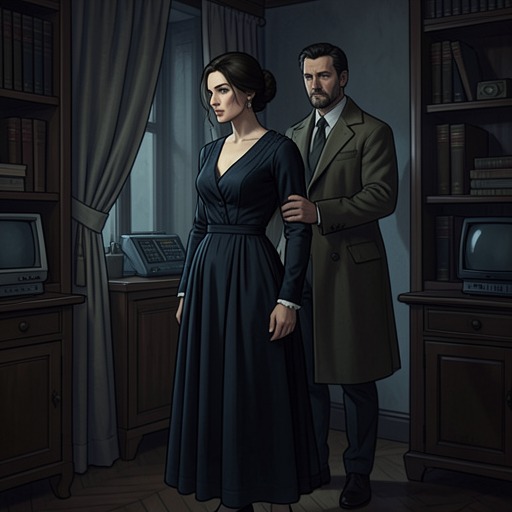
Henry's proposal to Beryl and Stapleton's interference
The Hound of the BaskervillesHenry's proposal to Beryl and Stapleton's interference is a courtship interrupted on the open moor, where Dr. Watson’s duty to protect Sir Henry collides with the young baronet’s wish for privacy. The scene initially appears to reveal an overprotective brother thwarting a promising match; its later settlement grants the pair a limited reprieve but leaves Beryl’s own wishes uncertain. Set against the danger surrounding Sir Henry and the fortune attached to his inheritance, the episode makes romance another contested form of choice and control.
Background and Stakes
Sir Henry has come to the moor despite the danger discussed in London. When Sherlock Holmes warned that he must not go alone, Dr. Watson was assigned to stay with him. Sir Henry’s determination to act for himself is consistent with his earlier insistence that neither a family legend nor a human threat would prevent him from going to his family home. The proposal therefore unfolds within a larger struggle between his independence and the precautions imposed by others.
The inheritance gives that struggle material weight. The estate is worth close to a million, and the land and property are entailed; the money could be disposed of by a will. Sir Henry has made no will, but says he believes the money should remain with the title and estate so the property can be maintained. Sherlock Holmes consequently insists that he should not travel alone. The courtship is not presented as separate from this atmosphere of danger: Sir Henry is both a man pursuing a relationship and the vulnerable heir whose safety has become a matter of urgent concern.
The Meeting on the Moor
When Sir Henry tells Dr. Watson that he must go out alone, Watson is caught between respecting his friend’s wishes and obeying Sherlock Holmes’s instructions. Sir Henry leaves with his cane before Watson has settled what to do. Worried that he may have failed in his responsibility, Watson follows toward Merripit House, then climbs a hill beside a dark quarry to look across the moor. From there, about a quarter of a mile away, he sees Sir Henry walking slowly with Beryl Stapleton. Their appointment and absorbed conversation make Watson suspect that they already understand one another, though from his distant vantage he cannot hear their words.
Watson initially keeps his distance because intruding on a private conversation seems improper, even as remaining apart leaves him unable to help quickly if danger appears. The scene acquires a second observer: a green wisp moving above the broken ground, carried on the stick of Stapleton’s butterfly-net. Stapleton is nearer to the pair than Watson and moves toward them. Sir Henry draws Beryl to his side and puts an arm around her; she appears to strain away, turn her face aside, and raise a hand as if to protest. Those gestures are visible to Watson, but their precise meaning is not yet clear to him.
Stapleton runs up, gesticulating with the net dangling behind him, and interrupts the pair. From the hill, Watson sees an angry exchange: Sir Henry appears to offer explanations, growing angrier as Stapleton refuses to accept them, while Beryl stands silent. Stapleton then sharply summons her away. After an uncertain glance toward Sir Henry, she leaves beside her brother. Stapleton’s anger appears to include her, too. Sir Henry watches them go and walks back slowly, head lowered. The interruption thus leaves Watson with a sequence of clear actions but an unclear explanation.
Sir Henry’s Account and the Reconciliation
Watson meets Sir Henry and openly admits that he followed him and watched the encounter. Sir Henry’s anger briefly flashes, but Watson’s frankness disarms it. Sir Henry describes himself as deeply attached to Beryl and says he believed she was happy in his company. He also reports that she used their private meeting to urge him to leave the dangerous place, not to discuss love. He replied that he was in no hurry to go and proposed that she leave with him; before she could answer, Stapleton arrived.
In Sir Henry’s account, Stapleton challenged his right to show Beryl attention and asked whether he assumed his title allowed him to do as he pleased. Sir Henry answered that he was not ashamed of his feelings and hoped Beryl would become his wife. He says he lost his temper when Stapleton continued to oppose him. His account emphasizes his own affection and the abruptness of the interruption, but it cannot settle what Beryl would have chosen: she did not answer his proposal before Stapleton took her away, and Watson’s observation had already registered her apparent effort to draw away from Sir Henry.
The next afternoon, Stapleton visits to apologize. After a long private conversation with Sir Henry, the breach is declared healed, and the men plan to dine at Merripit House the following Friday as a sign of reconciliation. Stapleton’s explanation, as Sir Henry relays it, is that Beryl is everything in his life and that the prospect of losing her came as a shock. He acknowledges that it was selfish to imagine he could keep her to himself for her whole life, and says he would rather she married a neighbour such as Sir Henry than anyone else. Nevertheless, he asks Sir Henry to let the matter rest for three months and cultivate Beryl’s friendship without claiming her love. Sir Henry agrees.
Consequences and Narrative Significance
The agreement changes an explosive confrontation into a temporary, negotiated pause. Sir Henry accepts a limit on his pursuit, while Stapleton withdraws his opposition on conditions that still place him between the couple. The reconciliation seems to explain his earlier outburst, but it does not provide Beryl’s own account of either the proposal or the bargain. Her warning that Sir Henry should leave, her apparent resistance during the embrace, and her silence after Stapleton’s interruption remain important counterpoints to the men’s explanations.
For Dr. Watson, the episode is also a test of his role as observer and companion. He follows against Sir Henry’s expressed wish to be alone, watches from a distance rather than interrupting, and then risks Sir Henry’s displeasure by confessing what he saw. His account preserves the distinction between witnessed conduct and reported motive: he can describe Stapleton running in, Beryl being led away, and Sir Henry’s dejection, but the cause of the quarrel emerges only afterward through Sir Henry’s report of Stapleton’s apology. The episode therefore advances the courtship while keeping its emotional and practical terms unsettled, and it adds a personal conflict to the wider danger that makes Sir Henry’s movements consequential.