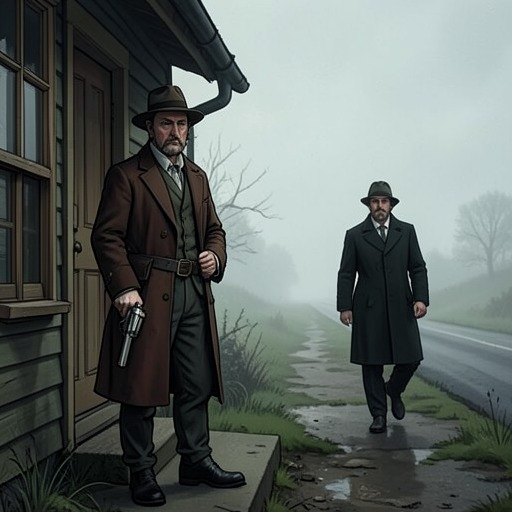
Holmes’s warning against crossing the moor alone
The Hound of the BaskervillesHolmes’s warning against crossing the moor alone is a practical rule for surviving terrain where apparent routes can conceal lethal hazards. Its force lies not in a blanket prohibition but in the contrast between uninformed movement and a route taken under strict instructions: Sir Henry Baskerville is told to walk alone only along one specified path, for a reason Holmes considers essential.
The Moor as a Hazardous Landscape
Holmes’s large-scale map places Baskerville Hall amid sparse, widely separated settlements and the desolate moor. Within five miles of the Hall, the map shows only a few scattered dwellings; Grimpen lies nearby, while Lafter Hall and two moorland farmhouses mark other isolated points. Princetown’s convict prison is fourteen miles away. The map makes the setting legible in outline, but knowing where places lie does not make the intervening ground safe to cross.
A striking example is the northern plain, where bright green patches look more fertile than the surrounding land. Their inviting appearance is deceptive: Stapleton explains that the area has cost several people their lives. The moor’s hazards cannot be read reliably from a distance, and a traveler who mistakes treacherous ground for firm passage may not return. A safe crossing depends on recognizing complex landmarks, not simply choosing the most direct-looking line.
The danger becomes especially acute after dark. During the pursuit of the fugitive, Dr. Watson and Sir Henry advance through darkness toward a single candle set among rocks and shielded from view except in the direction of Baskerville Hall. Although the light seems at times distant and at times close, it does not reveal the route between them and its source. The episode shows how darkness distorts distance and limits what travelers can know about their surroundings.
From General Caution to a Direct Rule
Holmes’s instructions to Sir Henry draw on this landscape knowledge and on earlier warnings against solitary travel. When Sir Henry recalls that Holmes has repeatedly cautioned him not to cross the moor alone, the objection confirms that the rule is already familiar to him. The new instruction does not cancel that caution; it defines a narrow exception, with the route and circumstances controlled in advance.
Holmes makes the restriction explicit: Sir Henry is to leave Merripit House on foot and take the straight path leading to the Grimpen Road, going in no other direction across the moor. The precision matters. Permission to walk is not permission to explore, improvise, or choose another crossing. Sir Henry accepts the instruction and promises to follow it exactly, turning Holmes’s warning into a concrete boundary on his movements.
That boundary is reinforced by the way Holmes frames the decision. He tells Sir Henry to remain at the Hall because it is his post of duty and because he has given his word to obey. Only after Sir Henry agrees to stay does Holmes direct him to make the later walk. Safety here is tied both to terrain and to disciplined compliance: the same moor that must ordinarily be avoided alone may be crossed when Holmes specifies the permitted route and requires Sir Henry to keep to it.
Why the Exception Is Necessary
The exception belongs to a larger operation, not to a change in Holmes’s estimate of the danger. He arranges for Sir Henry to drive to Merripit House, send the carriage back, and walk home. Holmes calls the walk essential, while assuring Sir Henry that he may undertake it safely if he follows the prescribed path. The evidence establishes the necessity of the plan and the limits placed on it; it does not make the moor itself less hazardous.
Holmes also manages what Sir Henry knows. Before the walk is arranged, he instructs Dr. Watson not to tell Sir Henry about the hound. Sir Henry is to believe the account of Selden’s death as Stapleton would have him believe it, so that he will retain his nerve for the ordeal ahead. This secrecy and the route instruction form part of the same protective management: Holmes controls both the information Sir Henry receives and the ground he is permitted to cross.
The landscape remains capable of changing the conditions around the plan. Over Grimpen Mire, a dense white fog drifts toward the observers and gathers like a wall; Holmes watches its slow movement impatiently. The fog’s advance underlines that even a known route exists within an environment whose visibility and conditions can shift. The rule therefore depends on more than courage: it depends on limits, guidance, and attention to the ground.
Function in the Narrative
The warning establishes a practical contrast between bravery and safe judgment. Sir Henry is willing to walk across the moor, but willingness alone cannot make the journey survivable. Holmes’s instructions convert a general danger into a specific procedure: stay when ordered, walk only when the plan requires it, and do not leave the designated path.
The rule also makes the moor an active constraint on the investigation rather than a passive backdrop. Its hidden hazards, deceptive lights, sparse settlements, and encroaching fog shape where people can go and what they can perceive. Holmes’s authority in this setting rests partly on recognizing those limits. His carefully restricted exception preserves the warning’s force: the crossing is permitted not because solitary travel has become safe in general, but because this particular walk has been deliberately bounded.