Inspector Lestrade
The Hound of the BaskervillesInspector Lestrade is the London professional detective whom Sherlock Holmes summons when the investigation reaches its decisive operational stage. His arrival brings police assistance to Holmes and Dr. Watson’s planned trap, and his conduct during the night pursuit shows both the limits of his composure before the hound and his practical value in the rescue and search that follow.
Identity and Introduction
Lestrade comes from London by express after Holmes has sent a telegram requesting his assistance. The message says that he is coming down with an unsigned warrant and will arrive at five-forty. The warrant signals that police authority is being brought into the operation, but its unsigned status does not establish that an arrest can yet be made. Holmes regards Lestrade as the most capable of the professional detectives and anticipates that his assistance may be needed.
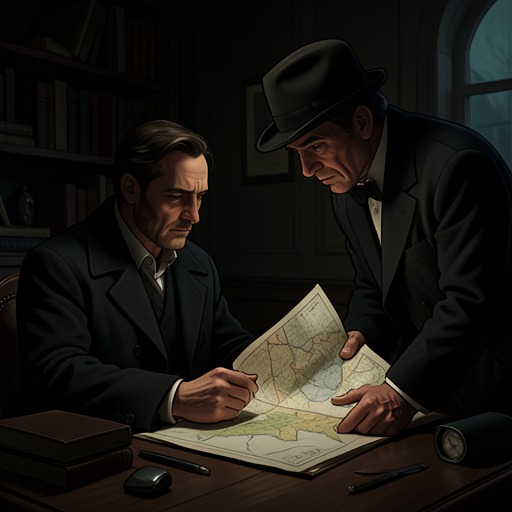
The account presents him through Dr. Watson’s observation rather than through an independent history. Watson describes a small, wiry man whose appearance suggests a bulldog. When Lestrade joins Holmes and Watson at the station, all three shake hands. Watson notices that Lestrade now regards Holmes with reverence, a marked change from the scorn that practical detectives had once shown toward Holmes’s theories. The contrast gives their reunion a professional history without detailing its earlier cases: Holmes’s methods have won a respect that was not initially granted.
Arrival During the Investigation
Lestrade joins an inquiry already shaped by Holmes’s effort to turn suspicion into evidence. Holmes has explained to Watson that they cannot yet prove a connection between the hound and the death of Sir Charles Baskerville. The dog has been heard but not seen in pursuit of Sir Charles, and the absence of a direct link leaves the case vulnerable in court. Holmes therefore plans to risk using Sir Henry Baskerville as bait in order to establish a case against the person behind the hound.
The timing of Lestrade’s arrival places him in the transition from investigation to action. Holmes and Watson have already formed a plan and are preparing to mislead their opponents about their movements; Lestrade’s police presence strengthens the group for the coming confrontation. On meeting him, Holmes tells him that the matter is exceptionally important and proposes that they spend the evening on the moor. Lestrade thus enters not as the investigator who has solved the mystery, but as a trusted professional called in to help carry out a dangerous plan.
The Night Pursuit
During the ambush, Lestrade crouches with Holmes and Watson among the stones as they wait for Sir Henry to pass through the fog. When Holmes warns that the hound is coming and cocks his pistol, Lestrade reacts with a yell of terror and throws himself face down. The scene makes plain that the apparition’s appearance can overwhelm even an experienced detective; professional standing offers no immunity to the shock of confronting the creature in the darkness.
Holmes and Watson fire as the hound races after Sir Henry. Lestrade is present when the creature is struck and when Holmes leads the pursuit up the track. Watson describes Holmes as outpacing him and himself as outpacing the smaller professional, placing Lestrade behind both in the run. The hound reaches Sir Henry before they do, but Holmes’s subsequent shots kill it and the group reaches the baronet in time to find no wound. Lestrade then uses his brandy flask to help revive him. His contribution is practical and immediate: he assists at the scene and helps care for the rescued man rather than directing the chase.
The House Search
After the encounter, Holmes concludes that Stapleton may have followed the hound to call it off, but warns that he may already have escaped. Lestrade accompanies Holmes and Watson into the house to search. The front door is open, and the rooms are dark apart from the dining room; Holmes takes a lamp and checks the house while the others search with him.
Upstairs, Lestrade detects movement behind a locked bedroom door and alerts his companions that someone is inside. Holmes breaks the door open, and all three enter. The evidence establishes Lestrade’s role in noticing this sign and joining the entry, but does not disclose what they find in the room. His final appearance in the supplied account therefore ends with the search in progress, not with a recorded arrest or explanation.
Character and Narrative Role
Lestrade’s part in the episode is defined by the difference between professional evidence and immediate danger. Holmes has delayed arrest because suspicion alone cannot prove the hound’s connection to the crime; the unsigned warrant brought from London likewise does not, by itself, resolve that evidentiary problem. Lestrade arrives as police support at the moment when the investigators hope to obtain stronger proof, but the decisive confrontation still depends on the group’s coordinated actions and Holmes’s plan.
The narrative also uses Lestrade to register Holmes’s changing standing. Watson remembers earlier scorn for Holmes’s reasoning, while Lestrade’s reverent regard at the station indicates how far that reputation has shifted. Yet Lestrade remains distinct from Holmes: he is identified with professional practice, reacts physically to the hound’s appearance, and contributes through assistance, observation, and the search of the house. The characterization is brief but functional. He brings the authority and practical presence of the police into the final movement of the investigation, while the account leaves the central deductions and the design of the trap with Holmes.