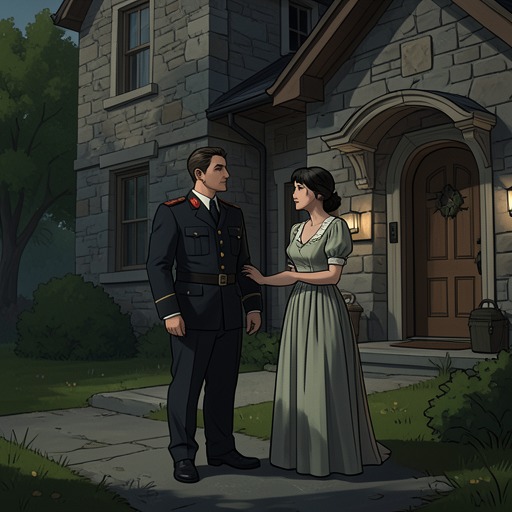
John Barrymore
The Hound of the BaskervillesJohn Barrymore is the butler at Baskerville Hall, where generations of his family have served the Baskervilles. A tall, distinguished-looking servant with a square black beard, he is first associated with the final days of Sir Charles Baskerville and then with the uneasy arrival of Sir Henry Baskerville. His secret night-time signals across the moor seem to point toward a conspiracy, but their purpose is to help his wife protect her escaped brother, Selden. The apparent mystery of Barrymore’s conduct thus turns on competing forms of loyalty: his long service in the house and his commitment to his wife’s family.
Identity and Service
At the time of Sir Charles Baskerville’s death, Barrymore serves as butler, while his wife, Eliza Barrymore, is housekeeper. The pair are the indoor staff at Baskerville Hall. In the account of the death presented after the inquest, their evidence helps establish Sir Charles’s impaired health: he had suffered changes of colour, breathlessness, and attacks of nervous depression. The report treats this testimony, supported by accounts from friends, as consistent with death from natural causes rather than foul play. Barrymore is therefore introduced not as an outsider to the household but as one of the people whose knowledge of its routines informs the public explanation of the death.
Barrymore’s service is also a family inheritance. Sir Henry understands the connection to have lasted for several generations and says that the Barrymores have lived under the family roof for more than a hundred years. That history gives his first exchanges with the new master the weight of more than an ordinary employment arrangement. The household’s continuity depends in part on a servant who knows its customs, rooms, and private rhythms; at the same time, Sir Henry’s succession changes the conditions under which that service is expected to continue.
Arrival of Sir Henry
When Sir Henry takes possession of Baskerville Hall, Barrymore greets him with formal attentiveness. He has seen to the luggage and asks whether dinner should be served, then explains that he and his wife would be happy to remain until Sir Henry has made new arrangements. He also points out that Sir Charles had lived a retired life and that the household would need a larger staff if the new master wanted more company. His practical remarks register the transition from one owner’s way of living to another’s before the personal cost of that transition is made clear.
Sir Henry initially resists the idea of ending the old connection. Barrymore’s response reveals how strongly the couple remain attached to the dead master: they were both fond of Sir Charles, his death shocked them, and the surroundings at Baskerville Hall have become painful. Barrymore fears that neither he nor his wife will ever again feel at ease there. Although he says they expect to establish themselves in a business, he emphasizes that Sir Charles’s generosity has given them the means to do so. Their prospective departure is thus framed not as a simple disagreement with Sir Henry, but as grief entangled with a long-standing dependence and affection.
The adjustment is not entirely smooth. After Sir Henry questions him, Barrymore appears concerned that his confidence has been forfeited. Sir Henry reassures him by giving him a considerable part of his old wardrobe, by then superseded by his London clothes. The gesture is a small but telling effort to preserve goodwill between master and servant: suspicion has entered their relationship, but Sir Henry still responds with a practical form of generosity.
Suspicion in the House
Barrymore’s appearance makes him an immediate candidate for suspicion when a dark-bearded man is reported to have followed someone. Asked whether he knows anyone on Dartmoor with a full black beard, Sir Henry names the butler. The identification supplies a possible lead, not proof of what Barrymore has done. His conspicuous beard and trusted place inside the household make him easy to connect with a threat, even as the evidence at this point leaves the connection unresolved.
Watson’s account of a later night intensifies that unease. Around two in the morning, he hears a stealthy step and sees a tall figure moving along the corridor in shirt and trousers, with bare feet and a candle. The figure is Barrymore. Watson follows him past the balcony into an unoccupied room at the far end of the passage, where Barrymore stands crouched at the window, holding the candle against the glass and staring out over the moor. After waiting there, he groans, extinguishes the light, and returns along the corridor. Watson later hears a key turn somewhere in a lock, though he cannot locate the sound. The episode offers precise signs of hidden activity but withholds its purpose, allowing the house’s ordinary passages and empty rooms to become a stage for conjecture.
Watson’s interpretation is sharpened by his observations of Eliza Barrymore. He has seen her weeping and wonders whether guilt or cruelty within the marriage might explain her distress. In retrospect, these suspicions misread the cause of her sorrow. Barrymore’s own nocturnal conduct looks furtive because its intended recipient is outside the house and its explanation is being kept from Sir Henry; it does not, as Eliza insists, form a plot against their new employer.
The Signal and Its Purpose
The secret is disclosed when Sir Henry threatens to dismiss Barrymore for what he takes to be a dark plot. Eliza appears at the door, pale and horrified, and interrupts the accusation: the affair is her doing, and her husband has acted at her request. Barrymore accepts that they must leave if Sir Henry requires it, but his wife insists that the conduct is not directed against him. Her intervention changes the meaning of the candle at the window from a sign of hostile surveillance into a message of assistance.
Eliza explains that her brother, Selden, is starving on the moor. The light in the window tells him that food is ready; a light from outside shows where it has been left. She and Barrymore check every second night whether he is still hiding, and, when his answering signal confirms that he remains there, Barrymore carries bread and meat to him. The apparently empty room and the candle pressed to the glass are parts of a practical communication system, shaped by the need to shelter a fugitive without openly bringing him into the house.
Eliza also supplies the family history behind their decision. Selden had been indulged as a boy, later fell in with bad companions, and descended into repeated crime. Yet she remembers him as the younger brother she nursed and played with. When he arrived exhausted and starving, with warders close behind, she and Barrymore took him in, fed him, and cared for him; once he was hiding on the moor, they continued to help rather than abandon him. Eliza accepts blame on her own behalf and asks that Barrymore not be punished for a choice he made out of loyalty to her.
Loyalties and Narrative Role
Barrymore occupies a difficult position between household duty and private obligation. He and Eliza have served the Baskervilles for generations, and his duties place him inside the very home where Sir Henry expects to be safe. Yet that access also allows him to use the house’s windows, corridors, and vacant rooms to aid his wife’s brother. His secrecy reasonably unsettles the people who observe it, but the explanation distinguishes concealment from a scheme against the Baskervilles: Barrymore’s actions are directed toward keeping Selden alive and hidden.
That reversal gives Barrymore a particular role in the chain of suspicion. His beard raises the possibility that he is connected to a pursuit; his candlelit vigil looks like a clandestine operation; and his wife’s tears seem to support more sinister explanations. Once the signals are explained, those details acquire a different coherence without losing their original ambiguity. Barrymore is neither simply an unquestioning servant nor the enemy his employers fear. He is a long-serving member of the household whose private loyalties expose how much its occupants may not know about the lives unfolding within and just beyond their own walls.