Lafter Hall
The Hound of the BaskervillesLafter Hall is the residence of Frankland of Lafter Hall, one of the few named neighboring households around Baskerville Hall. Its position on the sparsely inhabited moor makes it both a marker on the district’s map and a base for the eccentric activities that briefly interrupt the case’s atmosphere of isolation.
Position in the Moorland District
Dr. Mortimer identifies Frankland of Lafter Hall as one of only two educated men living near Sir Charles Baskerville, the other being the naturalist Stapleton. A map of the district places Lafter Hall among a handful of scattered dwellings within five miles of Baskerville Hall; Grimpen village, two moorland farmhouses, and the distant prison at Princetown help define the wider terrain. The settlement is not presented as a compact community: the houses sit amid an extensive, desolate moor.
Dr. Watson later places Lafter Hall about four miles south of Baskerville Hall. That distance makes Frankland a nearby neighbor, but not one who lives within the household’s daily orbit. The estate’s importance comes instead from its position at the edge of the case’s small network of local residents, each with their own knowledge and pursuits.
Frankland and the Law
The house is closely associated with its elderly, red-faced, white-haired owner, whose chief passion is litigation. Frankland of Lafter Hall has spent a large fortune on lawsuits and is portrayed as willing to argue either side of a dispute for the pleasure of fighting. His causes include closing a right of way and defying the parish, or pulling down someone else’s gate while insisting that a public path has long existed there. His knowledge of old manorial and communal rights sometimes benefits the villagers of Fernworthy and sometimes works against them.
These legal campaigns have made him a volatile local figure: villagers may carry him in triumph through the street after one exploit or burn him in effigy after another. He reportedly has about seven lawsuits in progress, likely to consume what remains of his fortune. Away from litigation, Watson finds him kindly and good-natured, a contrast to the combative public reputation generated by his causes.
Surveillance and Local Intrigue
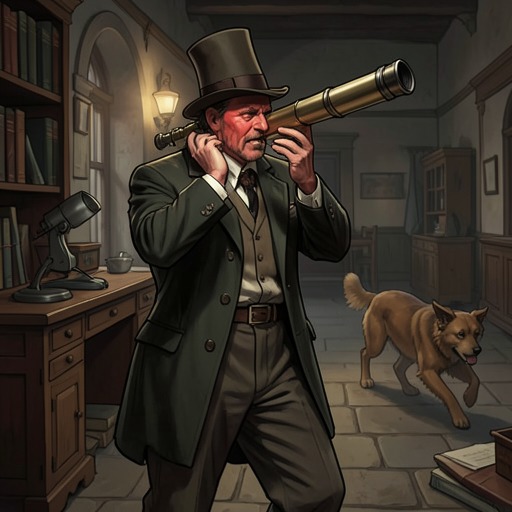
Frankland also uses an excellent telescope to scan the moor from the roof of his house, hoping to spot Selden, the escaped convict. The watch makes Lafter Hall a vantage point over the open landscape, but Frankland’s attention is not confined to the pursuit. Rumors say he intends to prosecute Dr. Mortimer for excavating a grave without the next of kin’s consent: the excavation produced a Neolithic skull from a barrow at Long Down.
The threatened case, like Frankland’s other legal quarrels, turns a serious matter into one more public contest. Watson presents the disputes as comic relief amid the danger surrounding the moor, while the telescope gives the estate a practical connection to the search for Selden. Lafter Hall thus joins the investigation’s scattered geography without becoming a scene of its central crimes: it is a neighbor’s house, a lookout, and a source of local commotion.