Laura Lyons
The Hound of the BaskervillesLaura Lyons is a separated, financially insecure woman whose wish to escape an unhappy marriage becomes a means for Stapleton to reach Sir Charles Baskerville. Her letter arranging an appointment with Sir Charles places her near the center of the murder plot, but the later revelation that Stapleton dictated it recasts her not as a knowing accomplice but as someone he deceived and used.
Identity and Circumstances
Laura is the daughter of Frankland of Lafter Hall. She married an artist who had come to sketch on the moor; he later deserted her. The marriage had taken place without her father’s consent, and he refused to have anything to do with her afterward. Local opinion held that the fault in the marriage may not have rested entirely on her husband, but the evidence offers no fuller account of that judgment. Whatever its cause, the separation left Laura in a precarious position, caught between an estranged father and a husband she said she abhorred.
James Mortimer understood her circumstances as a mixture of dependence and limited help. He believed Frankland allowed her only a small amount, while Frankland’s own financial affairs were involved. People in the district helped her earn a living rather than let her fall into destitution: Stapleton and Sir Charles were among those who contributed, as was Mortimer. Their assistance helped establish her in a typewriting business. When Dr. Watson later visits her in Coombe Tracey, he finds her working at a Remington typewriter in central, well-appointed rooms. That scene shows a measure of practical independence, though not the security she needed to resolve her marriage.
The Letter and Sir Charles’s Death
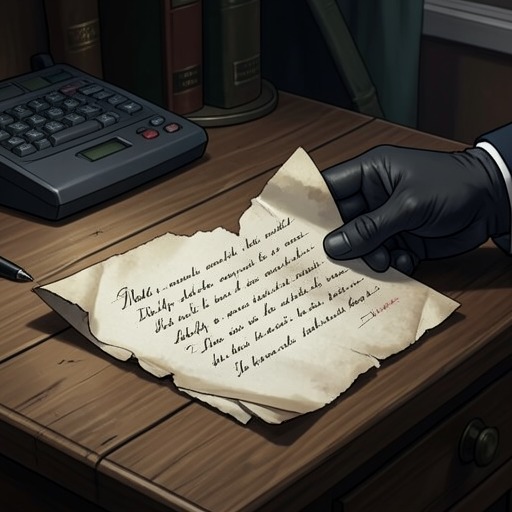
Laura’s need for money to regain her freedom supplies the reason she gives for contacting Sir Charles. She had learned there was a prospect of escaping the marriage if certain expenses could be met, and she believed that Sir Charles’s generosity might lead him to help if he heard her story. She wrote to him and arranged to meet at the place and hour where he later died. The appointment made her letter a crucial link in the inquiry, although it did not establish that she knew of any danger to him.
Her personal account also explains why that link was so easy for Stapleton to exploit. In Laura’s description, her husband’s legal position left her continually exposed to the possibility that he could force her to live with him. The chance of recovering her freedom promised not just a change in her circumstances but peace of mind, happiness, and self-respect. Her urgency was genuine; the purpose for which Stapleton turned it to his advantage was not.
Stapleton’s Deception
When Sherlock Holmes confronts Laura with a photograph and witness descriptions identifying Stapleton and his wife as the former Mr. and Mrs. Vandeleur, the evidence transforms her understanding of her relationship with him. Laura says that Stapleton had offered to marry her if she obtained a divorce from her husband. She had believed that his conduct was for her sake; faced with proof of his concealed identity and lies, she recognizes that he had treated her as a tool.
Holmes tests that revelation against the letter. He proposes that Stapleton suggested its contents and that Laura expected Sir Charles to help with the legal costs of her divorce. Laura confirms that Stapleton dictated the letter and that the proposed financial help was the reason. Her confirmation connects the apparently private effort to secure a divorce with Stapleton’s scheme, while distinguishing her own intention from his: she swears that, when she wrote, she never imagined that Sir Charles would be harmed, and says he had been her kindest friend. Holmes tells her he believes her.
Relationships and Narrative Role
Laura’s relationships are defined by unequal dependence. Her estrangement from Frankland and desertion by her husband leave her with little leverage; her need for legal expenses gives Stapleton a way to shape her choices. His offer of marriage ties her hopes for a future to his cooperation, but the offer rests on deception. By contrast, Sir Charles’s past generosity leads Laura to seek his help, and her later insistence that she never wished him harm preserves the distinction between the man she trusted and the plot in which Stapleton placed her.
Her role in the mystery changes as evidence accumulates. At first, the letter and fatal appointment make her an unexplained figure in the circumstances of Sir Charles’s death. Her testimony then reveals how Stapleton manufactured that connection: he dictated the appeal, directed it toward the financial need created by her marriage, and concealed his own purpose. Laura’s disclosure helps expose the human mechanism behind the crime—not a willing partner in murder, but a woman whose genuine hope of freedom was turned into an instrument of it.