Neolithic
The Hound of the BaskervillesNeolithic is the novel’s name for the prehistoric people who lived on Dartmoor, a past made visible in roofless stone dwellings, hearths, graves, monuments, and signs of work on the hillsides. The text gives this period no precise date: instead, it presents the moor as a landscape where the remains of an earlier community persist alongside the modern events unfolding there. The word therefore identifies both a remote human past and the material traces through which that past enters the characters’ view.
The Moor’s Prehistoric Settlements
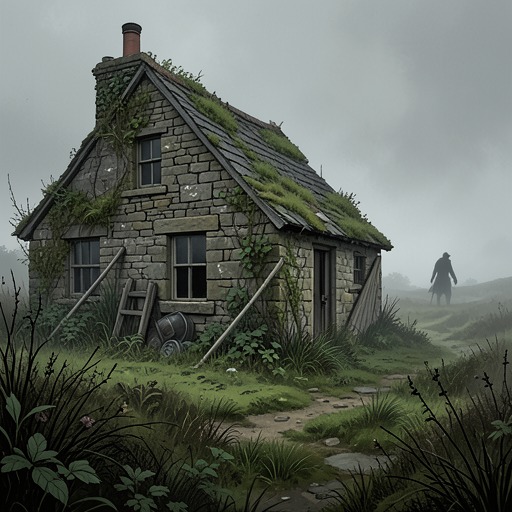
Stapleton explains to Dr. Watson that the gray circular rings of stone scattered across a steep slope are not sheep-pens but the homes of the moor’s ancestors. At least twenty such rings are visible together, enough to make the slope seem like a settlement rather than a collection of isolated ruins. Their roofs are gone, but Stapleton says that a visitor can still make out the hearth and couch inside one of the structures. His description makes the remains legible as domestic space: these stones once enclosed the ordinary arrangements of people who lived there.
The settlements appear unusually concentrated. In a letter to Sherlock Holmes, Watson describes stone huts across the hillsides, together with graves and huge monoliths that are supposed to have marked temples. He reflects on how thickly people once lived on ground he considers persistently unfruitful, and imagines that they may have been an unwarlike, harried population compelled to occupy land others would not choose. That explanation is Watson’s conjecture, not a confirmed account of the inhabitants’ history. The contrast between the visible density of their remains and the apparent barrenness of the terrain is what prompts his speculation.
Work and an Undated Past
When Watson asks when the settlement was inhabited, Stapleton answers, “Neolithic man--no date.” The reply supplies a period-name but no chronology. The past is identified through the remains and practices attributed to its people, rather than through a calendar or a sequence of named historical events.
Stapleton describes the inhabitants as grazing cattle on the slopes and learning to dig for tin when the bronze sword began to supersede the stone axe. He points Watson toward a great trench on the opposite hill and calls it the prehistoric people’s mark. The trench turns the landscape itself into evidence of labor: their presence is represented not only by the enclosures where they lived but also by an excavation cut into the hill. In Stapleton’s account, the passage from stone axe to bronze sword is connected to tin-working, giving the moor’s remains a technological as well as a domestic dimension. The novel does not elaborate on the chronology or accuracy of this account; its emphasis is on the visible traces through which the past can be read.
Discovery and Description
The prehistoric settlement is introduced during Watson and Stapleton’s walk across the moor. Stapleton identifies the stone rings and explains what can be seen inside them, then directs attention to the trench on the opposing hill. His guidance makes him, in this moment, an interpreter of the terrain: Watson sees stones and a cut in the hillside, while Stapleton assigns them functions and a human history.
Watson’s later letter expands this brief encounter into a sustained impression of the moor as a place that seems to preserve earlier ages. He describes the huts against scarred hillsides and imagines a skin-clad person emerging from a low doorway with a flint-tipped arrow ready on a bowstring. The imagined figure is not a witnessed event; it expresses Watson’s sense that the prehistoric inhabitant might seem more at home there than a modern visitor. His account moves from observed remains to imaginative reconstruction, while keeping the huts, graves, and monoliths as its material starting points.
Narrative Significance
The Neolithic past gives the moor a human history that predates the people currently moving across it. Watson observes that, away from modern England’s familiar signs, the landscape is still marked by old homes and work. Its apparent remoteness is therefore not emptiness: stone dwellings, burial places, monuments, and the trench disclose successive human use of the ground. The moor’s scale and isolation acquire depth because the present-day characters encounter evidence of lives that preceded them by an immense but undated span.
These remains also shape the way the landscape is narrated. Watson’s letter pauses the immediate report of events to describe the older world he sees around him, before returning to the facts concerning Sir Henry Baskerville. That shift makes the prehistoric setting both an observed environment and a subject of reflection: the ruins invite Watson to imagine their makers, while reminding him how little a modern visitor can know from the traces alone. Neolithic life is not developed into a separate historical narrative; it appears through the surviving forms of habitation and labor, and through the contrast between those durable traces and the present’s limited understanding of them.