Selden is hunted to death in Sir Henry's clothes
The Hound of the BaskervillesSelden is hunted to death in Sir Henry's clothes, a fatal episode on the moor that makes Sir Henry appear to have been killed before revealing that the victim is the fugitive Selden. The clothing explains how the hound could have followed a scent associated with Sir Henry, while the discovery leaves Holmes with a further question about Selden’s terror and flight.
The cry on the moor
The episode unfolds while Sherlock Holmes and Dr. Watson are away from Sir Henry Baskerville. Holmes has warned that the danger is immediate: the murderer may act before Holmes has completed his case. The cry that breaks the silence therefore arrives as the feared attack seems to have come to pass. Dr. Watson reacts with alarm, and Holmes moves quickly to look into the darkness. The sound first establishes urgency; its source is not yet known.
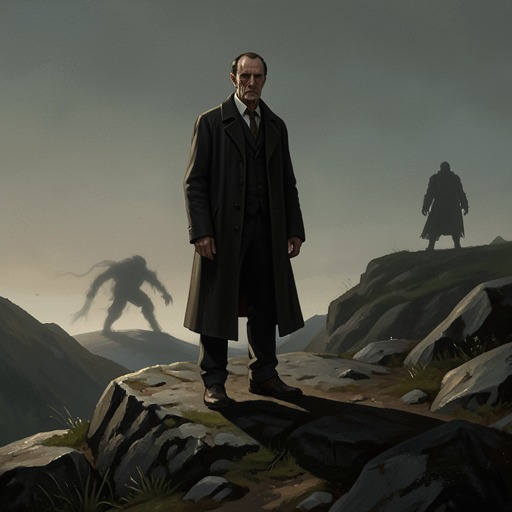
A second sound, a low moan, leads them toward a ridge on their left. The ridge ends in a steep cliff above a slope strewn with stones, where they find a man lying face down. Holmes checks the figure and strikes a match. In its brief light, Dr. Watson recognizes the distinctive reddish tweed suit as the one Sir Henry had worn on his first morning in Baker Street. The setting and the suit make the apparent identification feel conclusive, even though they have not yet seen the victim’s face clearly.
The mistaken identity
Dr. Watson believes Sir Henry is dead and reproaches himself for having left him exposed to danger. Holmes’s response abruptly changes when he notices a beard. He examines the man again, and the clothing no longer serves as reliable proof of identity. The match had shown them a familiar suit, not the face of its owner.
Turning the body over confirms that the dead man is Selden, the criminal whose face Dr. Watson had previously seen in the light of a candle. Recognition reverses the scene’s apparent outcome: Sir Henry has not been found among the dead, and the victim is instead the fugitive who had been hiding on the moor. Dr. Watson’s distress gives way to relief, though he does not treat Selden’s death as an uncomplicated happy ending. He acknowledges that the tragedy remains serious even after the mistaken identification is corrected.
Clothing, scent, and pursuit
The clothes provide the chain connecting Selden to Sir Henry and the hound. Sir Henry had given his old wardrobe to Barrymore, who passed the garments on to help Selden escape. Selden was wearing Sir Henry’s boots, shirt, and cap as well as the suit that had caused the mistaken identification. The disguise was thus not simply an outward resemblance: it also gave the hound an article associated with its intended target.
Holmes concludes that the hound had been set on the scent of something belonging to Sir Henry, probably the boot taken from the hotel. The distinction matters: the animal’s pursuit of Selden does not show that Selden himself was the intended victim. Rather, the clothes and the suspected stolen boot account for how the hound could follow him. Holmes’s explanation makes the wardrobe transfer a direct cause of Selden’s death and links this episode to the earlier theft of Sir Henry’s boot.
The question left open
The discovery resolves who died and offers a plausible explanation for how the hound found Selden, but it does not explain all of Selden’s behavior. Holmes asks how Selden knew that the hound was on his trail. Dr. Watson suggests that he heard it. Holmes objects that merely hearing a hound would not explain why an experienced fugitive would panic, cry out for help, and continue running at the risk of being recaptured. The exchange leaves Selden’s knowledge unexplained in this scene; Holmes treats the cries and flight as evidence that something more than the sound of pursuit alarmed him.
The episode works through a rapid shift in what the evidence appears to mean. A familiar suit first turns an unknown body into the apparent body of Sir Henry; the beard changes the identification; the transferred wardrobe then becomes the material link between Selden and the hound. The reversal gives Dr. Watson relief without erasing the death, and it sharpens rather than closes the inquiry. Holmes can explain the likely scent trail, but the reason Selden recognized the danger remains a separate problem.