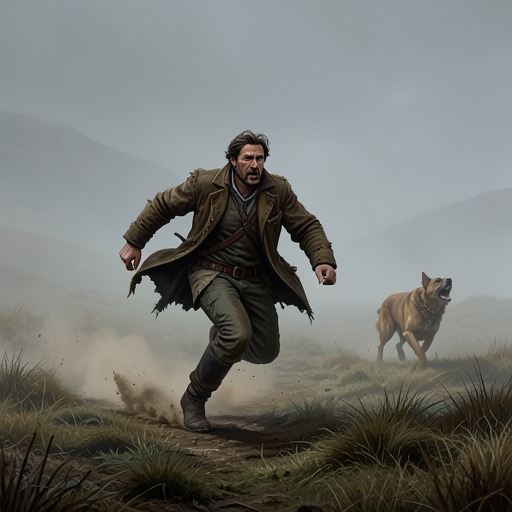
Selden's prison escape
The Hound of the BaskervillesSelden's prison escape turns the Dartmoor moorland from an ominous backdrop into an immediate source of danger around Baskerville Hall. The news first reaches Dr. Watson and his companions as they approach the isolated estate: a fugitive has been loose for three days, and the authorities have yet to find him. His presence alters how the surrounding landscape is read, making empty distances, scattered shelters, and the safety of nearby households part of the case.
Escape and Immediate Alarm
A driver tells Dr. Watson and James Mortimer that Selden has escaped from Princetown Prison. Warders are watching the roads and stations, but so far have seen no sign of him. The authorities offer five pounds for information, yet the local farmers regard the possible reward as small beside the danger of encountering a man they understand to be exceptionally violent. The report identifies him as the Notting Hill murderer, a name that makes the escape more alarming than the flight of an unknown prisoner.
Dr. Watson remembers the case because Sherlock Holmes had taken an interest in it. Selden's death sentence had been commuted amid doubts about his sanity, in view of the severity of his crime. This history explains why the driver's warning carries such weight: the community is not responding to an abstract possibility of disorder, but to an escaped man whose known violence shapes expectations before anyone sees him on the moor.
The escape itself is not described: the account supplies no method, accomplice, or precise route out of the prison. Instead, it begins with the consequences of the break—three days without a sighting, the watch on roads and stations, and fear spreading among isolated residents. That narrative choice introduces Selden through the uncertainty he creates. His absence from view becomes a practical danger, rather than evidence that he is far away.
The Moor as Refuge and Obstacle
The geography helps explain both the difficulty of finding Selden and the limits of the search. A large Ordnance map places Baskerville Hall amid surrounding woodland and shows Yew Alley along the edge of the moor. Within five miles, only a few dwellings are scattered across the district; Grimpen village, Lafter Hall, Stapleton's house, and the farmhouses High Tor and Foulmire are separated by the desolate open country. Princetown lies fourteen miles away. The map makes visible a region in which homes and institutions are isolated points, with extensive ground between them.
That ground offers places to disappear. In a later assessment, Dr. Watson reasons that any of the old stone huts could shelter a fugitive. Yet shelter does not solve the problem of food: unless Selden could catch and kill a moor sheep, remaining concealed for long would be difficult. The moor therefore works in two opposing ways. Its huts and wide spaces make concealment possible, while its scarcity of supplies makes prolonged survival uncertain.
The dangers are not confined to Selden. The moor's bright green patches can appear like inviting ground, but Stapleton warns Dr. Watson that crossing the plain without knowing its complex landmarks could be fatal. That warning underscores how unevenly the country is understood: a stranger may mistake a hazardous landscape for open, traversable ground, while someone familiar with it relies on detailed local knowledge. Selden's flight is difficult to track not simply because the district is empty, but because movement through it carries risks that are not obvious from a distance.
Fear and Changing Judgments
For a fortnight after Selden's escape, no one sees or hears from him. Dr. Watson considers it unlikely that he could have endured on the moor throughout that time and concludes that he has probably got away. The possibility of hiding remains, but the question of food weighs against it. On that basis, the outlying farmers sleep more easily. The apparent disappearance thus changes the local response: an active, immediate alarm gives way to a provisional belief that the danger has passed.
That reassurance does not remove concern for the Stapletons. Their home is miles from help, and Dr. Watson describes a small household consisting of a maid, an old manservant, and the brother and sister. Sir Henry Baskerville and Dr. Watson worry that they would be vulnerable if a desperate fugitive reached the house. Perkins, the groom, is proposed as someone who could sleep there, but Stapleton refuses the arrangement. The episode shows that the escape's effects extend beyond the search itself: even without a confirmed sighting, it prompts the residents to consider who can be protected and how quickly help could reach them.
The household's fear also sits alongside other pressures on the moor. Sir Henry is becoming interested in the Stapletons' sister, while Dr. Watson regards her brother as influential over her and difficult to read. Those observations do not establish any connection between the escaped prisoner and the Stapletons, but they place the fugitive scare within a wider atmosphere of isolation and uncertainty. The reported danger makes the distance between households feel consequential, even as other, less understood tensions develop nearby.
Search, Concealment, and Narrative Significance
Later, Dr. Watson and Sir Henry pursue a light across the moor at night. They find a candle sheltered in a cleft between rocks, positioned so that it is visible from the direction of Baskerville Hall but shielded from other approaches. A boulder conceals their own approach. The scene belongs to the investigation of Selden's whereabouts, but it does not establish how he escaped or identify him as the person who placed the light. Its concrete details instead show how a search across open country can depend on a small, deliberately screened sign.
Dr. Watson later follows a food boy across the hills and reaches a circle of old stone huts. One hut has enough roof to shelter someone from the weather, and a worn path suggests that the place has been used as a dwelling. Dr. Watson suspects it may be the fugitive's hiding place, but finds it empty. The distinction matters: the hut confirms that concealment is plausible, not that Selden is there at that moment. The search yields evidence of habitation without resolving the fugitive's location.
Selden's escape consequently remains both a concrete threat and an unresolved presence in the early account. The prison and its warders belong to a world of roads and stations; beyond them lies a sparsely settled moor where ordinary surveillance loses force and even a promising shelter offers no dependable refuge. The belief that Selden has left brings temporary relief, while the continued possibility of hiding keeps that relief provisional. His flight establishes the moor's central double function in the narrative: it can conceal a man from those seeking him, yet its isolation and unforgiving terrain also constrain anyone attempting to remain there.