Selden's death
The Hound of the BaskervillesSelden's death is discovered on the moor after a cry leads Dr. Watson and Sherlock Holmes to a figure they initially mistake for Sir Henry Baskerville. The reversal exposes the fatal consequence of Selden wearing Sir Henry's clothes: Holmes concludes that the hound followed the scent of an article belonging to the baronet. The scene both interrupts Holmes's efforts to complete his case and shows how a disguise intended to help Selden escape has placed him in the path of a danger meant for someone else.
Warning and Discovery
Before the cry, Holmes tells Dr. Watson that he regards the case as a deliberate murder and believes his evidence is nearly complete. He warns that the remaining danger is an attack before they are ready, and asks Watson to keep close watch over Sir Henry. The prolonged scream from the moor abruptly turns that warning into an immediate emergency. Its timing makes the threat seem to have reached Sir Henry while he is beyond their protection, and Watson reacts with alarm as Holmes moves to look into the darkness.
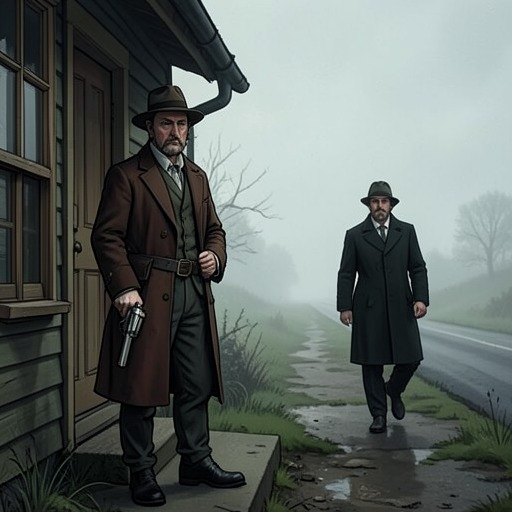
A second, quieter sound draws them toward a ridge of rocks and a steep drop. They find a man lying motionless on the stony slope. In the darkness, their first clear impression is of a body in the distinctive reddish tweed suit Sir Henry had worn in London. The match Holmes lights illuminates the clothing only briefly. Watson and Holmes therefore read the scene as the death of the man they had just feared might be attacked; Watson's first response is to blame himself for having left Sir Henry.
The Mistaken Identity
Holmes's grief gives way to an abrupt change of mood when he notices the dead man's beard. He recognizes the figure as Selden, the escaped convict, rather than the baronet. Once the body is turned and the face seen clearly, Watson confirms the identification: this is the same man he had encountered before on the moor. The detail of the beard overturns what the clothing seemed to prove, and the immediate crisis changes from an apparent attack on Sir Henry to the discovery that Selden has died.
The clothes explain why the misidentification was so convincing. Sir Henry had given his old wardrobe to Barrymore, who passed the garments on to help Selden escape. Selden was thus wearing Sir Henry's boots, shirt, and cap when he was found. The garments had served a practical purpose in his concealment, but their connection to Sir Henry also made the hound's pursuit dangerous to whoever wore them. Watson's relief that Sir Henry is alive does not erase the shock of the discovery; it changes its meaning and redirects attention to the chain of events that brought Selden onto the slope.
Scent and the Hound's Pursuit
Holmes infers that the hound tracked Selden by the scent of something belonging to Sir Henry. He considers the boot stolen from the hotel the likeliest source. This explanation links the theft to the hound's ability to follow a particular scent and makes Selden's borrowed clothes central to the death: the hound was pursuing the scent associated with Sir Henry, but Selden had taken his garments.
The inference does not settle every detail. Watson suggests that Selden heard the hound, but Holmes questions whether sound alone explains the convict's extreme alarm and his cries for help. The men are left asking how Selden knew the animal was on his trail. The scene therefore supplies a strong explanation for why the hound followed Selden while keeping the precise circumstances of Selden's recognition of the danger unresolved at this point.
Consequences and Narrative Role
Selden's death is a grim consequence of the clothing passed to him during his escape, and a near-fatal confusion for the people searching for Sir Henry. The borrowed suit first conceals Selden's identity from Holmes and Watson; then, when the body is mistaken for Sir Henry, it briefly makes the hound's intended target seem dead. Recognition breaks that illusion, but it leaves the investigators with a clearer indication that the hound can be directed by scent.
The discovery also sharpens the contrast between Holmes's confidence and the risk of acting before his case is complete. Moments earlier he had told Watson that he expected to have the evidence within another day or two, while acknowledging that the suspect might strike first. The scream appears to validate that fear, yet the victim is not Sir Henry. That reversal preserves the danger to the baronet while revealing how the scheme's effects can fall upon an unintended person. Through Watson's alarm, guilt, and subsequent relief, the episode presents the evidence not as an abstract clue but as a sudden, consequential misreading of identity.