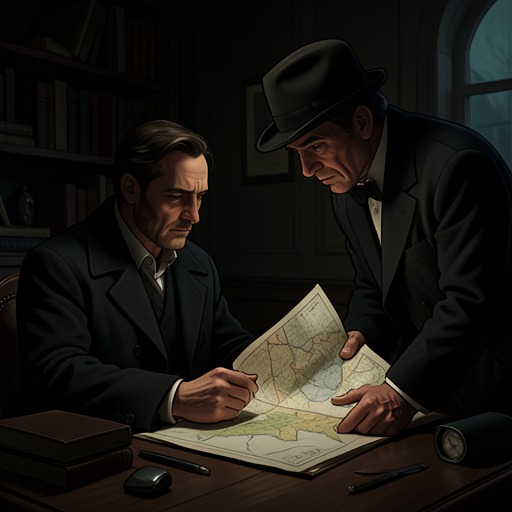
Sherlock Holmes
The Hound of the BaskervillesSherlock Holmes is the consulting detective at the center of the investigation into the danger surrounding Sir Henry Baskerville. His method joins minute observation to a deliberate control of what others know: he can infer a visitor’s habits from a forgotten walking stick, yet later conceal his own presence to keep a criminal from anticipating the investigation. The movement from a domestic puzzle in London to a hidden operation on Dartmoor makes his reasoning visible while repeatedly showing how much of his work depends on timing, disguise, and restraint.
Identity and Method
Holmes is introduced at breakfast at Baker Street, where Dr. Watson examines a substantial wooden walking stick left by their visitor. Its silver band bears an inscription identifying it as a presentation to James Mortimer from friends at Charing Cross Hospital, dated 1884. Before Watson has announced what he is doing, Holmes asks for his opinion of the object. He has noticed Watson’s attention without turning around, establishing the close observation that shapes their partnership.
Holmes reads the stick as evidence of its owner’s life. He infers that Mortimer is an amiable, unambitious, absent-minded country doctor: the presentation suggests the first quality, the move from a London career to rural practice the second, and the abandoned stick rather than a visiting card the third. Watson checks Mortimer’s record in the Medical Directory, finding his work at Charing Cross Hospital, his medical appointment in Grimpen and nearby parishes, and his publications in comparative pathology and psychology. The check gives Holmes’s deductions a concrete test; his account is not merely a performance of certainty but a chain of claims that can be compared with records.
When Holmes recognizes the sound of a dog at the front door and the walking stick’s owner approaching, he asks Watson not to move. Mortimer’s presence, he says, may make Watson useful because he is a fellow medical professional. The encounter reveals a further contrast in their interests: Mortimer is fascinated by Holmes’s skull and proposes that a cast would suit an anthropological museum, while Holmes notices the agile fingers with which Mortimer rolls a cigarette. Holmes responds to the visitor’s enthusiasm as a fellow specialist, but quickly turns the meeting toward the case Mortimer has brought.
The Case and the Call to Action
Mortimer reads the family manuscript recounting the origin of the Hound of the Baskervilles legend. Its account of Hugo Baskerville and its warning about the family’s past establish the inherited story that shadows the present case. Holmes listens to the tale, but his attention turns from its supernatural suggestion to the practical matter Mortimer says must be decided within twenty-four hours. He asks for the private facts behind the public account of Sir Charles Baskerville’s death. Mortimer explains that he withheld information from the coroner’s inquiry because he feared appearing to endorse superstition and worsening the reputation of Baskerville Hall. Holmes’s insistence on hearing what was kept back marks the difference between a public narrative and an investigation capable of testing it.
With Sir Henry due to arrive, Holmes advises Mortimer to meet him at Waterloo and say nothing until Holmes has decided what to do. He does not immediately accept the legend’s supernatural explanation. When Mortimer presses him about whether the young heir will be safe in Devonshire, Holmes’s recommendation is practical: meet Sir Henry, hold back the alarming information for the moment, and allow him time before making a decision. Sir Henry, for his part, rejects the possibility that either a family fiend or a human adversary will prevent him from going to his family home. Holmes’s role is not to make that choice for him, but to assess the danger and arrange support.
Watson as Partner and Field Agent
Holmes cannot leave London indefinitely, citing his extensive consulting practice and an urgent scandal he alone can stop. He therefore recommends Dr. Watson as the person best suited to accompany Sir Henry. The proposal surprises Watson, but Sir Henry immediately takes his hand and asks him to come to Baskerville Hall. Holmes’s delegation is practical as well as personal: Watson is trusted to observe, report, and stay near the heir while Holmes remains able to pursue other work in London.
The arrangement has limits. Holmes has instructed Watson not to leave Sir Henry alone on the moor, but Sir Henry eventually tells Watson that circumstances have changed and insists on going out by himself. Watson is caught between his instructions and Sir Henry’s request; once the baronet has left, his conscience drives him to set out after him. Holmes’s warning has therefore shaped the action even when it cannot prevent the breach. The episode also shows the tension between protective duty and Sir Henry’s insistence on acting independently.
Holmes’s assessment of their companions and suspects is often conveyed through others’ reports. Sir Henry tells Watson that Stapleton has apologized for opposing his attachment to his sister, explaining that he had feared losing his only close companion. He has asked Sir Henry to let the courtship rest for three months and cultivate friendship instead. Holmes is not present in the reported conversation, but the account becomes one of the threads Watson disentangles at Baskerville Hall. It matters to Holmes’s case because it clarifies Stapleton’s apparent hostility toward a potential heir and gives the investigation a personal conflict alongside the threat of the hound.
Concealment and the Investigation
Holmes’s most consequential tactical choice is to work without Watson knowing where he is. When he finally appears at the moor hut, Watson learns that Holmes has been moving about unseen rather than living at Baskerville Hall. Holmes explains that his presence beside Sir Henry and Watson would have warned their opponents; remaining unknown allowed him to observe and intervene at a critical moment. He also kept Watson uninformed because knowledge might have led Watson to seek him out or bring him provisions, creating an unnecessary risk of discovery. Cartwright, a boy from the express office, instead attended to Holmes’s basic needs and helped him keep watch.
The concealment complicates the partnership. Watson feels that he has been used and not trusted, but Holmes answers that Watson has been invaluable and that his secrecy was partly intended to protect him. Holmes had recognized the danger Watson himself was running and came to examine the situation directly. His tactic depends on Watson’s loyalty while withholding the explanation that might have made that loyalty easier to bear. After returning to the Baskerville gates, Holmes tells Watson to say nothing to Sir Henry about the hound. He wants Sir Henry to believe Selden’s death occurred as Stapleton would have them believe, so that the baronet will have steadier nerves before dining with the Stapletons the following day. Holmes even directs Watson to excuse himself, leaving Sir Henry to go alone as part of the plan.
Identity, Confrontation, and Resolution
Holmes’s attention to faces rather than clothing helps expose the concealed identity behind Stapleton’s appearance. A family portrait makes the resemblance to the Baskervilles plain to him; he recognizes the man as a family member with designs on the succession. The portrait supplies a missing link, but Holmes later sets out the fuller history: Stapleton is the son of Rodger Baskerville, Sir Charles’s younger brother, and therefore a Baskerville himself. The family connection turns the apparent local naturalist into a claimant with a direct interest in the estate.
Holmes also confronts Laura Lyons with the question of her connection to Sir Charles’s death. He points out that she arranged for Sir Charles to be at the gate at ten o’clock, the place and time of his death, and rejects her denial that the two facts are connected. He tells her that the case is being treated as murder and that the evidence may implicate both Stapleton and his wife. The revelation that Stapleton is married, rather than the brother Laura had understood him to be, startles her and opens a path toward exposing the deception.
The investigation reaches its physical crisis when the hound pursues Sir Henry through the fog. Holmes and Watson fire together; when the animal continues after being hit, Holmes runs after it and fires the remaining five shots from his revolver. The hound dies, and the men reach Sir Henry after it has knocked him down. Holmes and Watson find no wound, and Sir Henry soon begins to stir. The rescue confirms the practical conclusion beneath the legend: the hound can be wounded and killed. Holmes’s investigation has not only identified the human design behind the danger but brought him, at the decisive moment, close enough to prevent its intended consequence.
Narrative Role
Holmes’s importance lies in the contrast between visible inference and invisible labor. The walking stick and family portrait are objects that make identity legible; the hidden hut and the withheld information show that evidence must also be gathered without alerting its subject. His confidence is not simply faith in deduction: he seeks private facts, checks claims against records, and arranges circumstances in which a suspect can be exposed. At the same time, the case makes the cost of his methods apparent to Watson, whose fieldwork is essential even when Holmes decides that keeping him in the dark is safer. The detective’s final success rests on both kinds of work: careful interpretation of clues and the readiness to act when interpretation meets immediate danger.