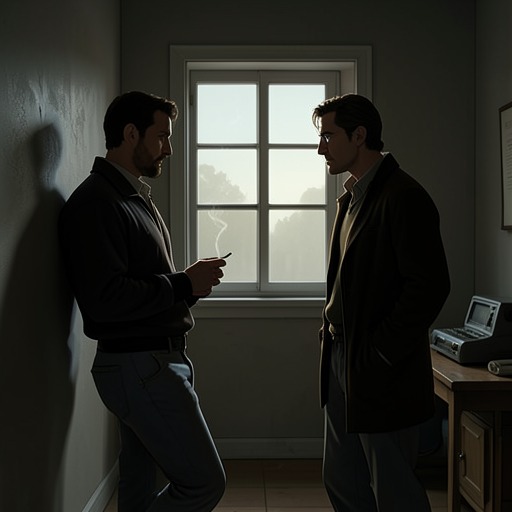
Sherlock Holmes—Dr. Watson
The Hound of the BaskervillesSherlock Holmes—Dr. Watson is a friendship built through shared investigation, but not through identical roles: Holmes directs the inquiry and tests the strength of its evidence, while Dr. Watson gathers observations and carries responsibility on the ground. The Baskerville case makes both the value and the strain of that partnership visible, as Holmes entrusts Watson with a dangerous assignment, secretly follows the case from the moor, and ultimately acknowledges how much he owes his friend.
Intellectual Partnership and Mutual Recognition
Their cooperation is already apparent in a small exercise of deduction over a walking stick. Dr. Watson offers an interpretation of its markings; Holmes calls it sound, then examines the stick himself, first unaided and then with a convex lens. He finds indications that can support further deductions, treating Watson’s contribution as a starting point for inquiry rather than a rival performance. The exchange shows their differing strengths at work together: Watson can apply Holmes’s methods, while Holmes can extend the initial reading.
Holmes makes the respect behind that arrangement unusually explicit. He tells Watson that, in recounting Holmes’s achievements, Watson has habitually underrated his own abilities. Holmes distinguishes between possessing genius and having the power to stimulate it, and says that he is much in Watson’s debt. For Watson, the admission matters precisely because Holmes has not said as much before. He has sometimes been piqued by Holmes’s indifference to his admiration and to his efforts to publicize Holmes’s methods; now he takes pride in having mastered the system well enough to earn Holmes’s approval. The moment gives their partnership a reciprocal dimension: Watson is not simply an audience for Holmes’s brilliance, but a perceptive participant whose work can call that brilliance forth.
Trust and the Field Assignment
When Holmes cannot leave London, he recommends Watson to accompany Sir Henry Baskerville to Baskerville Hall. Holmes places a hand on Watson’s arm as he makes the proposal and assures Sir Henry that no one is better worth having at his side in a difficult situation. Sir Henry immediately welcomes Watson as a companion, and Watson accepts with pleasure. Holmes then asks him to report carefully and says he will direct his actions when a crisis comes. The assignment is therefore both practical and personal: Holmes selects the friend whose judgment he trusts, while Watson agrees to shoulder responsibility in Holmes’s absence.
That responsibility weighs on Watson as the inquiry grows more troubling. After failed efforts to settle whether Barrymore had been in London, Watson considers the possibility that the butler might have been involved in the pursuit of Sir Henry, but recognizes that the suspected motive would not explain the subtle scheme surrounding the new heir. He longs for Holmes to be free of his London obligations and come down to take the burden from him. The thought conveys the imbalance of their immediate circumstances—Watson must make decisions amid uncertainty, while Holmes remains the distant source of direction—but also the confidence Watson places in Holmes’s judgment.
Secrecy, Reports, and Reconciliation
Holmes has in fact come to the moor without telling Watson. He later explains that being openly beside Watson and Sir Henry would have warned their opponents, whereas remaining unknown allowed him to move about freely and intervene at a critical moment. He also says that concealing his presence was partly for Watson’s sake: knowing Holmes was nearby might have led Watson to approach him, creating an unnecessary risk. Holmes brought Cartwright to supply simple necessities and provide another pair of eyes, while Cartwright sometimes watched Watson as Holmes watched Stapleton.
Watson does not initially receive the explanation as reassurance. He protests that Holmes has used him without trusting him, and says he deserved better. Holmes answers that Watson has been invaluable, apologizes for seeming to play a trick, and insists that his presence and work would have been compromised had he lived openly at the Hall. He then produces Watson’s reports, explaining that they have been closely read and were delayed only briefly on their way to him. His praise of Watson’s zeal and intelligence changes the emotional balance of the exchange: Watson remains hurt by the deception, but recognizes the practical reason for it and accepts that secrecy served their purpose.
The reports were not ceremonial updates. Holmes says they helped him establish the identities of the man and woman involved, and singles out Watson’s account of Stapleton’s biography as particularly useful. Watson’s inquiries also clarified the escaped convict’s connection with the Barrymores, although Holmes had reached the same conclusions independently. Their work thus converges from separate positions: Holmes gathers intelligence covertly, while Watson’s reports give his investigation local detail and help confirm what he has observed.
Evidence, Judgment, and the Cost of Partnership
Their different temperaments are clearest when Watson urges decisive action. Holmes calls him a man of action whose instinct is to do something energetic, but argues that arresting Stapleton without evidence would accomplish little. The hound has not been seen in a way that proves its connection to Sir Charles’s death; there are no bite marks, and the known facts cannot yet establish the chain of events before a jury. Holmes insists that suspicion, even strong suspicion, is not a case. Watson’s urgency presses toward intervention; Holmes’s caution keeps their shared aim tied to what they can demonstrate.
That evidentiary discipline shapes the risk Holmes asks Watson to accept. With no direct connection yet proved between the hound and the death, Holmes decides that they must wait for a chance to catch Stapleton red-handed. The plan uses Sir Henry as bait, apparently alone and unprotected. It succeeds in completing the case and driving Stapleton to his destruction, but Sir Henry suffers a severe shock. Holmes admits that exposing him is a reproach to his management, since they could not foresee the terrible spectacle of the beast or the fog that let it appear so suddenly. He also expects the injury to Sir Henry’s nerves and feelings to be temporary, while acknowledging that his love for the woman who deceived him makes the betrayal especially painful.
The outcome reveals the strength and limit of Holmes’s trust in Watson. Holmes relies on Watson’s reports and steadiness, yet keeps him ignorant when secrecy seems necessary and assigns him a role within a dangerous plan. Watson’s hurt is real, but so is his recognition that Holmes’s concealment protected the investigation. Their partnership endures not because it is free of friction, but because Holmes can acknowledge Watson’s value, Watson can judge the reasons for Holmes’s choices, and both return to the work of establishing what can be proved.