Sir Henry Baskerville's arrival at Baskerville Hall
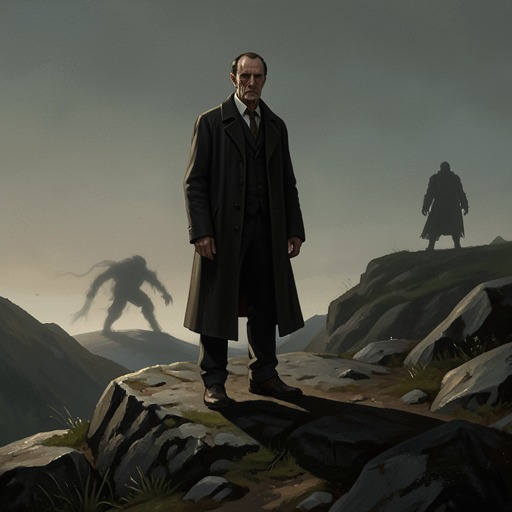
The Hound of the BaskervillesSir Henry Baskerville's arrival at Baskerville Hall is the point at which the threatened inheritance becomes a lived reality. Having resolved to return to his family's home despite the possibility of danger from either the legendary family fiend or human enemies, Sir Henry reaches the estate with Dr. Watson and James Mortimer. Before him stands not merely a property to inherit but a place where the Baskerville name, its accumulated wealth, and the danger around its newest representative converge.
Decision and Stakes
The journey begins with a choice rather than a reassurance. When Sherlock Holmes asks whether the danger comes from a supernatural family fiend or from human beings, Sir Henry refuses to let uncertainty decide for him. He insists that nothing will prevent him from going to the home of his own people, but asks for time alone before settling the details. At lunch he confirms that he will go to Baskerville Hall at the end of the week. Holmes considers the decision wise: Sir Henry is being followed in London, and the anonymity of the city makes it difficult to identify his pursuers or their purpose.
The decision carries substantial material stakes. The estate is valued at close to a million, and Holmes asks who would inherit if Sir Henry were to die. James Mortimer explains that the entail would pass the estate to the Desmonds, distant cousins; James Desmond, an elderly clergyman, is the next heir. The money, unlike the entailed property, could be left elsewhere by will. Sir Henry has not yet made one, but says he believes the money should remain with the title and estate, as his uncle intended: without the means to maintain it, the Baskervilles could not restore the family's former standing. The old house is therefore both a home and the visible center of a succession whose financial consequences give the danger a human dimension.
The Journey into Devonshire
On the appointed day Sir Henry and James Mortimer set out for Devonshire, with Dr. Watson accompanying them. Holmes sees Dr. Watson off at the station and asks him to report facts rather than adopt a theory in advance. The division of labor is explicit: Dr. Watson is to observe fully; Holmes will do the theorizing. The assignment makes the arrival part of an investigation as well as a homecoming, and places the reader alongside the observer who must interpret what the estate and its occupants disclose.
The approach to Baskerville Hall sharply changes the landscape. The fertile country gives way to a bleak, open expanse of moor, with craggy tors and boulders under a cold wind. The road passes stone cottages and descends into a hollow where storm-twisted trees gather beneath two narrow towers. Against that rough country, the Hall appears as an imposing landmark, but not a welcoming one: the drive runs beneath a dark tunnel of old trees, and the house glimmers at its far end. Sir Henry, who has just asserted his determination to come, looks up the drive with a shudder and asks whether this was where his uncle had been.
The House and Its Inheritance
The gateway makes the contrast between the family's past and its present unmistakable. Its elaborate wrought iron is held between weather-worn pillars marked with lichens and topped by the Baskerville boars' heads. Beside it stands the ruined lodge, its black granite and exposed rafters giving way to a half-built new structure, the first result of Sir Charles Baskerville's South African gold. At the end of the avenue, the Hall itself combines an ivy-covered central block and ancient, crenelated towers with more modern wings of black granite. Its heavy windows and steep roof present the house as old, defensive, and still inhabited; the new construction registers the wealth that has recently begun to renew it.
Sir Henry's response is not simply fear. He remarks that the place could make anyone feel that trouble was coming, then imagines installing powerful electric lamps at the entrance within six months. His confidence in modern lighting meets the Hall's darkness with a practical promise of change. The gesture also gives the inheritance a personal scale: he sees the house not only as a threatening relic but as a property he intends to occupy and alter. The manor's atmosphere remains formidable, however, and its physical gloom makes the family's inherited anxieties difficult to separate from the building itself.
Watson's Assignment and the Hall's Future
At the door, the household welcomes Sir Henry. A tall man steps out from the porch to open the carriage, while a woman appears in the hall's yellow light and helps with the luggage. James Mortimer leaves directly for home, so Sir Henry and Dr. Watson enter the estate together. The welcome marks a formal transfer into the new master's household, but it does not settle what kind of security the Hall can offer him. Holmes has insisted that Sir Henry must not travel alone, and Dr. Watson's presence turns companionship into a protective and investigative duty.
That duty becomes difficult once life at the Hall begins. Sir Henry later argues that events on the moor have changed the circumstances Holmes anticipated and insists on going out alone. His desire to act for himself stands against Dr. Watson's instructions to keep him safe. The estate also becomes the setting for Sir Henry's attachment to Beryl Stapleton and the conflict caused by her brother, Stapleton, who first objects to the match and later presents an explanation for his behavior. These developments give the arrival's promise of a settled family home an unstable underside: the new master is building a life there while danger and concealed motives remain close at hand.
The inheritance question ultimately reveals why the house is more than Gothic scenery. Holmes later identifies the difficulty a concealed claimant would face in inheriting the property while having lived nearby under another name. The arrival thus places Sir Henry inside the landscape of a disputed succession, where the ancient family seat, its modern wealth, and the identity of its rightful heir are inseparable. Dr. Watson's first view of the Hall is also the beginning of his work there: he must record what happens without knowing in advance which details will prove decisive.