Stapleton home at Merripit
The Hound of the BaskervillesStapleton home at Merripit, also called Merripit House, is the isolated residence of Stapleton and Beryl Stapleton on the moor near Baskerville Hall. It serves as Dr. Watson’s first introduction to their household and as a revealing contrast: a repaired, furnished home sits amid a bleak, sparsely settled landscape whose paths and green patches conceal real danger.
Location and Approach
On Holmes’ large-scale map, the house is marked as the possible residence of the naturalist Stapleton. Baskerville Hall stands near the centre of the mapped district; within five miles are only a few scattered dwellings, including Grimpen village, Lafter Hall, and the moorland farms High Tor and Foulmire. Princetown and its prison lie fourteen miles away. The surrounding moor is described as desolate and lifeless, making Merripit a remote neighbour rather than part of a close-set community.
Dr. Watson approaches with Stapleton along a narrow grassy track branching from the road and winding across the moor. A steep, boulder-strewn hill beside it had once been cut into a granite quarry; beyond a rise, smoke marks the direction of the house. The terrain is not merely difficult scenery. Stapleton warns that the plain’s bright green patches are dangerous, and says that crossing safely depends on remembering complex landmarks. His warning makes the approach itself a demonstration of how easily the open landscape can become a trap.
Building and Interior
The house was formerly a grazier’s farm, dating from a more prosperous period, and has since been repaired and converted into a modern dwelling. An orchard surrounds it, but its trees are stunted and wind-worn, contributing to the mean, melancholy impression of the exterior. A wizened, old-fashioned servant admits Watson, seemingly in keeping with the house’s austere appearance.
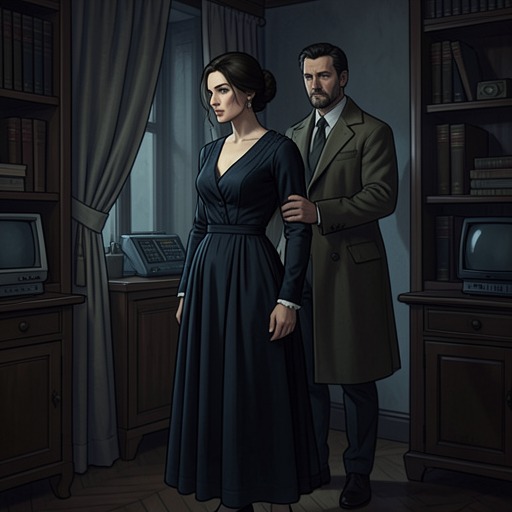
Inside, the impression changes. The rooms are large and elegantly furnished, and Watson recognizes what appears to be Beryl’s taste in their arrangement. From the windows, the occupants look out over an apparently unbroken expanse of granite-flecked moor. This contrast between cultivated rooms and exposed landscape is central to the house’s character: it offers refinement and shelter, but does not remove the isolation beyond its walls.
Household and Neighbours
Stapleton brings Watson to the house after meeting him on the moor and invites him to meet his sister. Beryl presents Merripit as a place made bearable by books, study, and interesting neighbours. She speaks of Dr. Mortimer as learned and remembers Sir Charles Baskerville as an admirable companion; his death has left a noticeable absence in their local circle. She asks whether she may call on Sir Henry Baskerville, hoping that she and Stapleton can make his adjustment to unfamiliar surroundings easier.
Beryl also shows Watson her collection of Lepidoptera, which she considers the most complete in south-west England. Her attention to study and collecting gives the interior a cultivated character that contrasts with the harshness of the moor. Yet her assurance that she is content there lacks conviction, leaving a tension between the house’s signs of comfort and the unease suggested by its setting and her manner.
Narrative Significance
Merripit introduces Stapleton and Beryl as residents of a settled home while placing them within a landscape defined by distance, hazardous ground, and limited landmarks. The hospitable visit makes the house appear socially connected: its occupants know the neighbouring household, remember Sir Charles, and offer to welcome Sir Henry. At the same time, its isolation and the dangerous moor just beyond the approach keep that domestic welcome in uneasy relation to the wider setting. The house thus establishes the Stapletons’ place in the local community without making the surrounding landscape feel safe or accessible.