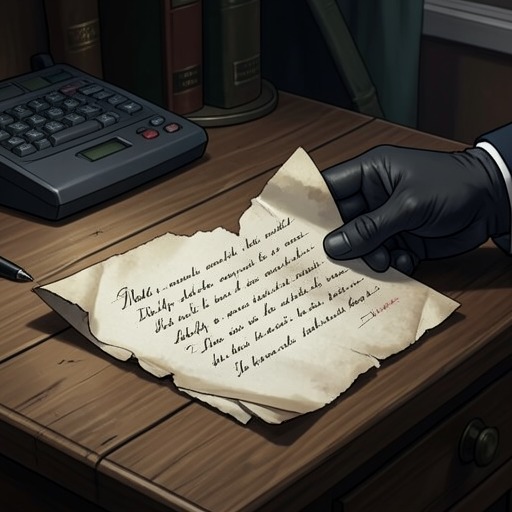
Stapleton uses Laura Lyons to plot Sir Charles's murder
The Hound of the BaskervillesStapleton uses Laura Lyons to plot Sir Charles Baskerville’s murder by turning a request for legal help into a means of arranging an appointment and then bringing his hound to the waiting baronet. In Sherlock Holmes’s reconstruction, the scheme joined a personal deception to a calculated use of the Baskerville legend: Sir Charles’s fear and weak heart made the hound a weapon, while the circumstances of the death obscured the human agency behind it.
Background and Design
Stapleton had cultivated a friendship with Sir Charles and learned from him about the family legend of a terrifying hound. From Dr. Mortimer he learned that Sir Charles had a weak heart; he also knew that Sir Charles took the legend seriously. Holmes presents these two pieces of knowledge as the basis of Stapleton’s method: a shock could kill the baronet, and a death associated with the legendary creature would be difficult to explain as an ordinary crime.
Stapleton prepared the means before he had a dependable opportunity to use them. He acquired a large, savage dog in London, brought it into the countryside without attracting notice, and kept it hidden in Grimpen Mire, a place he knew how to enter from his insect-collecting excursions. He treated the animal with an artificial luminous substance to make it appear consistent with the supernatural story. The disguise did not itself create the plan; it strengthened the legend that could conceal the plan’s human author.
The opportunity was delayed because Sir Charles could not be lured out of his grounds at night. Stapleton had hoped Beryl Stapleton would draw the baronet into a sentimental attachment, but she refused to assist. Holmes recounts that she resisted despite pressure from Stapleton. These failed attempts left Stapleton without the opening he needed and made Laura Lyons’s separate circumstances crucial to his design.
Laura Lyons and the Appointment
Sir Charles had become a charitable helper to Laura Lyons, who needed money for expenses connected with obtaining a divorce. Stapleton represented himself to her as a single man and promised to marry her if she secured the divorce. Holmes’s account makes her expected future with Stapleton part of the deception: she believed his promises, while he used his influence over her to serve another purpose.
When Stapleton learned that Sir Charles planned to leave Baskerville Hall for London, the opportunity became urgent. He dictated a letter asking Sir Charles to meet Laura on the evening before his departure. The request appeared to concern her need for financial assistance, and Holmes establishes that Stapleton gave her the impression Sir Charles might help with her legal expenses. Laura confirmed that Stapleton had dictated the letter.
After she sent it, Stapleton persuaded her not to attend. He presented his refusal to accept help from another man as a matter of self-respect, while claiming that he would use his own limited means to remove the obstacles between them. The promise made his intervention appear consistent with the marriage he had offered. In practice, keeping Laura away ensured that Sir Charles would wait for a meeting that would not take place as she had requested it, leaving Stapleton free to act.
Laura’s later account to Holmes clarifies the limits of her involvement. She said she had believed Stapleton’s assurances and had not understood herself to be anything but an instrument in his hands; she also insisted that when she wrote, she had never imagined that Sir Charles would be harmed. Holmes accepted her account and tested the sequence by asking whether Stapleton had dictated the letter and then dissuaded her from keeping the appointment. Her confirmations establish how he used her without making her a knowing participant in the murder.
The Attack and Concealment
On the evening of the appointment, Stapleton returned from Coombe Tracey, collected the hound, applied its artificial treatment, and brought it to the gate where he expected Sir Charles to be waiting. The dog pursued the baronet along Yew Alley. Sir Charles died there from the combined effects of heart disease and terror, according to Holmes’s reconstruction. The setting and the animal’s altered appearance made the attack seem to fulfil the frightening family story rather than expose a deliberate human scheme.
The tracks helped preserve that misdirection. Sir Charles ran along the path, while the hound remained on the grassy edge; Holmes explains that this left the baronet’s tracks visible without a corresponding trail from the dog. The hound may have approached the body, but, finding Sir Charles dead, it turned away. It left a print that Dr. Mortimer later observed. Stapleton called the animal off and returned it to its hiding place in Grimpen Mire.
The result was a death that puzzled the authorities and alarmed the surrounding country. The legend supplied an apparent explanation, the meeting letter concealed why Sir Charles had waited at the gate, and the missing tracks frustrated a straightforward account of the hound’s presence. Holmes stresses that the method was designed not simply to kill, but to make it exceptionally difficult to connect the death to its actual organizer.
Consequences and Narrative Significance
The plot depended on different people knowing different parts of the truth. Laura knew she had written at Stapleton’s direction and had been persuaded not to attend, but she did not know of the hound or the danger to Sir Charles. Beryl Stapleton knew of Stapleton’s designs and the animal, yet had refused to help lure the baronet. Holmes’s reconstruction joins these partial suspicions to the physical and circumstantial details of the death, revealing how Stapleton exploited both women’s situations while keeping them from exposing the whole scheme.
For Stapleton, Sir Charles’s death accomplished the first part of an inheritance plan: he expected to gain the estate, though Holmes notes that a further and more difficult stage remained. For the investigation, the episode explains why an apparently supernatural story could coexist with deliberate preparation, and why the letter and the hound’s tracks matter as evidence. The murder’s design turns the legend into camouflage: the more persuasive the supposed supernatural explanation seems, the more effectively it hides the human decisions that made the death possible.