Stapleton's disappearance in Grimpen Mire
The Hound of the BaskervillesStapleton’s disappearance in Grimpen Mire is the unresolved end of his flight: he vanished in the fog while trying to reach a refuge on an island in the bog. The search that followed found a clear trace of his escape—Sir Henry Baskerville’s missing boot—but no body or footprints. The mire therefore concealed both his route and his final fate, leaving Holmes to conclude that Stapleton had perished there without proof that he had reached the waterlogged depths where he was presumed buried.
Causes and the refuge in the mire
Once Stapleton’s crimes were exposed, Beryl Stapleton identified the place where she believed he would flee: an old tin mine on an island in the heart of Grimpen Mire. He had kept the hound there and prepared a refuge for himself. The island was not simply an arbitrary hiding place; it connected his escape to the concealed lair from which he had operated.
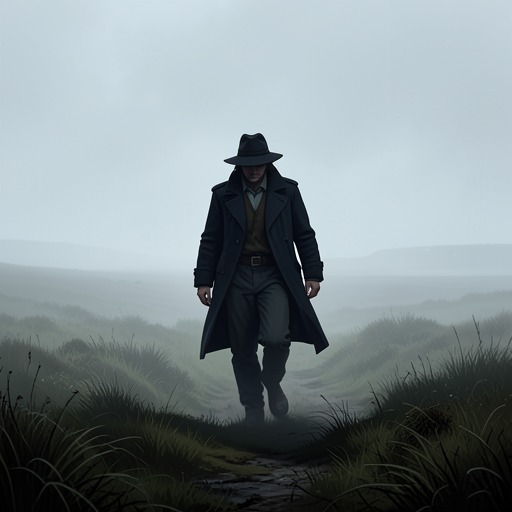
The fog made immediate pursuit impossible. Looking out at the white bank pressed against the window, Sherlock Holmes recognized that no one could find a safe way into the mire that night. Beryl Stapleton explained why Stapleton might nevertheless attempt it: she and her husband had planted guiding wands to mark the route through the bog. Their shared knowledge of the path gave him an advantage, but it also exposed how dangerous the crossing was. She said that she wished she had pulled the markers out earlier; without them, Stapleton might have been trapped beyond reach. The guides that could lead him toward refuge also made his escape dependent on a route whose safety vanished in the fog.
The flight and the missing boot
The investigators could do nothing until the fog lifted. They left Inspector Lestrade at the house and returned with Sir Henry Baskerville to Baskerville Hall. There, the story of the Stapletons could no longer be withheld from him. He bore the revelation about the woman he had loved bravely, but the night’s adventures had shattered his nerves: before morning he was delirious with a high fever, under Dr. Mortimer’s care.
On the following morning, with the fog gone, Beryl Stapleton guided the search party to the beginning of the path through the bog. She led them eagerly along the narrow track, marked by small wands from one tuft of rushes to another. The surrounding ground offered no safe margin for error. Green-scummed pits, foul quagmires, and slimy plants crowded the route; the mire quivered underfoot, and more than once a false step sank the searchers thigh-deep into the mud. Holmes himself stepped off the path and sank to his waist. His companions had to drag him back to firm ground before he could continue.
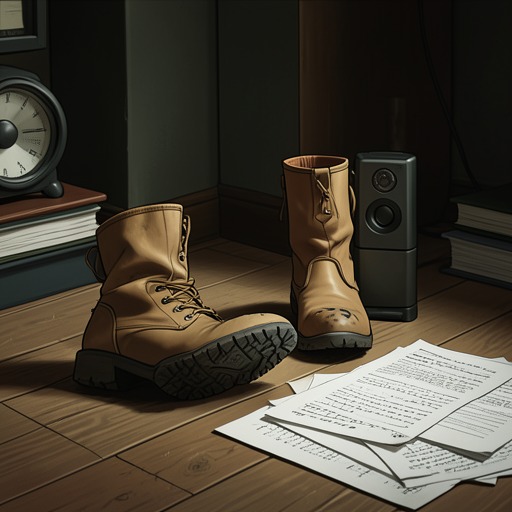
The one trace of another traveler was a dark object projecting from a tuft of cotton grass. Holmes seized it and raised an old black boot, its leather marked with the words “Meyers, Toronto.” It was Sir Henry Baskerville’s missing boot. Holmes identified it as the boot Stapleton had retained after using it to set the hound on Sir Henry’s trail, and concluded that Stapleton had thrown it away at this point in his flight. The object established that he had reached at least this far safely; it did not show where he went next.
An inference without a final trace
The search could not reconstruct Stapleton’s complete route. Rising mud quickly closed over footprints, and when the party reached firmer ground beyond the morass, no further sign of him appeared. The boot marked a point on his flight, but not its destination. Holmes reasoned that Stapleton had been struggling through the fog toward the island refuge and had not reached it; somewhere in the vast mire, the mud had engulfed him. The narrative presents this as the likeliest conclusion, not as a witnessed death: Stapleton’s body was never recovered, and the investigators could never know more than the boot and the silence of the bog allowed them to infer.
The conclusion is sharpened by the landscape through which the search proceeds. Its narrow, wavering path can be followed only by the planted markers, while a step away from it may bring a searcher down into ground that closes around the body. Even Holmes, who recognizes the danger, nearly disappears beneath the mud. The terrain thus turns Stapleton’s local knowledge into no guarantee of survival: the same mire in which he hid his hound and prepared a refuge could erase the evidence of his passage and deny him escape.
Aftermath and narrative significance
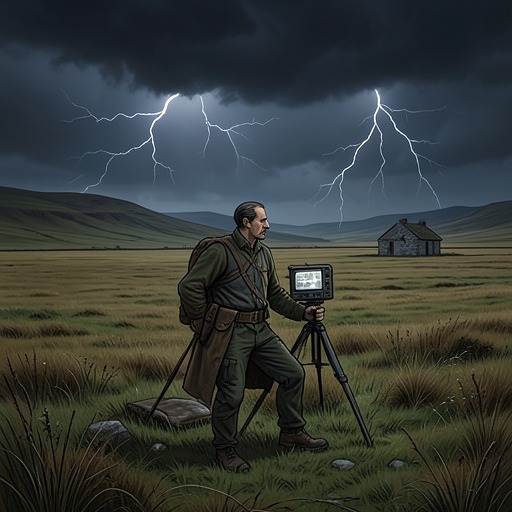
The search also brings the party close to the island where Stapleton had hidden the hound. The remains of an abandoned mine—its huge driving-wheel and a shaft partly filled with rubbish—locate the refuge, while the crumbling miners’ cottages testify to how thoroughly the swamp isolated it. In one cottage, a staple, chain, and gnawed bones showed where the animal had been confined; nearby lay the skeleton of a curly-haired spaniel, the missing pet of Dr. Mortimer. These discoveries explain the hidden infrastructure of Stapleton’s plot, but they do not resolve his disappearance. The island and its traces can be found; the fugitive cannot.
The uncertainty closes the pursuit without converting suspicion into direct evidence. Stapleton’s boot shows that he fled along the dangerous route, and the absence of any later trace supports Holmes’s conclusion that the mire swallowed him. Yet the search ends where firm ground resumes, not at a recovered body or a witnessed final moment. For Sir Henry Baskerville, the immediate consequence is physical as well as emotional: after the shock of that night, he remains gravely ill and later travels around the world with Dr. Mortimer before regaining his former health. Stapleton disappears into the bog; the survivors must make their way back from the danger he left behind.