The London cab pursuer's escape
The Hound of the BaskervillesThe London cab pursuer's escape is the first direct proof that Sir Henry Baskerville is being watched in London, and it shows that the watcher can anticipate Sherlock Holmes as well as follow his target. Holmes catches sight of the man but loses him in traffic; when he later traces the cab, the pursuer has already planted a false identity and vanished into Waterloo Station. The episode turns an unseen threat into an active opponent and leaves Holmes with a cab number, a misleading name, and no reliable account of who is behind the pursuit.
The Shadow on the Street
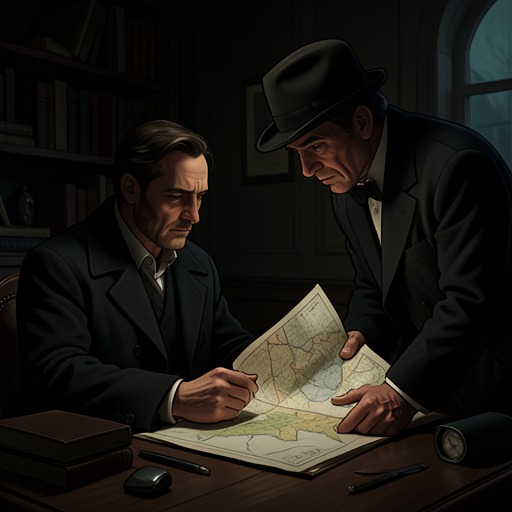
After Sir Henry and Dr. Mortimer leave Sherlock Holmes’s rooms, Holmes abruptly abandons his languor, changes into a frock-coat, and hurries after them with Dr. Watson. He does not try to stop the two men. Instead, he and Watson keep their distance as the pair walk toward Oxford Street and then down Regent Street. Their caution is part of the pursuit: Holmes wants to see who is following Sir Henry without warning that person he has been noticed.
Holmes’s suspicion has developed from the case’s immediate circumstances. Sir Henry has chosen the Northumberland Hotel, and Holmes reasons that anyone who followed him on his first day in London would likely continue the next. During Dr. Mortimer’s reading of the family legend, Holmes twice went to the window to look for loiterers; he saw none. The absence of an obvious watcher does not reassure him. It suggests instead that the surveillance is being conducted with care, and that the person behind it may be difficult to detect.
The streets supply the clue the windows did not. When Sir Henry and Dr. Mortimer stop to look into a shop window, Holmes mirrors them. He then notices a hansom cab across the street, stationary with a passenger inside, which begins to move again. Holmes identifies it as their man’s cab and urges Watson to come on so they can get a better look. The watcher has chosen a vehicle that can remain behind, move past the pedestrians, or follow them if they take a cab of their own.
The Pursuer Escapes
As Holmes and Watson approach, a bushy black beard and a pair of piercing eyes appear at the cab’s side window, turned toward them. The reaction is immediate: the trapdoor flies open, the passenger calls to the driver, and the cab races down Regent Street. Holmes looks for another cab but sees none available, then runs after the fugitive through the traffic. The head start is too great. By the time Holmes stops, panting and vexed, the cab has disappeared.
The escape is not merely a matter of speed. The watcher has recognized the danger of being identified and uses the cab’s mobility to break contact before Holmes can reach him. Holmes’s own eagerness helps the opponent: the sudden pursuit reveals that the supposed shadow is being watched in return. Holmes later judges that he should have turned away upon noticing the cab, hired another vehicle, and followed at a distance—or waited at the Northumberland Hotel to see where the watcher went after Sir Henry returned. Instead, the visible chase gives their adversary the chance to flee. Holmes does, however, obtain the cab’s number: 2704. At the time, he believes that this detail will not by itself solve the problem.
A Number, a Driver, and a False Name
Holmes’s later inquiry through the Official Registry leads to the cabman rather than the passenger. John Clayton arrives at Holmes’s rooms after receiving word that someone has asked about cab 2704. He says he has driven for seven years without a complaint and has come directly from the Yard to ask what is wanted with him. Holmes explains that he has no grievance against Clayton and offers him half a sovereign for straightforward answers, making clear that the investigation concerns the fare who watched the house and followed the two gentlemen.
Clayton initially hesitates because his passenger had claimed to be a detective and instructed him not to speak about the matter. Holmes presses him to explain, and Clayton reveals that the passenger gave a name. Holmes expects that indiscretion to expose the pursuer. Instead, the name Clayton reports is Sherlock Holmes. The answer briefly leaves Holmes silent; then he laughs and acknowledges that his opponent has scored a clever point. The false name is not evidence that Holmes himself followed Sir Henry. It is a calculated message that turns the investigator’s identity into cover for the fugitive.
Clayton’s account reconstructs the surveillance in detail. The passenger hailed him in Trafalgar Square at half-past nine, called himself a detective, and offered two guineas for a day’s work without questions. They drove to the Northumberland Hotel and waited until two gentlemen came out and took a cab. Clayton followed that vehicle to a point near Holmes’s rooms, then waited with his fare for an hour and a half. When the gentlemen later passed on foot, the cab followed them along Baker Street and into Regent Street. Near the point where Holmes and Watson recognized the watcher, the passenger ordered Clayton to drive hard to Waterloo Station. They reached it in under ten minutes; the passenger paid and went into the station, then disclosed that Clayton had been driving Sherlock Holmes.
The Cost of the Failure
The cabman’s story explains how the pursuer could be both visible in Regent Street and gone before Holmes could identify him. He had used Clayton from early in the morning, watched the address where Sir Henry had consulted Holmes, followed the two men after they left, and anticipated that Holmes might seek the cab’s number and question its driver. By giving Clayton Holmes’s name, he arranged for the inquiry to return a deliberate falsehood. The cab number remains accurate, but the most promising result of tracing it is compromised before Holmes can exploit it.
Clayton leaves chuckling after Holmes gives him the promised half-sovereign and offers another for any further information. Holmes turns to Watson with a rueful smile: the third investigative thread has snapped, and the inquiry has returned to its starting point. He recognizes that the opponent knew Sir Henry had consulted him, noticed Holmes in Regent Street, and predicted that Holmes would obtain the cab number and find the driver. The escape therefore changes the London pursuit from a simple matter of locating a tail into evidence of a deliberate intelligence contest. Holmes has been checkmated, not because he failed to see the man, but because the man understood what Holmes would do after seeing him.
The immediate consequence is a heightened sense of danger as Watson prepares to go to Devonshire. Holmes admits that the business appears ugly and dangerous and worries about sending Watson, even while hoping for his safe return to Baker Street. The London pursuer’s identity remains undiscovered in this episode; what is established is the reach of the surveillance, the watcher’s ability to adapt, and the cost of confronting him too openly.