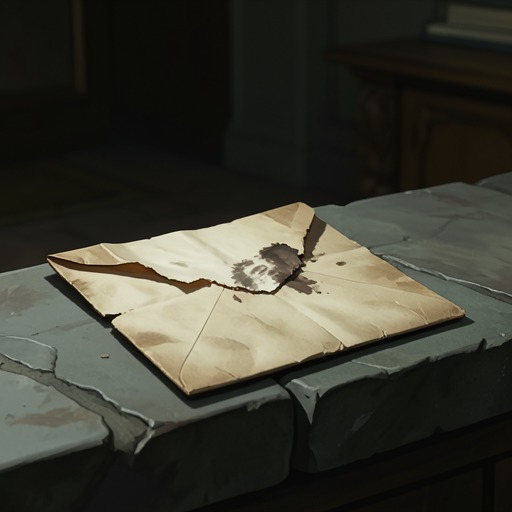
The anonymous warning to Henry Baskerville
The Hound of the BaskervillesThe anonymous warning to Henry Baskerville turns an apparently crude threat into a material puzzle: its pasted words warn him away from the moor, while the envelope, typography, and ink give Sherlock Holmes grounds to reconstruct how it was made. Delivered to Henry at the Northumberland Hotel, the message signals that someone is monitoring his movements, but its handmade form also supplies clues to the sender’s efforts to conceal an identity.
Arrival and Immediate Stakes
Henry presents the message to Sherlock Holmes as a possible joke, though he has come seeking help because he cannot make sense of it. The envelope is ordinary grayish paper, addressed in rough printed characters to Henry at the Northumberland Hotel. Its Charing Cross postmark dates its posting to the preceding evening. Those details become important because Henry says that nobody could have known he would be staying at that hotel: the decision was made only after he met Dr. Mortimer, who confirms that he had been staying with a friend and that there had been no indication of their plans.
The warning itself is a half-sheet of foolscap folded into four. Across it, printed words have been pasted to form the sentence, “As you value your life or your reason keep away from the moor.” Only the word “moor” is printed in ink. The message is therefore both an explicit threat and a deliberately manufactured object: instead of writing the sentence normally, its sender has taken pains to disguise the writing and leave a trail of physical evidence.
Henry wants to know who is so interested in his affairs and what the warning means. Dr. Mortimer distinguishes the question of how the message was made from what its sender believes: he sees nothing supernatural in the document itself, but allows that it might have come from someone convinced that the matter is supernatural. Henry recognizes that the others know more about his affairs than he does. Holmes promises that he will share their knowledge before Henry leaves, but first confines the inquiry to the document.
Holmes Reconstructs the Message
Holmes identifies the source of the cut-out words by comparing their type with a leading article in the previous day’s Times. He explains that the distinctive print of a Times leader could not plausibly have come from an evening half-penny paper, and that the words fit the article’s vocabulary. His comparison turns the newspaper Henry and Dr. Mortimer might otherwise overlook into a likely source: because the message was composed the day before, Holmes reasons that its words should be present in that day’s issue. He also points to “keep away” and “from the” having been cut as single pieces, reinforcing the connection between the fragments and the original printed text.
The physical assembly yields finer deductions. Holmes identifies the scissors as short-bladed: the phrase “keep away” required two cuts. He corrects Henry’s assumption that the words were pasted with paste, identifying the adhesive as gum. The sender could not find “moor” in print and therefore wrote that word in ink, while using newspaper fragments for the rest. These observations distinguish the sender’s practical choices from the warning’s frightening content: the threat has been constructed to conceal handwriting, but the construction itself is imperfectly hidden.
Holmes reads the rough printed address as part of that concealment. Since the Times is rarely in the hands of anyone but the highly educated, he infers that the composer is educated but wishes to appear uneducated. The effort to disguise the writing, he adds, suggests that the writer’s handwriting might be known to Henry or could become known to him. This is an inference about the sender’s purpose, not a confirmed identification; the letter supplies a reason to suspect concealment without naming the person behind it.
Haste, Place, and Limits of the Clues
The words do not sit in a straight, carefully aligned line. “Life,” for example, is noticeably out of place. Holmes considers two explanations: carelessness, or agitation and haste. He favors haste because the matter seems important and a composer taking such pains to manufacture the warning would be unlikely to arrange it carelessly. That judgment opens a further question rather than answering it: since a letter posted early enough would still reach Henry before he left the hotel, why was the sender in a hurry? Holmes speculates that the writer may have feared interruption, while Dr. Mortimer cautions that they are approaching guesswork. Holmes describes his approach instead as balancing probabilities from a material basis; the distinction leaves the proposed interruption a hypothesis, not a fact established by the document.
The address offers another, more specific inference. Holmes observes that the pen spluttered twice within a single word and ran dry three times in the short address. He reasons that a private pen and ink bottle would rarely both be in such poor condition, whereas hotel pens and ink commonly present that problem. On that basis he thinks the address was written in a hotel. He proposes searching the waste-paper baskets of hotels around Charing Cross for the remains of the mutilated Times leader, which might lead to the sender. The suggestion follows from the posting mark and the suspected source of the cuttings, but at this point it remains a proposed investigative route, not a reported discovery.
Narrative Function
The warning’s force comes from the gap between what it says and what can yet be proved. Its command is unmistakable, but its sender, reason, and relation to the supernatural story remain unresolved in this exchange. Dr. Mortimer’s distinction makes that uncertainty explicit: a physically ordinary piece of paper could still have been composed by someone who believed in supernatural danger. Holmes does not settle the question by accepting or dismissing that belief; he starts with the document’s observable features.
The investigation also changes the message from a simple threat into a chain of testable clues. The Times fragments suggest a source; the inked word reveals what the source could not supply; the short cuts, gum, uneven line, rough address, and failing hotel pen each narrow the circumstances in a different way. Holmes’s promise to explain the wider affairs of Henry’s family keeps the warning within a larger, still undisclosed danger, while his close examination gives Henry—and the reader—a method for approaching it. The document warns Henry away from the moor, but its construction draws the inquiry toward the unknown person who sent it.