The hound attacks Sir Henry Baskerville
The Hound of the BaskervillesThe hound attacks Sir Henry Baskerville at the climax of the plan to expose and stop it: emerging from an approaching bank of fog, the enormous animal pursues Sir Henry along the path until Sherlock Holmes and Dr. Watson can intervene. The attack turns the danger that had shadowed the investigation into a visible, mortal threat. Holmes’s shots kill the hound, Sir Henry survives, and examination of the animal’s glowing appearance identifies phosphorus as the means behind its frightening effect.
Causes and Background
The attack takes place under severe pressure of time. Holmes judges that the approaching fog is the one circumstance capable of disrupting his plans, because the rescue may depend on Sir Henry coming out of the house before the path is swallowed. The night is clear above the fog, and the house remains visible in the moonlight; from the observers’ position, its lit windows and the advancing white bank make the danger’s approach measurable. As the fog moves nearer, the men retreat until they are some distance from the house, then stop because they cannot risk Sir Henry being overtaken before he reaches them.
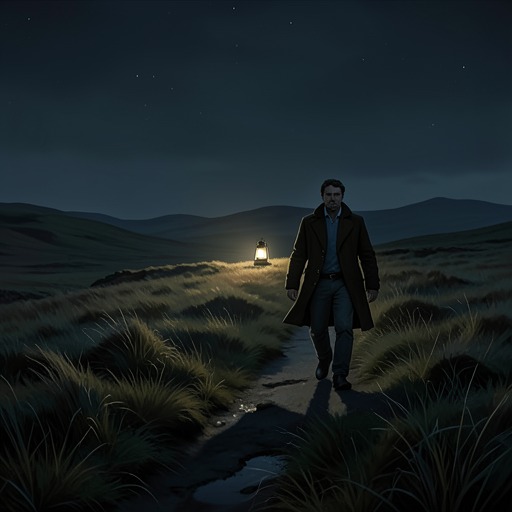
Holmes listens for the expected footsteps and recognizes that the success of the plan depends on timing as much as preparation. The moment Sir Henry emerges into the clear night, he passes close to the men concealed beside the path and continues uphill. His repeated glances behind him convey unease, but he does not yet appear to know that the hound is following. The attack is therefore not a chance encounter: the pursuer and its intended victim are brought together in the narrow interval between the advancing fog and the watchers’ position.
The Attack
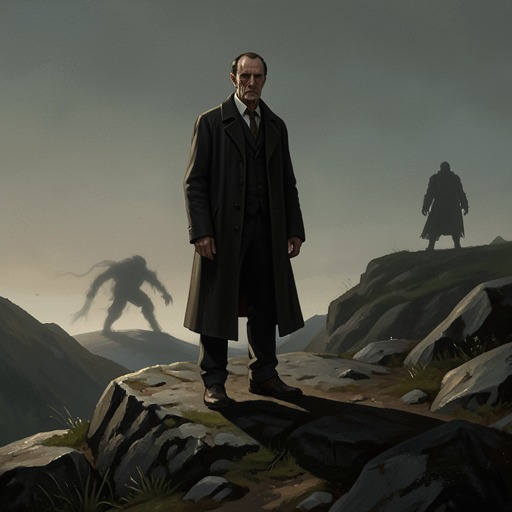
A continuous patter from within the fog signals that something is moving toward the group. Holmes, Dr. Watson, and Inspector Lestrade watch the bank, unable to see the approaching threat clearly. When the hound breaks into view, its appearance initially overwhelms them. Dr. Watson sees an enormous dark animal whose outline seems to shine with fire; Inspector Lestrade throws himself to the ground, while Holmes’s first reaction changes from expectation to astonishment. The delay matters: the hound passes the concealed men before they recover enough to act.
Holmes and Dr. Watson fire together. The hound cries out but continues down the path after Sir Henry, making clear that the first shots have not stopped the pursuit. At a distance, Sir Henry turns toward the animal, visibly frightened and unable to escape its advance. Holmes and Dr. Watson run after them, with Inspector Lestrade following behind. Dr. Watson reaches the scene as the hound brings Sir Henry down; Holmes then fires repeatedly into the animal, which falls and dies. The sequence is abrupt: concealment gives way to revelation, the revelation to pursuit, and the pursuit to a rescue that arrives just in time.
Rescue and Discovery
Sir Henry lies unconscious after the attack, but Holmes and Dr. Watson find no sign that the hound has wounded him. Their immediate examination establishes that he is alive, and Inspector Lestrade gives him brandy. Sir Henry soon begins to stir and asks what happened. Holmes answers that the animal is dead and that the family’s supposed ghost has been put to rest. The danger that had seemed supernatural is thus answered by a practical outcome: the pursuer has been killed, and its intended victim has survived.
The hound’s appearance still requires explanation. In death, its size and strength remain striking; the observers identify it as a cross between a bloodhound and a mastiff. Dr. Watson touches its muzzle and notices the substance responsible for the glow. Holmes identifies it as a carefully prepared phosphorus application, arranged so that it would not interfere with the animal’s sense of smell. The discovery changes the meaning of what the group has just witnessed: the light was not evidence of a ghostly creature, but a deliberate disguise applied to a real and dangerous animal.
Consequences and Significance
The event resolves the immediate conflict by converting the hound from an apparently otherworldly menace into a vulnerable animal that can be stopped. The first gunfire gives Holmes the crucial proof that it can be hurt; that recognition turns the group’s initial paralysis into action. Holmes’s repeated shots end the pursuit, while the absence of a wound on Sir Henry confirms that the intervention succeeded before the attack became fatal.
The scene also shows the limits of Holmes’s control over his plan. He has anticipated a hound, but not the exact terror of its appearance, and the fog leaves little time to respond once it emerges. The threat’s staging depends on concealment and spectacle; its defeat depends on observation, timing, and a physical explanation. Dr. Watson’s identification of phosphorus and Holmes’s account of its application dismantle the supernatural impression without diminishing the real danger. The hound’s death and Sir Henry’s rescue bring the attack to an end, while the revealed disguise makes the apparent family ghost legible as a manufactured instrument of the plot.