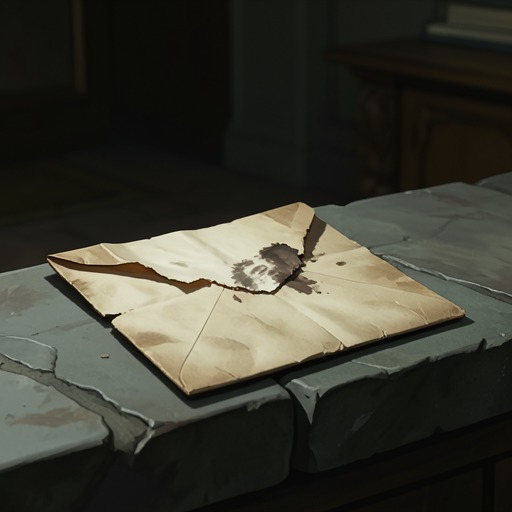
Warning letter to Sir Henry
The Hound of the BaskervillesThe Warning letter to Sir Henry is both a threat and a small physical puzzle: its anonymous sender urges Sir Henry Baskerville to keep away from the moor, while the materials and assembly of the message offer Sherlock Holmes clues to the sender’s methods and possible circumstances. Holmes can identify how the warning was made and draw cautious inferences about its author, but the letter does not name the sender or establish the precise danger it predicts. Its force lies in that gap between an urgent command and an unresolved threat.
Arrival and Physical Form
Sir Henry receives the letter in London on the morning he visits Sherlock Holmes. He initially dismisses the experience as possibly no more than a joke, but presents the envelope for examination. It is of common, grayish paper, addressed to Sir Henry at the Northumberland Hotel in rough printed characters. Its postmark is Charing Cross, and it was posted the previous evening. These details establish both the letter’s recent arrival and the anonymity its maker has tried to maintain.
The message itself is on a half-sheet of foolscap folded into four. Rather than being written out by hand, a single sentence has been assembled by pasting printed words across the paper: “As you value your life or your reason keep away from the moor.” Only the word “moor” is printed in ink. The contrast between the cut-out words and that handwritten exception makes the warning look at once manufactured and improvised: most of its language has been borrowed from print, but its most distinctive destination has had to be supplied separately.
The hotel address raises an immediate question about how the sender knew where Sir Henry was staying. Dr. Mortimer explains that he had been staying with a friend, and that there was no indication that the party intended to go to this hotel. Holmes consequently reads the letter as evidence that someone is deeply interested in Sir Henry’s movements. The text itself cannot disclose how the sender learned the address; the uncertainty about that knowledge is part of the threat, not a clue the investigation has yet solved.
Holmes’s Examination of the Message
Holmes identifies the source of the cut-out words by recognizing the typeface, not by guessing at the sender’s handwriting. He distinguishes the leaded print of a Times leader from the slovenly type of an evening half-penny paper, and reasons that the words must have come from the previous day’s issue because the message was prepared the evening before. Comparing the warning with the leading articles in that issue, he finds the source. The construction is therefore concealed in plain sight: its vocabulary has been assembled from a printed article, but its arrangement turns that borrowed language into a personal command.
The cutting itself offers a more particular clue. Holmes observes that “keep away” and “from the” were cut out together, and identifies the scissors as nail-scissors: their short blades required two snips to cut the words “keep away.” This close inspection makes the message’s small physical limitations legible. The tool is not merely incidental; the edges and grouping of the cuttings let Holmes reconstruct something of how the sentence was put together.
The word “moor” is the exception because, Holmes concludes, its rarity made it difficult to find in print. The other words were commonplace enough to be located in an issue of the paper, whereas “moor” was less likely to appear. The handwritten word thus marks the point where the borrowed text could not supply the warning’s essential destination. Holmes’s explanation accounts for the mixed method without requiring the whole sentence to have been written by the sender.
Inferences and Limits
The letter’s rough printed address also becomes evidence. Holmes argues that someone using The Times—a paper he associates with highly educated readers—would be unlikely to have chosen it by chance. He infers that the composer was educated but wished to pose as uneducated; printing the address rather than exposing handwriting would further conceal a script that might be known, or become known, to Sir Henry. These are Holmes’s deductions, not identifying facts: neither the paper nor the disguise reveals a name.
The arrangement of the pasted words appears irregular. Holmes notes that they do not sit in a level line and that “Life” is especially out of place. He considers two explanations: carelessness, or agitation and haste. He favors haste because the matter seems important, then asks why the composer would hurry when a letter posted early enough could still reach Sir Henry before he left the hotel. The possibility of interruption follows, but Holmes frames the question of who might have interrupted the sender as an unresolved line of inquiry. When he examines the foolscap for further identifying features, he finds only a blank half-sheet with no watermark. The paper yields no additional clue.
The letter also leaves the nature of its warning unsettled. Dr. Mortimer suggests that it could have come from someone convinced that the Baskerville affair was supernatural; Holmes asks whether there is anything supernatural about the document itself, and Mortimer says there is not. The distinction matters: a sender might believe in a supernatural danger without the warning being supernatural evidence. Holmes promises that Sir Henry will learn what the others know before leaving the room, but the letter alone cannot tell him whether the danger comes from the family’s story or from a human enemy.
Effect and Narrative Significance
Sir Henry does not allow the warning to decide his course. After hearing the broader danger under discussion, he says that neither devil nor man will prevent him from going to the home of his own people. His response gives the letter a consequence without making it effective as a deterrent: it sharpens the question of risk, but does not turn him aside. Later, on the moor, he likewise insists on going out alone despite Dr. Watson’s reminder that Sherlock Holmes had warned against it. The warning letter and the later instruction are distinct; together, they show how danger is communicated while Sir Henry continues to assert his own judgment.
The message’s importance is therefore not that it supplies a complete solution, but that it changes an ominous story into an investigable object. Its wording invokes death, reason, and the moor; its cuttings, ink, address, postmark, and blank paper give Holmes concrete points of examination. Yet the most consequential questions remain open: who composed it, how the sender tracked Sir Henry’s movements, and what danger the warning refers to. That combination of precise material clues and incomplete meaning makes the letter an early test of the difference between an alarming claim and what can actually be established from evidence.