Watson and Henry pursue Selden
The Hound of the BaskervillesWatson and Henry pursue Selden after discovering that Barrymore has been carrying food to the escaped convict. Their attempt to return him to custody brings them to a concealed candle signal on the moor, where they find Selden but cannot catch him. The failed pursuit also leaves Watson with a second, unexplained sighting: a tall, solitary figure on a distant tor, seen by Watson alone.
Cause and Decision
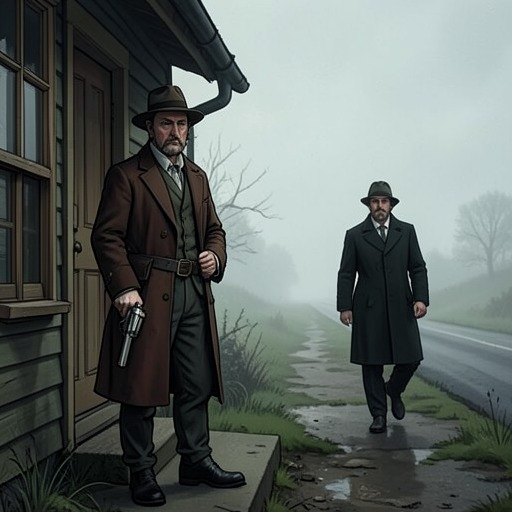
The pursuit begins when Watson and Sir Henry infer that Barrymore’s food deliveries must lead to Selden’s hiding place. Their discovery of the household’s secret has not come through a voluntary explanation, and Watson stresses that the men have not been taken into the Barrymores’ confidence. He and Sir Henry therefore act on what they regard as a public duty: Selden is an escaped convict whom Watson considers dangerous, and leaving him at large could put other residents at risk. That concern helps explain Sir Henry’s willingness to go out at night rather than wait for another opportunity.
The two men estimate that the hiding place cannot be far from Baskerville Hall if Barrymore has carried provisions there. They understand that Selden may be waiting near the light used to signal him, and they set out quickly in case he extinguishes it and leaves. Watson takes a revolver; Sir Henry has a hunting-crop. Their plan is to approach rapidly and surprise Selden before he can resist. The choice of weapons and the stated aim of taking him into custody establish the encounter as an attempted capture, not an effort to kill him.
Following the Signal
They cross the grounds and move out onto the moor with the candle still visible ahead. Its apparent distance is hard to judge in the darkness, so the small, steady light serves both as a guide and as evidence that their quarry may still be nearby. When they reach it, they find the candle sheltered in a cleft between rocks. Its position protects it from the wind and restricts its visibility to the direction of Baskerville Hall. A large granite boulder gives Watson and Sir Henry cover as they watch the signal.
The arrangement makes the candle more than a chance light on the moor: it is a deliberately placed marker connected to Barrymore’s deliveries. Watson and Sir Henry wait beside the boulder, expecting Selden to appear near it. The plan is interrupted by a strange cry rising from the moor. Watson recognizes it as a sound he has heard before near Grimpen Mire; Sir Henry identifies it as the cry of a hound and is visibly shaken. Watson tells him that people associate the sound with the Hound of the Baskervilles. The cry does not end their pursuit, but it briefly gives the expedition a second source of danger and brings the family legend directly into Sir Henry’s thoughts.
After the sound subsides, Sir Henry decides to continue toward Selden rather than turn back. They proceed carefully until the candle’s rocky shelter is close enough to inspect. Selden then appears above the cleft. Watson describes him as a man whose appearance reflects the hardships of his concealment, and notes that he scans the darkness as if alert to danger. Something seems to have made him suspicious, though Watson cannot tell whether Barrymore has failed to give a private signal or whether Selden has noticed some other warning.
Selden Escapes
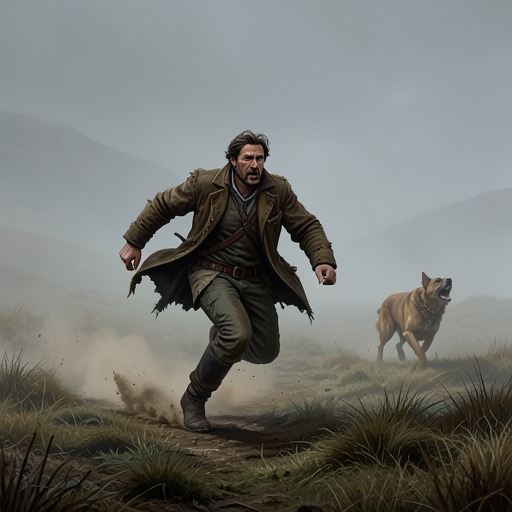
Watson and Sir Henry spring from cover as Selden’s suspicions become apparent. Selden curses them and throws a rock, which strikes the boulder that had hidden their approach. He then runs downhill. A break in the clouds allows the pursuers to see his route, but the brief advantage does not close the distance. Watson has brought his revolver for self-defence, not to shoot an unarmed man who is fleeing, and he does not fire. This restraint preserves the distinction between apprehending Selden and using lethal force, even as it removes a possible means of stopping him from a distance.
Watson and Sir Henry run after Selden, who moves quickly over the uneven ground and stones. They can follow him for some time in the moonlight, but their efforts do not gain on him; the gap grows until he is only a small figure among the rocks on a distant hillside. Exhausted, they stop and watch him disappear. Their central objective has failed: they have located Selden’s refuge and confirmed that he is close to the candle signal, but they have not returned him to custody.
The Figure on the Tor
As the two men give up the chase and prepare to go home, Watson notices another figure, silhouetted on a granite tor against the moon. He sees a tall, thin man standing still with his arms folded and his head bowed toward the surrounding moor. Watson is certain that this is not Selden: the figure is much taller and is far from the place where the convict vanished. When Watson turns to draw Sir Henry’s attention to him, the figure is gone. Sir Henry has not seen the man and therefore cannot share Watson’s certainty about the sighting.
Sir Henry suggests that the stranger might be a warder, since men have been searching the moor since Selden’s escape. Watson considers that explanation possible but does not treat it as confirmed. The contrast between the two sightings is striking: Selden has been seen clearly and pursued, while the tall figure appears only briefly and leaves no evidence by which to identify him. The pursuit thus ends not with an arrest but with two unresolved matters—the escaped convict’s continued freedom and the identity of the watcher on the tor.
Outcome and Narrative Significance
Watson reports that he and Sir Henry intend to tell the authorities at Princetown where they should search for Selden. He regrets that they have not brought the convict back themselves, but the expedition has established the location and function of the candle signal. It also clarifies that Barrymore’s actions arose from his connection to Selden rather than from an unexplained scheme against the household. Watson considers this clarification progress, while acknowledging that the moor and its inhabitants remain difficult to understand.
The episode is conveyed through Watson’s report to Sherlock Holmes, whose absence shapes the account: Watson presents the failed chase, the hound’s cry, and the stranger on the tor as observations for Holmes to assess, rather than claiming to solve their significance himself. The pursuit consequently advances one investigation while widening another. Selden’s hiding place is no longer wholly unknown, but his escape leaves the practical problem unsettled; the unidentified figure adds a further clue whose meaning remains open.