Watson follows the food boy to the moor hut
The Hound of the BaskervillesWatson follows the food boy to the moor hut, an investigation that converts an apparent lead in the search for a hidden man into a revelation about Sherlock Holmes’s secret presence on Dartmoor moorland. By tracing a child’s regular supply route, Watson finds a concealed shelter, evidence of sustained occupation, and a message reporting his own movements. The search culminates when the hut’s occupant identifies himself as Holmes, reversing Watson’s expectation that he is closing in on a stranger.
Setting and Operational Risks
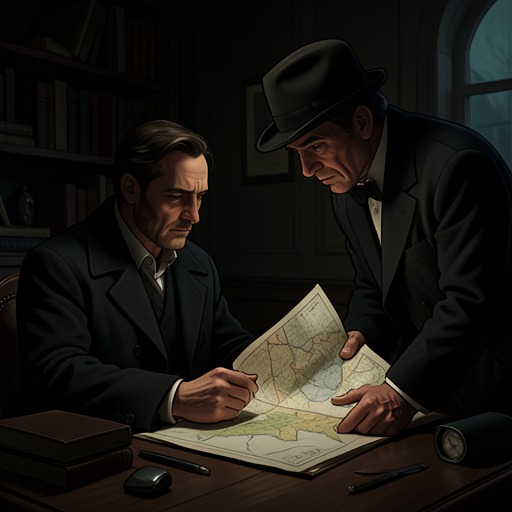
The investigation unfolds across a sparsely inhabited landscape whose geography makes observation and movement consequential. Holmes had earlier studied a large Ordnance map showing Baskerville Hall amid surrounding woodland, with Yew Alley along the edge of the moor. Grimpen village, where Dr. Mortimer had his headquarters, and Lafter Hall appeared among only a few scattered dwellings within five miles; the convict prison at Princetown lay fourteen miles away. Beyond these named points stretched the open moor, leaving few settled places in which a traveler or fugitive could readily be found.
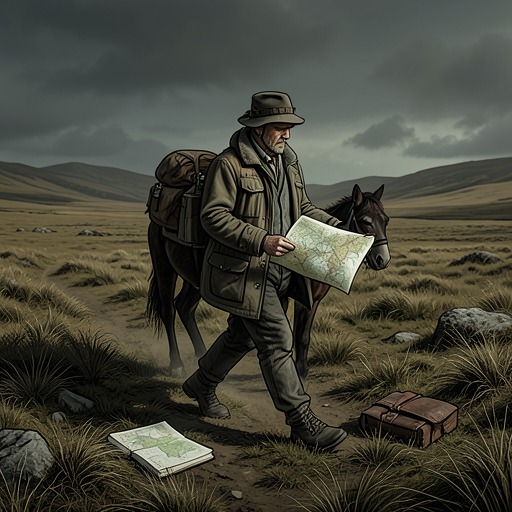
Its apparent openness is deceptive. In a conversation with Watson, Stapleton points out the bright green patches scattered across a northern plain: they look like more fertile ground, but crossing them has cost lives. He warns that safe passage depends on remembering complex landmarks. That warning gives the search for a small hut its practical danger: Watson must follow a route through a landscape where visual impressions cannot be trusted and where a wrong choice of ground may be fatal. Elsewhere, a concealed candle among rocks has served as a signal visible in the direction of Baskerville Hall, another sign that the moor’s isolated features can be used to hide or convey information. Later, a dense fog advancing from Grimpen Mire further demonstrates how quickly visibility across this landscape can become a hazard.
Frankland’s Observation and Watson’s Decision
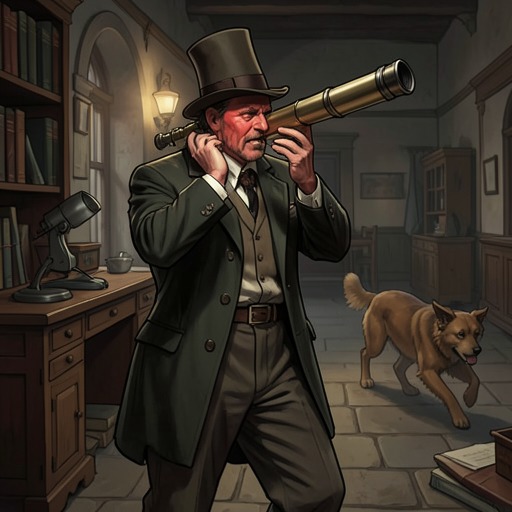
Frankland of Lafter Hall tells Watson that he has seen the person who carries food to the fugitive. He watches from a powerful telescope mounted on the roof of his house and says that the messenger is a child who passes along the same path at the same hour each day. When the boy comes into view, he is carrying a small bundle on his shoulder and moving uphill. At the crest, he looks around warily before disappearing beyond the hill. Watson acknowledges that the child appears to have a secret errand, but keeps his interest concealed: Frankland’s observation may lead him to the supplier’s destination, and revealing that interest could jeopardize the opportunity.
Frankland’s grievance against the police helps Watson leave without being escorted home. Frankland is still angry about his treatment by the authorities and declares that he will not assist them. Watson resists his invitation to stay, continues along the road while Frankland can see him, and then turns across the moor toward the hill the boy crossed. The detour is deliberate. Watson is not following the fugitive directly; he is following the person whose repeated delivery may disclose where the fugitive is hiding.
The Route to the Hut
Watson reaches the hill near sunset and surveys the ground below. The boy is no longer visible, but a group of old stone huts lies in a cleft among the hills. One retains enough of its roof to offer shelter, making it a plausible hiding place. Watson follows a faint path between boulders to the hut’s damaged entrance. It is empty when he looks inside, so the boy’s track has not immediately brought him face to face with its occupant.
The contents establish that this is not an accidental stop. A waterproof covering holds blankets on a stone slab; ashes, cooking utensils, and a bucket of water show that the hut has been used for ordinary necessities. Empty tins indicate an extended stay, while a pannikin and a bottle of spirits add further evidence of someone living there. On a flat stone used as a table, Watson finds a cloth bundle like the one he saw on the boy’s shoulder. It contains bread, tinned tongue, and two tins of preserved peaches. The food links Frankland’s observation to the hut: Watson has located the end of the child’s delivery route and, with it, the likely refuge of the person being supplied.
The Note and the Unseen Observer
Beneath the food bundle lies a sheet of paper bearing a brief report that Dr. Watson has gone to Coombe Tracey. The note changes the meaning of the search. The hidden man has not merely been using the hut as shelter; he has also been receiving information about Watson’s movements. Watson reasons that he, rather than Sir Henry Baskerville, is the person being watched, and considers whether the boy has been used as an agent. The note itself confirms the report of his destination, while the boy’s role in carrying provisions makes him a possible link in the surveillance. Watson does not find proof of who directs it or what the watcher intends.
Finding no further reports or clear indication of the occupant’s identity, Watson decides to remain in the hut and wait. Its rudimentary furnishings and exposure to rain suggest a life arranged around concealment rather than comfort, but they do not establish whether the resident is an enemy or an ally. That uncertainty keeps the discovery unresolved: the supplies identify the hut as inhabited and connected to the boy, while the message shows that its occupant has taken an active interest in Watson.
Holmes’s Appearance and the Reversal
When footsteps approach, Watson hides in the darkest part of the hut and keeps his revolver ready, intending to observe the stranger before giving himself away. Instead, the approaching voice is familiar. The occupant invites him outside, warning him to be careful with the weapon. Watson recognizes Holmes and calls out in astonishment. Holmes is seated outside the hut, thin and weathered but alert, dressed in ordinary moorland clothing that allows him to pass as a tourist.
The encounter resolves the immediate mystery without explaining every detail of the surveillance. The person living in the hut is not the unidentified adversary Watson expected to confront but Holmes, who has remained concealed on the moor. The message about Watson’s trip to Coombe Tracey confirms that his movements have been reported, but the evidence available at this point does not establish who wrote the note or exactly how Holmes obtained information about Watson. The scene’s reversal is therefore precise: Watson follows a boy to expose the hidden occupant, only to discover that the occupant is the detective whose absence had left him uncertain and alone in the investigation.