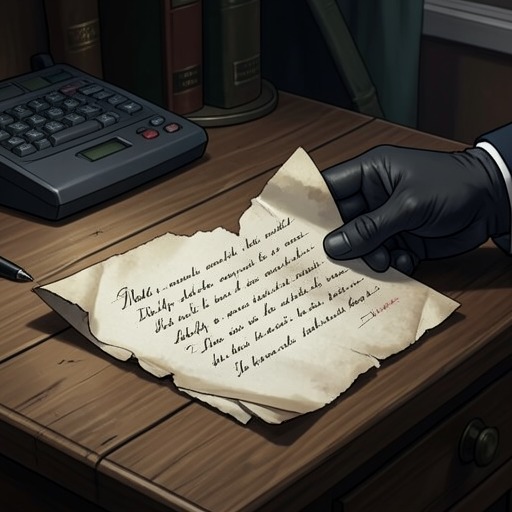
Watson investigates Laura Lyons
The Hound of the BaskervillesDr. Watson’s investigation of Laura Lyons turns a pair of initials into a troubling link with Sir Charles Baskerville’s death. It establishes that Laura had arranged to meet Sir Charles at the very hour and place where he died, while leaving unresolved whether she went there and what she withheld. Her account offers a coherent reason for seeking his help, but Dr. Watson ends the interview convinced that it explains only part of the matter.
Identifying Laura Lyons
While travelling with James Mortimer, Dr. Watson asks whether he knows a woman whose initials are L. L. James Mortimer cannot identify anyone among the farmers or gentry at first, then recalls Laura Lyons, who lives in Coombe Tracey. She is the daughter of Frankland of Lafter Hall. This brief exchange supplies Dr. Watson with a name and a place to pursue, turning an otherwise unexplained clue into a direct line of inquiry.
The question matters within a case in which motive is not separable from inheritance. Earlier, Sherlock Holmes learned that the Baskerville estate was worth close to a million pounds. If Sir Henry Baskerville died without a different disposition of the money, the estate would pass to the distant cousins, the Desmonds; the land was entailed, while the money could be left by its owner. This establishes the unusually high stakes surrounding the family succession, though it does not by itself connect Laura to any scheme. Dr. Watson’s inquiry instead tests the significance of her particular contact with Sir Charles.
The Appointment and Its Denial
Dr. Watson asks Laura what happened after she arranged to meet Sir Charles in the garden. She says she never went. When he presses her about the reason for the appointment, she refuses to disclose it, calling it private. Dr. Watson then states the essential point plainly: she acknowledges making an appointment with Sir Charles at the hour and place where he met his death, but denies keeping it. She confirms that this is true and does not move beyond that account despite repeated questioning.
The distinction between making and keeping the appointment becomes the hinge of the investigation. Laura does not deny contact with Sir Charles, and her refusal to explain the original purpose initially leaves the most consequential part of the meeting obscure. Her assertion that she never attended is also difficult for Dr. Watson to test through questioning alone. The appointment places her close to the circumstances of the death; her denial prevents that proximity from becoming proof that she was present.
Laura’s Explanation
Laura eventually explains that she had made a rash marriage and regretted it. She describes a life of continual persecution by a husband she abhors, and fears that the law may force her to live with him. When she wrote to Sir Charles, she believed there was a prospect of regaining her freedom if she could meet certain expenses. Escape from the marriage promised her peace of mind, happiness, and self-respect. Knowing Sir Charles’s reputation for generosity, she hoped he would help if he heard her story directly.
This account gives the appointment a practical and personal purpose: Laura wanted financial assistance toward recovering her freedom. She says that help came from another source before she met Sir Charles, so she no longer had a reason to keep the appointment. She did not write to cancel it because, as she explains, she saw news of his death in the paper the following morning. Her account thus explains both the original request and why she says she stayed away, while leaving the other source of assistance unidentified in this interview.
Limits and Consequences of the Inquiry
Dr. Watson judges Laura’s story coherent and finds that his questions cannot shake it. He considers whether she would plausibly have risked lying about a visit to Baskerville Hall: such an excursion would have required a trap and a return to Coombe Tracey in the early hours, making secrecy difficult. On that basis, he thinks she is probably telling the truth, or at least part of it. He cannot independently settle the matter, however, and leaves without securing further disclosure.
Her manner sustains his doubts. Dr. Watson recalls that she had turned pale and resisted each admission until pressed. These details do not prove that she attended the meeting or committed any wrongdoing, but they prevent him from treating her explanation as complete. The interview ends in frustration rather than resolution: he reaches what seems another dead end and turns back to the separate clue of the stone huts on the moor. Later, Sherlock Holmes tells him not to inform Sir Henry about the hound’s role in Selden’s death, because Sir Henry needs his nerve for the coming ordeal. That warning belongs to the wider investigation, but it underscores the conditions under which Dr. Watson’s inquiry proceeds: crucial knowledge is partial, and discoveries must be managed as well as made.