Andrew Falsely Accuses Nina of Trying to Kill Him and Their Daughter
The HousemaidAndrew Winchester’s false accusation that Nina Winchester tried to kill herself and Cecelia is the turning point that converts his private abuse into a public story of Nina’s supposed mental illness. After keeping Nina without food or water for two days, he arranges circumstances that make her rescue of Cecelia look like an attempt to drown her. The police accept that interpretation, and Nina is hospitalized for eight months, increasingly persuaded that the account of her actions must be true. The episode shows how Andrew’s control depends not only on confinement and punishment but also on making other people—and eventually Nina herself—believe his version of events.
The staged emergency
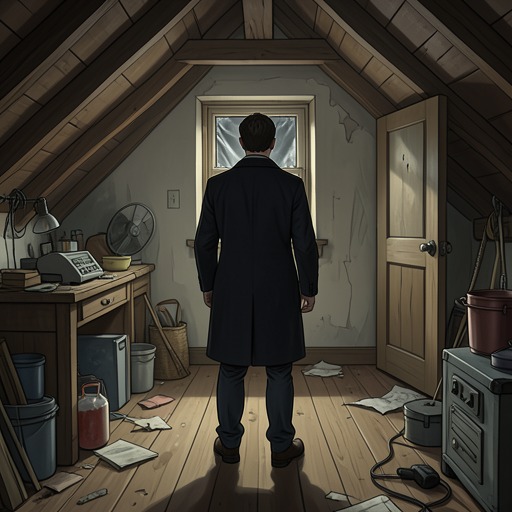
The sequence begins after Nina has spent hours pounding on the attic door and screaming, only to learn that the house is soundproofed below the attic. Andrew tells her nobody can hear her, even if he were entertaining guests downstairs. By the time she wakes later, she is weak and groggy after two days without food and water. Her phone lies on the bedside table, and messages from Andrew have woken her. Although she considers calling the police, she decides to wait until she is far away from him.
Water running in the master bathroom draws Nina from the bed. She makes it only partway across the room before collapsing to her knees, then crawls the rest of the way. Inside, she finds Cecelia propped in a bathtub with her eyes closed as the rising water reaches her shoulders. Nina sees that the water will soon cover the child’s head and moves to turn off the faucet. A uniformed man orders her not to move, but she reaches for the tap anyway. She succeeds in stopping the water before a man pulls her upright and another person removes Cecelia from the tub.
Nina is drugged and barely able to speak. She believes the police have arrived because they know what Andrew has done and that both mother and daughter are in danger. Instead, an officer asks why she was trying to drown Cecelia. Nina cannot make him understand that she was trying to save her. The officer interprets her condition as evidence that she took drugs herself and instructs a colleague to take her to hospital, while saying he will inform her husband that they arrived in time. The rescue scene thus gives Andrew’s account an apparent witness: the police encounter Nina disoriented beside a bathtub, not the confinement that preceded it.
The account Nina is made to accept
Nina spends the next eight months at Clearview Psychiatric Hospital. There, the incident is repeatedly explained as a suicide attempt in which she took sedatives prescribed by her physician, gave some to Cecelia in a bottle, and put her in the bathtub with the water running. In this version, Andrew suspects what is happening and the police save them. Nina has no memory of taking pills, giving them to Cecelia, or placing her in the tub. She also cannot remember her physician prescribing the medication, though the family doctor she and Andrew see confirms that it happened.
A therapist at Clearview attributes Nina’s memories of attic captivity to delusions arising from major depression, and describes the supposed murder-suicide attempt as a consequence of that depression. Nina initially resists the explanation: her memories of the attic are vivid, including the physical pain of pulling at her hair. Dr. Barringer explains that a delusion can feel real even when it is not. Nina is placed on an antipsychotic and an antidepressant. Though she still remembers waking to find Cecelia in the bathtub, she eventually accepts that she must have caused the emergency because she cannot see who else could have done so.
The institution’s changing treatment of Nina makes the account feel settled into daily life. When she first arrives, she is locked in her room; after improving on medication, she is allowed an unlocked room as a privilege. The antipsychotic increases her appetite, and she gains twenty pounds. Andrew visits whenever he can, arriving from work in a suit and bringing muffins and cookies for the nurses, with one saved for Nina. The staff’s affection for him and his attentive visits reinforce the public image of a devoted husband. Nina takes his apparent care as proof that he could never have harmed her, and that belief helps complete the deception: the accusation is not merely something she is told, but something she comes to use to explain her own missing memories.
Return to the house and continuing control
Andrew plans to collect Nina on Sunday at noon and drive her home while his mother stays with Cecelia. Nina is eager to see her daughter but dreads returning to the house, especially the attic. The prospect of going back exposes the divide between the apparent resolution of her hospital treatment and the danger she associates with home. Her discharge does not free her from Andrew’s account of what happened or from the setting in which he controls her.
Over the following years, Nina tries different ways to escape the marriage. She offers to leave with only Cecelia and the clothes they are wearing, but Andrew laughs at the proposal. Nina believes her psychiatric history would allow him to tell police that she had kidnapped Cecelia and might harm her again. She tries to behave as a perfect wife—cooking, keeping the house spotless, and concealing her revulsion during sex—in the hope that she will not be sent to the attic. When that fails, she attempts to repel him by snapping at him, stopping her gym visits, and eating what she wants. Neither strategy protects her. On one occasion, Andrew catches her eating chocolate cake and punishes her by starving her in the attic for two days.
Andrew’s punishments remain unpredictable. On average, he sends Nina to the attic about once every other month, though the intervals vary, including one stretch of six months. She does not know when the next confinement will occur or what supposed transgression will provoke it. The uncertainty extends the punishment beyond the hours in the attic: Nina cannot know whether she will sleep in her own bed or on the uncomfortable cot, or what treatment awaits her.
Andrew also uses Cecelia to narrow Nina’s choices. When Cecelia does something he considers unacceptable, Nina is punished. He buys Cecelia itchy, frilly dresses that other children mock; Cecelia wears them because she knows her mother may disappear for days if she refuses or gets them dirty. Nina fears Andrew may someday punish the child directly, and accepts her own punishment in the hope of sparing her. He also repeatedly puts peanut butter, to which Cecelia is allergic, back in the pantry after Nina throws it away. At times he slips some into Cecelia’s dinner, provoking welts and discomfort. Nina’s attempted departure is therefore burdened by the threat that Cecelia will pay for it.
Exposure of the deception
The later disclosures make clear how the original accusation fits Andrew’s wider system of coercive control. Nina’s memories of being held in the attic were not delusions, and her perception that she and Cecelia were in danger was justified. Andrew’s version gained force because Nina was drugged and disoriented when the police found her, because the scene appeared to support the accusation, and because her psychiatric diagnosis gave others a ready explanation for her resistance.
Andrew’s control also reaches beyond the staged bathtub scene. In a later attic encounter, he reveals that he can see Nina through a hidden camera and says he has been watching her for only the past few weeks. When she demands to be released, he calmly tells her she is not in a position to make demands. The exchange echoes the original reversal: Nina’s appeals for help are recast as evidence that she cannot be trusted, while Andrew presents himself as the person entitled to decide what is true and what happens next. The false accusation is therefore both a specific act of deception and a durable instrument of control, one that makes Nina’s attempt to protect Cecelia appear to confirm the danger Andrew claims she poses.