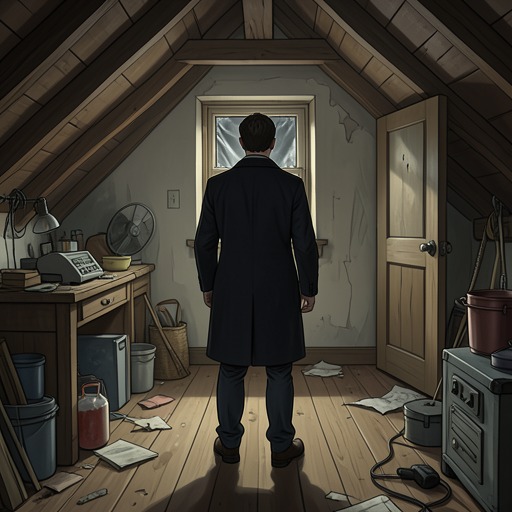
Andrew Locks Nina in the Attic Again
The HousemaidAndrew Winchester locks Nina in the attic again after persuading her that her earlier memories of captivity were delusions. In the room she recognizes the cot, bucket, and tiny bottles of water from her supposed fantasy; Andrew then confirms that he created the conditions she remembered and makes clear that he can use her psychiatric history and their daughter Cecelia to keep her trapped. The event converts Nina’s uncertainty into knowledge, but that knowledge does not free her: it begins years of recurring punishment, surveillance, and threats designed to make escape seem impossible.
Background and Return to the Attic
Nina’s return begins under the guise of reassurance. Andrew brings her to the attic staircase, promising to proceed slowly and presenting the visit as a way for her to discover that there is nothing there to fear. Nina tries to accept his explanation that the dungeon she remembers existed only in her mind. When they reach the room, she recognizes it as the storage closet she had supposedly transformed in her imagination. Andrew asks if she is all right, and she manages to say that she thinks she is.
The door opens onto darkness. Nina knows there is a window and remembers seeing a full moon from the bedroom, so the pitch-black room seems wrong even before Andrew turns on the light. At his reassurance, she steps inside and asks him to switch it on. Instead of ordinary illumination, the overhead bulbs blaze with an almost blinding intensity. As Nina shields her eyes, she hears the door slam. Once she can make out the room, its contents match her memories: a dingy cot, a closet with a bucket, and a mini fridge that had held three small bottles of water. The apparent contradiction between Andrew’s explanation and the room itself collapses; Nina’s supposed delusion has a physical setting.
The Punishment and Its Design
When Nina asks for the light to be turned off, she finds the cord and plunges the room into darkness. Relief lasts only briefly before she realizes that she cannot see. Andrew explains that he boarded up the window the previous week and installed new lights, leaving Nina with a choice between total blackness and harsh brightness. The light is not simply a practical feature of the room: he makes access to ordinary vision conditional, then frames deprivation as discipline for wasting electricity. His appeal to people in other countries who lack electricity turns a household rule into a justification for punishment.
Andrew reinforces the trap by insisting that Nina’s previous confinement was real, despite the story he has taught her to tell herself. He invokes her hospitalization after trying to kill herself and Cecelia, her admission to the attempt, and the police finding what appeared to be an ordinary storage closet when they came to investigate. Those details give him a ready-made explanation for any account Nina might later offer: her history will make the truth sound like another delusion. He tells her that he wanted her to understand what would happen if she tried to leave. When he says she must first be disciplined for wasting electricity, Nina recognizes the language of an earlier punishment and sinks to her knees.
The event turns on the reversal between Nina’s belief and Andrew’s admission. She had been led to distrust her memory; now Andrew confirms its accuracy while demonstrating that the room has been altered to intensify the same control. The blinded window and extreme bulbs make that confirmation bodily as well as verbal. Nina can no longer dismiss what happened as a fantasy, but proof alone gives her no leverage against the person who controls the door.
Release Under Conditions
Andrew eventually tells Nina that he will let her out, but makes release conditional on new rules. She must tell no one what happened in the room—not her friends, not her doctor, and not anyone else. He warns that disclosure will be treated as evidence that she is delusional again and that Cecelia may be in danger. The rule converts Nina’s medical history into a means of silencing her and makes the threat to her daughter part of the mechanism of confinement.
He also establishes that future discipline may take place in the attic. Nina objects, but Andrew dismisses her objection and says she is in no position to negotiate. He presents the punishments as being for her own good and the marriage as ordinary, while insisting that he will make her the best wife in the neighborhood. His assurance that he is always watching her leaves no boundary between the public appearance of a settled marriage and the private system of control. The attic is therefore not a single episode of confinement: Andrew establishes it as a standing threat that can be invoked whenever he decides Nina has broken a rule.
Years of Coercive Control
Seven years into the marriage, Nina describes Andrew as financially supportive, even-tempered, and outwardly almost perfect, while also stating that she hates him. That contrast is one consequence of the renewed imprisonment: the respectable husband presented to others coexists with the man who repeatedly punishes her in secret. Nina tries several ways to escape or reduce the danger. She offers to leave with only Cecelia and the clothes they are wearing, but Andrew laughs; she knows he could tell the police that she had kidnapped their daughter and might hurt her again.
Nina first attempts compliance. She cooks elaborate dinners, keeps the house spotless, and pretends not to be repulsed during sex, hoping that a performance of the perfect wife will prevent another trip upstairs. It does not. She then tries to repel Andrew, snapping at him and changing her eating and exercise habits in the hope that he will lose interest. He instead punishes her for eating chocolate cake by taking her to the attic and withholding food for two days. Nina cannot identify a reliable rule: on average, Andrew sends her to the attic every other month, sometimes more often and sometimes less, with one six-month interval between visits. The unpredictability makes her unsure whether she will sleep in her own bed or on the uncomfortable cot, and she never knows what alleged transgression will be used to justify the next punishment.
Cecelia is also drawn into the system. Andrew buys her itchy, frilly dresses that she dislikes and that other children mock. Cecelia wears them because she understands that refusing or dirtying them may make her mother disappear for days, likely to be punished by being kept naked. Nina fears that Andrew may eventually punish Cecelia directly, and accepts punishment herself in the hope of sparing her daughter. Andrew also keeps peanut butter in the pantry despite Cecelia’s allergy. Nina repeatedly throws it away, only for it to reappear; Andrew sometimes puts a little into Cecelia’s dinner, producing welts and discomfort to prove his point. His earlier threat that Cecelia could be in danger thus becomes an ongoing method of controlling Nina’s choices.
Significance
The renewed imprisonment establishes the attic as the hidden counterpart to Andrew’s respectable household: a place where ordinary objects, such as a light switch or a child’s clothes, can be turned into instruments of discipline. Its soundproofing means Nina’s screams cannot reach the neighbors, while Andrew’s use of her psychiatric history makes her account vulnerable before she even speaks. Her eventual certainty that the earlier captivity was real is a decisive change in understanding, but not an immediate change in power. The event explains why subsequent resistance is constrained by secrecy, fear for Cecelia, and the expectation that punishment can recur without warning. Andrew’s later assurance to another captive that she is not in a position to make demands echoes the same coercive logic: he treats a locked door, surveillance, and control of the story as parts of one system.