Connors closes the investigation into Andy's death as an accident
The HousemaidDetective Connors’s decision to treat Andrew Winchester’s death as an accident closes the immediate threat of Nina Winchester’s arrest. The scene turns on an unlikely account of a locked attic room, then on a revelation about Connors’s own connection to Andrew: instead of using his authority against Nina, he recognizes the story’s significance and lets her leave without handcuffs.
The attic account under scrutiny
Nina has already tried to keep Millie Calloway out of the investigation. She explains that she gave Millie the week off because Cecelia Winchester was away at camp, and says she has not seen Millie all week. Nina knows investigators may try to contact Millie; her effort to remove Millie from suspicion is, in her view, the least she can do after what she did to her. The explanation places Nina in the role of someone managing the investigation’s possible consequences for another person, even as she faces scrutiny herself.
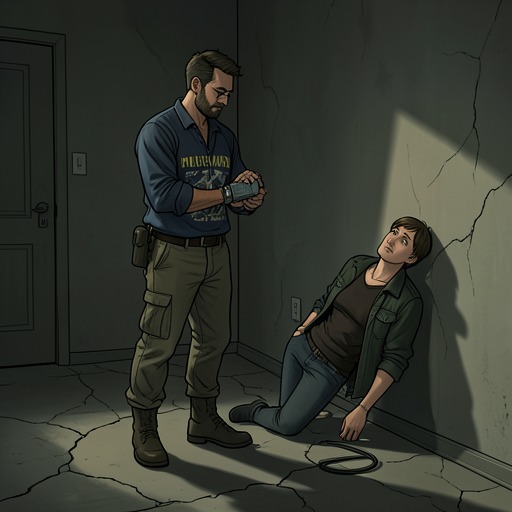
Connors tests the account by setting out its physical oddities. Andrew was a grown man who supposedly became locked in an attic room without his phone, although the room could only be locked from the outside. While trapped there, he apparently pulled out four of his own teeth. The detective’s pointed restatement makes the circumstances sound less like an ordinary accident and more like a story that demands disbelief. Nina recognizes the force of his framing; the account becomes harder to sustain when its details are heard together.
Connors’s personal connection
Nina initially reads Connors through her fear of the Winchester family’s influence. His age and appearance make her think he could belong among the golfing companions of Andrew’s father, or among people who benefited from the family’s generosity. Her wrists begin to tingle as she anticipates being handcuffed. That expectation gives the conversation a second pressure: she is not only answering questions about Andrew’s death, but bracing for the possibility that the local power she associates with the Winchesters will turn against her.
Connors interrupts that assumption by disclosing that his daughter knew Andrew personally. Her name is Kathleen Connors, and she and Andrew had been engaged long before. The revelation changes the detective’s position in Nina’s eyes: he is not merely another possible beneficiary of the Winchester family’s connections, but a father with a personal reason to wonder what Andrew had done to his daughter. Connors says the breakup was painful, that Kathleen would not talk about it, and that she moved far away and changed her name. She has not dated a man since. Her silence and withdrawal do not establish what happened between the former fiancés, but they give Connors’s suspicion a history that predates his investigation of Nina.
From suspicion to an accidental death
Connors explains that he transferred to the area about a year earlier and began looking into Andrew’s history. Nina had claimed that Andrew locked her in the attic, but nobody could verify her account. Connors adds that, in his view, very little had been done to try. The Winchesters once had considerable influence in the area, including among some police officers, before moving to Florida; Connors draws a clear boundary between that past influence and his own conduct. His disclosure links the family’s standing to the earlier failure to substantiate Nina’s allegations, without claiming that he can now prove them through this interview.
He then offers the explanation that changes the encounter’s direction. The attic, he says, is a hazard because it is too easy to become locked inside. Andrew’s entrapment can therefore be treated as a cautionary tale, and Connors indicates that a contact in the coroner’s office will likely agree. The language recasts the suspicious details he had just listed: the room’s outside lock is no longer only evidence against Nina’s account, but the basis for an accidental explanation of Andrew’s death. Connors does not spell out every investigative step or announce a formal finding; his remarks and departure convey that he will not press the case toward Nina’s arrest.
Release and significance
After one last long look at Nina, Connors goes upstairs to join his colleagues. Nina understands that she will not leave in handcuffs. The reversal is immediate but not uncomplicated: the same attic that made Andrew’s death look implausible becomes the hazard that allows the authorities to accept it as an accident. Connors’s personal knowledge of Kathleen, his judgment that Nina’s earlier claims were not seriously tested, and his refusal to defer to the Winchesters’ former influence all inform the exchange, while the evidence does not specify his private reasoning beyond what he tells Nina.
The scene resolves the immediate danger of Nina being treated as a suspect, but it does so through a deliberately cautious account rather than a full public reckoning with Andrew’s conduct. Connors’s description of the attic as a cautionary tale converts a place associated with coercion and confinement into a sufficiently ordinary explanation for death. His choice protects Nina from arrest, while the lack of a detailed disclosure leaves the circumstances of Andrew’s abuse and the earlier failure to investigate them largely unspoken.