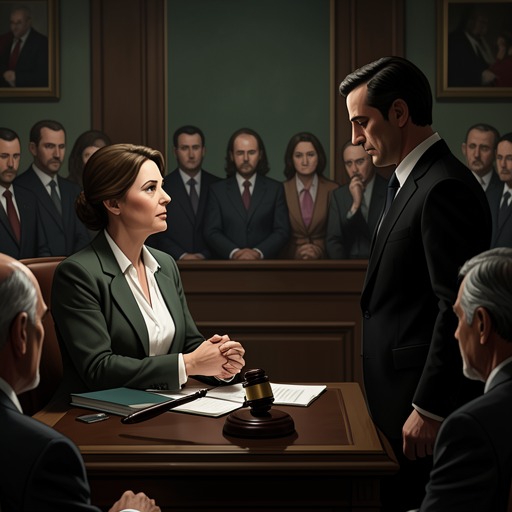
Detective Connors
The HousemaidDetective Connors is the investigator who questions Nina Winchester after Andrew Winchester is found dead, and his interview becomes more than a test of her explanation. As he probes the bruising and the circumstances of Andrew’s disappearance, he reveals a personal connection to Andrew: Kathleen Connors, his daughter, was once Andrew’s fiancée. That disclosure changes the force of the questioning. Connors is not simply assessing a suspicious death; he has long wondered what Andrew did to Kathleen, and he recognizes that Nina’s account of attic confinement was never properly investigated.
The Investigator and the Case
Connors appears as the investigation turns back to Nina. After descending the stairs, he sits opposite her and asks about bruising on Andrew’s body. Nina is genuinely surprised by the question: she knows that Andrew is missing teeth, but says she did not press Millie Calloway for further details about what happened in the attic. Connors follows the discrepancy rather than treating her first answer as sufficient.
He lays out the story Nina appears to be giving: Andrew must have been locked in the attic accidentally, and she somehow failed to realize he was missing. He tests that account against the couple’s lack of calls or text messages during the period in question, and against information from Andrew’s parents that Andrew had asked Nina to move out the previous week. These details make the supposed accident difficult to separate from the strained circumstances of the marriage. Connors’s questions focus not just on how Andrew could have become trapped, but on whether Nina’s explanation fits what was happening between them.
The interrogation also brings the physical evidence into view. When Connors asks about bruising, Nina insists that she does not know what happened upstairs and challenges the suggestion that she beat Andrew, pointing out that he was taller and more muscular than she was. Her response shows the danger she perceives in the inquiry: suspicion could turn the death into an accusation against her. Connors does not immediately resolve that danger for her. Instead, he keeps asking questions and watches how she answers.
Kathleen Connors and Andrew’s Past
The interview changes when Nina asks whether Connors knew Andrew. He first clarifies that he did not know him personally, then explains that Andrew had been engaged to Kathleen Connors a long time earlier. The revelation gives Connors a personal stake, but it does not make him an eyewitness to the former relationship. He tells Nina that the breakup was difficult for Kathleen: she would not talk about it, moved far away, changed her name, and has not dated a man since.
Connors’s account is defined as much by what he does not know as by what he discloses. Kathleen has not explained the breakup to him, and he cannot give Nina a firsthand account of Andrew’s conduct toward her. Still, he admits that he has always wondered what Andrew did to his daughter. The implication is not a proven history of abuse between Andrew and Kathleen; it is Connors’s unresolved suspicion, rooted in the aftermath he observed and in Kathleen’s continued silence.
Reopening the Attic Story
Connors says that after transferring to the area about a year earlier, he began looking into Andrew. He found it striking that Nina had claimed Andrew locked her in the attic, while nobody could verify that her story was true. He also recognizes that the absence of verification does not mean the claim received a serious examination: in his view, nobody had done very much to investigate it. His distinction matters. The attic story had been treated as unsupported, but Connors questions the process that left it unsupported.
He connects that failure to the influence of the Winchester family. Before moving to Florida, the family had considerable pull in the area, including with some police officers. Connors separates himself from that history, telling Nina that he was not among those influenced by the family. His statement positions him as an investigator willing to question an account that earlier local scrutiny had failed to establish, while also acknowledging how power could shape what authorities chose to pursue.
The Cautionary Tale
After pressing Nina about the evidence and her marriage, Connors shifts from interrogation to a pointed description of the attic. He calls it a hazard, noting how easily someone can be locked inside. He then suggests that the coroner will agree and frames Andrew’s death as a cautionary tale. Nina repeats the phrase, recognizing the protection embedded in it: the attic can be treated as a dangerous place where an accidental confinement occurred, rather than as the scene of a killing she might be asked to explain.
Connors’s final conduct is deliberately consequential. He gives Nina one last long look and returns upstairs to his colleagues; the scene does not show him presenting a confession or establishing exactly what happened in the attic. Instead, his words offer a way for the death to be understood without forcing Nina to admit what she knows. The earlier investigation’s failure to verify her account, the family’s former influence, and Connors’s knowledge of Kathleen’s painful history converge in that choice. His connection to Andrew’s past does not supply proof, but it changes how he reads the present case—and his closing remarks suggest that he will not turn suspicion into a charge against Nina.