Hidden camera
The HousemaidThe Hidden camera is the concealed instrument through which Andrew Winchester watches Millie Calloway in the attic, making his control extend beyond the room itself. Its importance lies not only in what it records but in the imbalance it creates: Andrew can observe Millie without being seen, while she initially does not know that her private actions have become visible to him. Once Millie gets hold of Andrew’s phone, however, the camera’s images also give her a way to monitor him and understand the conditions of his confinement.
Discovery and Operation
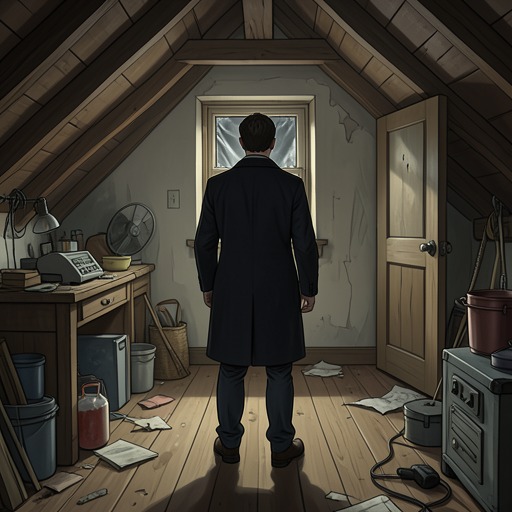
Millie learns that Andrew can see her when he challenges her denial and explains that he can see her. She searches the walls for a camera, but he tells her she will not find it because it is well hidden. He also says he has not been watching her throughout her time there, only since a few weeks earlier. The distinction limits his claim about how long he has actively monitored her, but does not make the discovery less threatening: the room she understood as private has an unseen observer.
Andrew’s explanation establishes the camera as part of a deliberate system of watching rather than a chance glimpse. Millie’s immediate response is to scan the room and wonder how long he has been spying on her. The device is effective precisely because it remains out of sight; the attic’s walls no longer mark a boundary between what Andrew can know and what Millie can keep to herself. Her uncertainty about the camera’s position becomes part of the coercion, since she cannot identify or avoid the point from which she is being watched.
The phone interface later makes the camera’s operation concrete. When Millie asks how Andrew could tell exactly how long she had been doing something, he opens an app and shows her a crisp, high-resolution color image of the room. It displays both of them sitting on the bed, with enough detail for Millie to see her own pale, hunched appearance and stringy hair. Andrew likens the image to a movie, presenting the view as something he can inspect rather than as a record of her distress. The screen turns surveillance into a performance he can show her: he is not merely aware of her actions, but can demonstrate that he has watched.
Surveillance as Control
The camera gives Andrew informational power over Millie. He can challenge what she says because he can compare it with what he has seen, and he can assess the timing of her actions closely enough to question how long she has followed an instruction. The device therefore supports the attic’s punitive rules: Andrew can watch, evaluate, and decide whether Millie has done something correctly. His authority is not confined to being physically present in the room.
The image also changes the meaning of the attic for Millie. She had already been made a prisoner there, and Andrew’s hidden observation confirms that confinement includes a loss of privacy as well as freedom of movement. When the phone shows her hunched and visibly worn down, the camera gives Andrew an image of the suffering he has imposed. Millie understands that he watched her endure the day and expects to make her endure another, potentially longer punishment. The recording capacity makes the threat feel repeatable: an episode of punishment can be observed and measured, not simply inflicted and forgotten.
The book also presents a separate form of digital monitoring through the phone Nina Winchester gives Millie to use. Patrice points out that Nina installed a tracking app, and Millie realizes Nina could therefore know where she was on the night of the show without searching her purse or calling the house. This location tracking is not the attic camera, and the evidence does not identify the two as one system. Their juxtaposition nonetheless shows how ordinary phones can carry surveillance into daily life: one tracks Millie’s movements, while the hidden camera exposes her conduct inside a locked room.
Reversal and Narrative Function
After Millie takes Andrew’s phone, its screen gives her access to the camera’s view of him. When Andrew demands his phone and threatens to call the police, Millie answers that he cannot do so while she has it. Looking at the screen, she sees him standing there in vivid color, his face red from pepper spray and tears on his cheeks. The apparatus that had made Andrew the unseen observer now supplies Millie with information he does not control. The shift does not erase the violence or restore an ordinary relationship between them; it alters who has access to the image and who can act on what it reveals.
Later, when Millie thinks Andrew may have left the room, movement on the phone’s screen shows him beneath the covers on the cot, so still that she had not noticed him. She rewinds the room’s video and watches him lying on the floor, grimacing under the weight placed on top of him. The footage establishes that he endured the imposed position for five hours. Millie treats that duration as relevant to her side of their bargain and decides that she must now let him out. In this moment, the camera is not simply a means of watching: its recorded sequence lets Millie verify what happened and measure the time.
The Hidden camera thus changes function without changing its basic capacity to observe. First it helps Andrew enforce his authority while remaining outside Millie’s awareness; later, the same visual access lets Millie check Andrew’s condition and determine when to act. The shift makes surveillance a contested resource rather than a power that belongs permanently to the person who installed or controlled it. Its most important consequence is the reversal of visibility: the hidden image that once exposed Millie to Andrew becomes evidence through which she can see him.