Incarceration and reentry
The HousemaidIncarceration and reentry are not a completed before-and-after divide in Millie Calloway’s life: release leaves her still subject to parole, vulnerable to losing work and housing, and afraid that a misstep will send her back to prison. The novel traces reentry through concrete pressures—an unaffordable phone, a job search conducted from her car, concealed setbacks, and a locked room that revives the memory of her cell—rather than presenting freedom as a clean break from confinement.
Release and the precarious search for work
Less than a year after leaving prison, Millie is still trying to make a fresh start. A potential employer addresses her by her full name, Wilhelmina Calloway, rather than the name she uses, Millie. She corrects people quickly, but this caller is not someone with whom she expects to establish familiarity. Her prepaid flip phone is the kind she can afford, and it serves as a lifeline in a job search where each call might matter.
When one employer, Ms. Stanton, ends the call without offering her another location, Millie is left holding her sandwich and phone in the back seat of her Nissan. She believes potential employers all look at her the same way and feels that nobody wants to hire her. Her desire for a fresh start is joined to a willingness to work hard and do whatever is required, but determination alone cannot make an employer give her a chance. The scene establishes how little security she has: even the space where she eats is her car, and the rejection lands in private, without anyone there to witness her distress.
A later call changes the immediate direction of that search. Millie exchanges details with Nina Winchester about coming to work the next day, while keeping her imprisonment undisclosed. She wonders whether Nina would feel the same way about her if she knew she had spent the previous ten years in prison. The new job therefore offers an opening, but not an uncomplicated new beginning: Millie enters it carrying a history she fears could determine whether she is accepted.
Parole, concealment, and the threat of return
Three weeks after moving in with the Winchesters, Millie schedules her first meeting with her parole officer, Pam, for a day off because she does not want the household to know where she is going. Her supervision is down to monthly meetings. The contrast between that routine and her earlier instability is significant: immediately after release, she lived in housing subsidized by the prison; Pam helped her obtain a waitressing job; and she then moved out to live independently. When the job and apartment were lost, however, Millie did not tell Pam either development.
The omissions carry explicit legal stakes. Millie understands that lying to her parole officer violates parole, as does having no residence and living in her car. She fears that parole could be revoked and that she would have to return to prison to serve the final five years of her sentence. Her concealment is not simply reluctance to discuss a difficult period: she is trying to avoid a consequence that could erase the fragile independence she has managed to establish. By the time circumstances improve, she can be honest with Pam only almost completely.
One concealed setback concerns Charlie’s, where Millie tells Pam she quit. In fact, she was fired. The employer agreed to let her go quietly without involving the police; Millie believes that if the police had become involved, she would have gone straight back to prison. That agreement leaves her with little room to explain what happened without risking further scrutiny. She withholds the firing because she expects Pam to contact the employer and ask why she left, and that same fear helps explain why she also hides losing her apartment.
The return of confinement
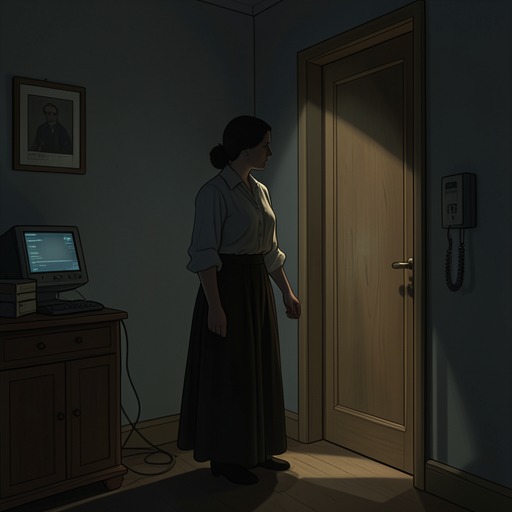
The memory of imprisonment surfaces with particular force when Millie finds herself locked in the attic room at the Winchesters’ home. The locked door sends her back to the first night ten years earlier, when her cell door shut and she understood that prison would be her home for a long time. She remembers having sworn that, if she ever got out, she would never again let herself be trapped in any situation. Now, less than a year after release, she is locked in a room once more.
The recollection makes her present fear more than a response to a locked door. The physical confinement connects the new danger to the institutional confinement she had hoped to leave behind, exposing how quickly a supposedly ordinary opportunity can become another setting in which she has little control. The parallel also gives her vow a painful measure: release has not removed the possibility of being trapped, and her determination to avoid confinement cannot by itself guarantee safety.
Reentry and the limits of security
At her meeting with Pam, Millie is able to say that circumstances have turned around, but her account remains qualified by everything she has concealed. Pam asks about the job at Charlie’s, and Millie maintains that she did not like it; the truth that she was fired remains unspoken. Her new employment and shelter make it possible to present a more stable version of her life, but the old vulnerabilities have not disappeared simply because she has found work again.
Pam also stresses that employment and shelter matter, while human connections matter even more. Millie is not ready to focus on relationships. Her immediate priority is keeping her record clean and avoiding a return to prison. That response defines the tension at the heart of her reentry: building a life requires more than work and a place to stay, yet supervision and the fear of renewed incarceration make even ordinary risks feel consequential. The novel presents release as a beginning whose freedom remains conditional, practical, and repeatedly unsettled.