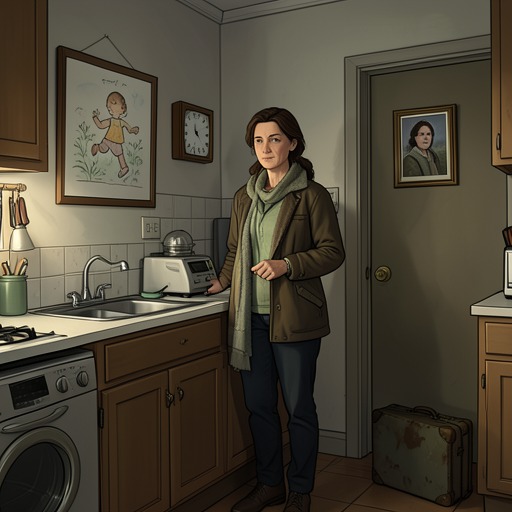
Millie agrees to help Lisa escape an abusive relationship
The HousemaidMillie agrees to help Lisa Killeffer after recognizing a bruise on her arm as evidence of possible abuse. The epilogue makes the request a turning point: Millie’s precarious search for work becomes an opportunity to act on the hard-earned knowledge Nina understood she possessed.
The Interview and the Recommendation
Nearly a year after the events at the Winchester house, Millie is interviewing for a housekeeper position in Lisa’s newly renovated kitchen. She has managed a few odd jobs, but has been living on the deposit Nina made to her bank account after Andrew’s death was ruled accidental. Millie did not apply for Lisa’s opening; Lisa found her advertisement for cleaning and nannying services and contacted her. The salary is attractive, but Millie knows that her prison record remains a barrier to employment, and she is trying to present herself with confidence.
The interview initially concerns ordinary domestic work: cleaning, laundry, and light cooking. Then Lisa explains that Nina Winchester recommended Millie highly. Nina has moved to California with Cecelia, and her recent contact with Millie has been limited to a photograph of herself and Cecelia at the beach and a brief expression of thanks. Her recommendation carries a meaning Millie does not grasp until she notices Lisa tugging at her collar and sees a dark-purple bruise on her upper arm, marked like the grip of fingers. On the refrigerator, a photograph shows Lisa beside a tall, stocky man. The juxtaposition leads Millie to understand why Nina directed Lisa to her.
The Recognition Becomes a Choice
Lisa’s recommendation from Nina is followed by a charged pause: while discussing the job, Lisa toys with a knife in the kitchen block, tugs at her collar, and reveals a dark-purple bruise on her upper arm shaped like fingers. A photograph on the refrigerator shows her beside a tall, stocky man. Millie connects the mark to the man’s possible grip, though she cannot know from the photograph alone what happened. Lisa’s anxious manner and the bruise give the interview a second meaning. Nina has not simply helped Millie find employment; she appears to have sent her toward someone who may need help herself.
The request makes that implication explicit. Lisa slides the knife back into its block, straightens, and asks whether Millie can help her. Millie answers yes. The exchange changes the scene from a job interview into a commitment to assist a woman whose visible injury suggests abuse. It also gives new meaning to Nina’s confidence in Millie: Nina recognizes a capacity for intervention that Millie’s criminal record, unstable work, and difficult history might otherwise obscure.
A Pattern of Intervention and Its Cost
Millie’s decision to help Lisa resonates with a history in which intervening against sexual aggression has repeatedly brought her punishment rather than recognition. At sixteen, while attending a boarding school for teenagers with disciplinary problems, she heard a friend screaming from a bedroom in the boys’ dormitory. Inside, she found a two-hundred-pound football player assaulting her friend and struck him repeatedly with a paperweight; he died before reaching the hospital. The photographs of his crushed skull made it difficult to argue that she had not intended to kill him, but Millie pleaded guilty to the lesser charge of manslaughter. The boy’s family wanted vengeance while also agreeing to avoid having him publicly branded a rapist. Millie accepted the deal in part because a trial could have brought other incidents to light, including an earlier fight in which she pushed a boy from the monkey bars and broke his arm.
Her later recollections make clear that the boarding-school case was not an isolated experience of being disbelieved or penalized after responding to mistreatment. After she said a teacher had threatened her over math unless she let him touch her, her mother did not believe her and sent her away to boarding school. Years later, a bartender named Kyle repeatedly grabbed her; Millie punched him, he declined to press charges, and she lost the job. In another intervention, she killed Duncan while he was forcing himself on Kelsey, but Kelsey subsequently looked at her with disgust and never spoke to her again. Millie could not understand why the person she had acted to protect rejected her. Against that history, her affirmative answer to Lisa is not a guarantee that helping will be safe or welcomed; it is a choice made despite the personal costs that have followed her earlier attempts to protect others.
The Risks and Limits of the Commitment
The offer arrives against a background of legal and economic insecurity that makes any new entanglement consequential. Millie’s parole requires her to maintain a residence and avoid police involvement. She has concealed from her officer, Pam, that she was fired from a waitressing job and evicted; she feared that explaining the firing would prompt Pam to contact her former employers, and that losing her home could send her back to prison. The history does not make her acceptance of Lisa’s request a simple rescue narrative: Millie is taking on another person’s danger while her own stability remains fragile.
Nina’s recommendation links this choice to a chain of women recognizing what others have failed to see in Millie. Her past interventions have cost her friendships, work, and freedom, and have often been treated as evidence against her rather than as attempts to protect someone. The epilogue does not show what happens after she agrees to help Lisa, or promise that this attempt will be safer or more successful. It ends instead at the point of commitment: Nina’s private confidence in Millie has become an opening for Lisa, and Millie chooses to answer it despite the uncertainty.