Millie’s captivity in the attic
The HousemaidMillie Calloway’s captivity in the attic begins with a locked door she initially tries to explain as an accident, then becomes a calculated punishment imposed by Andrew Winchester. When he makes her balance three books on her abdomen for three hours and watches her through a hidden camera, the room’s confinement becomes part of a larger system: Andrew controls the door, the terms of release, and even Millie’s knowledge of whether he is watching.
Conditions and Context
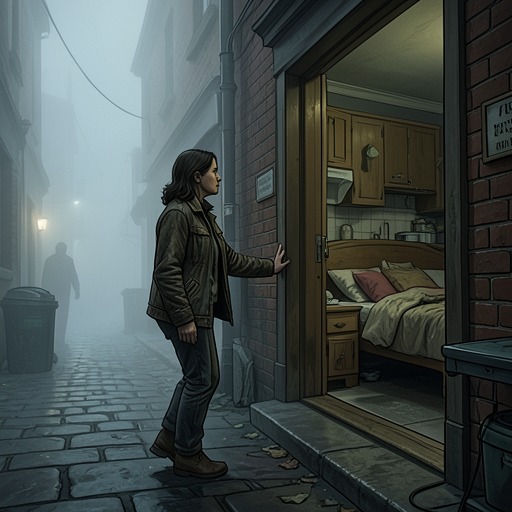
Millie is trapped in an attic room after reading books from Andrew’s bookcase. At first, she clings to the possibility that he has locked her in by mistake. That explanation collapses when Andrew confirms that he has the key and refers to the books he left on the floor. The placement of the books, which she had nearly tripped over, is revealed as preparation for a punishment rather than an accident or oversight.
The captivity echoes Andrew’s earlier treatment of Nina Winchester, though the experiences belong to different women and occur in distinct circumstances. Nina describes being sent to the attic unpredictably, on average every other month, without knowing what supposed transgression will be punished or what ordeal awaits her. Andrew also uses Cecelia Winchester’s clothing and allergy to peanut butter to make Nina’s compliance answer to her daughter’s safety. That history establishes a pattern of punishment and coercion; Millie’s own confinement gives it a new target.
From Accidental Lock-In to Deliberate Punishment
Millie’s uncertainty turns to alarm when Andrew asks whether she remembers reading his books. She understands that he can open the door, but release is made conditional: first she must lie on the floor and balance the three textbooks on her stomach. The demand converts the room from a place where she is inexplicably stuck into a controlled punishment site. Andrew alone sets the task, and Millie cannot leave simply by asking.
He later frames the ordeal as a lesson, insisting that wrongdoing must be taught and that doing the task correctly the first time would have spared her a repeat demand. His calmness sharpens the imbalance: Millie pounds on the door and pleads to be let out, while he decides what she must do and when the conditions have been met. He tells her she is not in a position to make demands, making explicit the power the locked door has already enforced.
The Three-Hour Ordeal
The books remain on Millie’s abdomen for two hours and fifty minutes before the three-hour mark. Andrew has also left her with water bottles; once she has drained the third, her desperation to get out intensifies. She imagines waterfalls and keeps enduring the discomfort because completing the task seems to offer a chance of release, even though she has no guarantee he will open the door afterward.
At three hours, Millie shoves the books off her belly. The relief is immediate, but sitting up makes her abdomen ache badly enough to bring tears to her eyes, and she expects bruises. She pushes through the pain to pound on the door and announce that she has finished. Andrew does not come. The task’s completion therefore does not restore control to Millie: she still does not know whether he is in the house, at work, or somewhere else, while he knows where she is.
Surveillance and Recognition
Andrew’s absence is not the same as his ignorance. When Millie challenges him about how he could know what she was doing, he answers that he can see her. She searches the room for a camera, but cannot find it; Andrew says it is well hidden and that he has been watching only since a few weeks earlier. The revelation retrospectively changes the meaning of her confinement. The room has not merely kept her physically contained: it has also allowed Andrew to observe her without her knowing when or how she is being watched.
Andrew brings up an app on his phone and shows Millie a crisp, high-resolution color image of the room, including the two of them sitting together on the bed. He presents the image as impressive, but for Millie it confirms the violation behind his apparent knowledge of her actions. Her first response to the discovery is bodily shock; the unseen camera has made the room’s walls signify not privacy but exposure. Andrew can inspect her from elsewhere, while she cannot see him or even locate the device that makes that observation possible.
Significance
The episode marks a decisive change in Millie’s understanding of Andrew. She recalls that she had taken him for kind, normal, and wonderful, then recognizes that his aim is not simply to marry her but to make her a prisoner. The locked door and the books make his purpose concrete: affection and promises no longer explain his behavior as a mistake, because he has knowingly designed a punishment and withheld the means of escape.
The three-hour limit offers only the appearance of a boundary. Millie endures the physical strain, completes the task, and calls for release, yet Andrew does not immediately answer; even the hidden camera gives him knowledge without giving her reciprocal access. In this captivity, pain, uncertainty, and surveillance reinforce one another. The attic is not just a room that separates Millie from the rest of the house: it is where Andrew makes her dependence on his permission visible, and where her image of him gives way to recognition of the captor he has become.