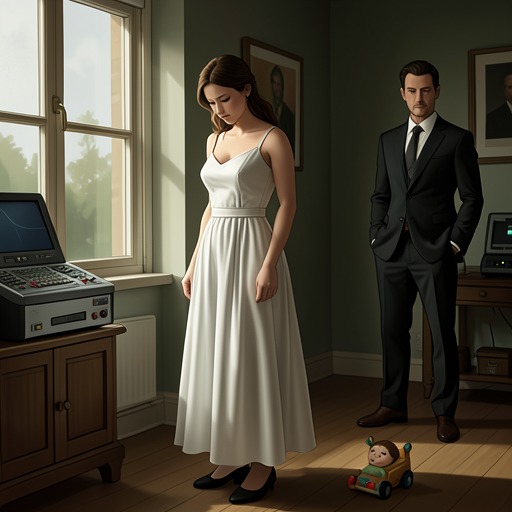
Nina and Andrew learn Nina cannot become pregnant again
The HousemaidNina and Andrew learn that Nina will not become pregnant, ending their shared expectation of another child. The appointment had been approached as a hopeful next step toward IVF and a nursery; its outcome instead leaves Andrew grieving a future he had imagined and Nina, as he later describes her, devastated. The scene matters both for that intimate reversal and for the way the couple’s private hopes sit within a marriage whose later history is recast by coercion, contested memories, and the use of Nina’s psychiatric history against her.
Anticipation and the Appointment
For the week before their consultation, Nina and Andrew are both nervous and excited. Nina has undergone a series of fertility tests, and the appointment is to discuss the results. She expects that they will move on to IVF. Its expense does not seem prohibitive to the wealthy couple, and their conversations have already turned toward the practical shape of a new baby’s arrival: they plan to transform the guestroom into a nursery. From Millie Calloway’s perspective, their anticipation appears mutual; she cannot tell which of them is more excited and hopes they will conceive soon.
While the couple are at the appointment, Millie is responsible for Cecelia. The ordinary details of that arrangement give the hoped-for baby a place in the household before the consultation has even delivered its answer. Cecelia, nine years old, returns from an activity with a friend’s mother and scatters her shoes and backpack in different directions. Millie is left to watch her amid the small disorder of family life, while Nina and Andrew pursue the possibility of adding another child to it. The contrast is not a conflict between Cecelia and the hoped-for baby: Andrew later makes clear that he loves Cecelia. Rather, the scene establishes that the couple’s wish for another child exists alongside a daughter who is already part of their family.
The News and Andrew’s Grief
After the specialist has given the results, Andrew tells Millie that Nina is not going to get pregnant. Millie is surprised; she has little knowledge of fertility treatment and had assumed that wealth might enable the couple to overcome the problem. But she accepts that a leading specialist’s judgment carries authority she cannot challenge. Her initial impression of the appointment as a step toward IVF gives way to the finality of Andrew’s account: there will be no baby.
Andrew does not present the news as a simple medical fact. He says he is trying to accept it but cannot deny his disappointment. He loves Cecelia as though she were his own, yet he had wanted a child and had always dreamed of becoming a father in a different way. His qualification holds affection and loss together: his love for Cecelia is not withdrawn, but it does not erase the future he had hoped to share with Nina. Millie recognizes this as the deepest conversation she and Andrew have had. She offers sympathy, and he looks down at his lap as he says he needs to be strong for Nina, who is devastated.
What the Scene Establishes
The event turns on the gap between expectation and result. Before the consultation, the couple have tests, a possible treatment, and a room already assigned to the imagined baby; afterward, Andrew speaks of a pregnancy that will not happen. IVF had been Nina’s expectation, not a treatment the evidence says the couple actually pursued, so the scene’s decisive change is the loss of their anticipated possibility rather than the failure of a documented IVF attempt.
The news also gives Millie a view of Andrew’s vulnerability. He speaks openly about disappointment and a long-held dream, and Millie experiences his disclosure as an unusual intimacy between them. At this point, she reads his confidence as a sign that he is opening up to her. The moment is therefore both about the couple’s loss and about Millie’s growing closeness to Andrew: she is made the listener to a grief that he says he must manage in order to support Nina.
Later Context and Narrative Reframing
Nina’s later account supplies a starkly different context for understanding the marriage, but it does not say that the fertility news caused her subsequent hospitalization or the abuse she describes. Nina spends eight months at Clearview Psychiatric Hospital after an alleged attempt to kill herself and Cecelia, an event she says she cannot remember. Her therapist attributes her belief that Andrew confined her in the attic to delusions and diagnoses major depression; Nina initially doubts her own vivid memories, including the sensation of pulling out her hair. These later events make the earlier appearance of a couple jointly planning for a child part of a broader, more troubling history, without canceling the grief Andrew expresses at the consultation.
Nina also recalls confiding in Suzanne years later, hoping for help in going to the police. Andrew had, she says, been telling Nina’s new friends about her mental-health history and asking them to alert him if they thought she was having another episode. Suzanne contacted him, and he was waiting when Nina returned home; Nina then spent another two months at Clearview. Nina says she forgave Suzanne because she believed they had both been deceived, but their friendship never recovered and she could no longer trust anyone. This later pattern of psychiatric authority and social isolation sharpens the contrast with Millie’s early confidence in Andrew’s account of the fertility specialist: the scene records a genuine disclosure of disappointment, while the wider narrative warns that what Nina’s husband says about her cannot, by itself, settle what happened to her.