Punishment Framed as a “Privilege”
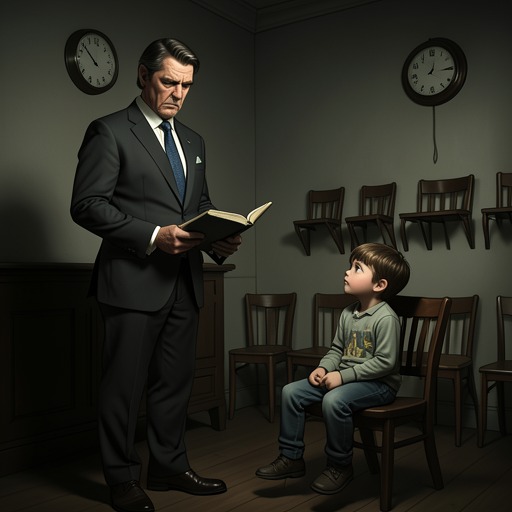
The HousemaidPunishment Framed as a “Privilege” is the system Andrew Winchester uses to turn ordinary needs, household expectations, and parental care into grounds for disciplining Nina Winchester. By insisting that hair and light are privileges he may grant or withdraw, he disguises arbitrary cruelty as a lesson in responsibility. The rhetoric gives his punishments a rule-bound appearance, while the rules shift to keep Nina uncertain, confined, and afraid for Cecelia Winchester.
Making Punishment Sound Like Instruction
During one stay in the attic, Nina pounds on the door and screams until she loses her voice, hoping someone outside might hear. Andrew tells her the area below the attic is soundproofed, so even a dinner party downstairs would not hear her. He promises that she will be let out, then postpones her release until she has learned the consequences of her actions. The sequence establishes the pattern: reassurance is made conditional, and confinement is presented not as violence but as correction.
The stated offense is Nina’s visible dark hair roots. Andrew says he cannot have his wife walking around looking like a slob and rejects her promise to make a hairdresser’s appointment as insufficient. He tells her that hair is a privilege and, because she has failed to take care of it, says she must give it to him. He specifies a hundred strands. The demand makes his logic literal: what he calls a privilege becomes something he claims the right to take, while a minor matter of appearance is inflated into an offense warranting punishment.
The same logic governs access to light. Andrew has boarded up the attic window and installed new lights; when they are off, Nina faces pitch darkness, and when they are on, the bulbs are painfully bright. He invokes his mother’s observation that Nina failed to turn off lights and contrasts her supposed wastefulness with people in countries without electricity. His declaration that light is a privilege converts an ordinary household expectation into justification for controlling the conditions in which Nina is held.
A Rule System Without Stable Rules
Andrew also announces that, from time to time, discipline will take place in the attic. When Nina objects, he tells her she is not in a position to negotiate. He presents the arrangement as being for her own good and cites the electricity punishment as proof that he has taught her a valuable lesson. His claimed authority therefore rests on both coercion and an explanation of coercion: he decides what counts as wrongdoing, chooses the penalty, and calls the result improvement.
The stated offenses do not provide Nina with a reliable way to avoid punishment. Years into the marriage, she says Andrew takes her to the attic on average once every other month, though the intervals vary; once, six months pass without a trip. She cannot know when the next stay will come or what alleged transgression will prompt it. Even trying to meet his expectations does not protect her. She cooks, keeps the house spotless, and acts as a perfect wife, but he always finds something wrong. The unpredictability makes the rules an instrument of control rather than a consistent standard she could satisfy.
Her attempts to change tactics reveal the same imbalance. Nina eventually stops trying to please Andrew and behaves in ways intended to repel him, including eating whatever she wants. When he catches her eating chocolate cake, he takes her to the attic and starves her for two days. Changing her behavior changes neither his power to define the offense nor his ability to punish it.
Cecelia as Leverage
The system reaches beyond Nina. If Cecelia does something Andrew considers unacceptable, Nina is punished instead. Andrew buys Cecelia itchy, frilly dresses that she dislikes and that other children mock. She learns that refusing to wear them or getting them dirty may mean her mother disappears for days. The clothes thus become more than a dress-code demand: the possibility of Nina’s absence enforces obedience in the child, while Andrew uses Nina’s suffering to regulate Cecelia’s behavior.
Andrew also uses Cecelia’s peanut allergy to taunt Nina. A jar of peanut butter repeatedly reappears in the pantry after Nina throws it away, and Andrew sometimes puts a little into Cecelia’s dinner, causing welts. Nina fears that he may eventually punish Cecelia directly and says she accepts her own fate if that spares her daughter. She also understands that escape could bring consequences for Cecelia. The threat is credible because Andrew has already nearly drowned the child; Nina recalls that he later treated the possibility of her drowning as a lesson he could have taught her. In this household, protection itself becomes another vulnerability Andrew can exploit.
Escalation and Surveillance
The punishments extend from deprivation and confinement to compelled physical harm. On one occasion, Andrew objects that Nina has used too much air freshener, although she says she used the same amount as usual and believes he would have punished her for using none by locking her in with something foul-smelling. This time he says the spray irritated his eyes and leaves pepper spray in a dresser drawer for Nina to use on herself. The contradiction makes the accusation difficult to answer: either choice can be reclassified as wrongdoing, and the assigned punishment turns Andrew’s supposed grievance into an injury Nina must inflict on herself.
Surveillance reinforces the same control. When Andrew tells Nina he can see her, she searches the attic for a camera. He says it is well hidden and that he has been watching only for the past few weeks. He then calmly repeats that she is not in a position to make demands as she pounds on the door. The hidden camera adds observation to confinement: Nina cannot know when she is being watched, while Andrew uses his ability to see her to assert that he can judge and overrule her.
Significance
Nina’s account of the seven-year marriage sharpens the contrast between Andrew’s public appearance and the rules of private life. She acknowledges that he has supported the family financially, acted as a father figure to Cecelia, and appeared even-tempered and agreeable. Yet she also describes repeated attic stays, invented or shifting offenses, and threats that make leaving seem dangerous. His language of privilege and instruction helps preserve this contrast: punishment can be presented as care, and control as a lesson for Nina’s own good.
The phrase is therefore not merely a cruel slogan attached to isolated incidents. Hair, electricity, clothing, food, and safety become permissions Andrew claims to administer, while Nina’s efforts to comply cannot secure predictable release or protect Cecelia from being used as leverage. The system’s defining feature is the gap between its moral language and its operation: Andrew speaks of responsibility and improvement, but he retains the power to decide what the rules mean, when they have been broken, and what Nina or her daughter must endure.